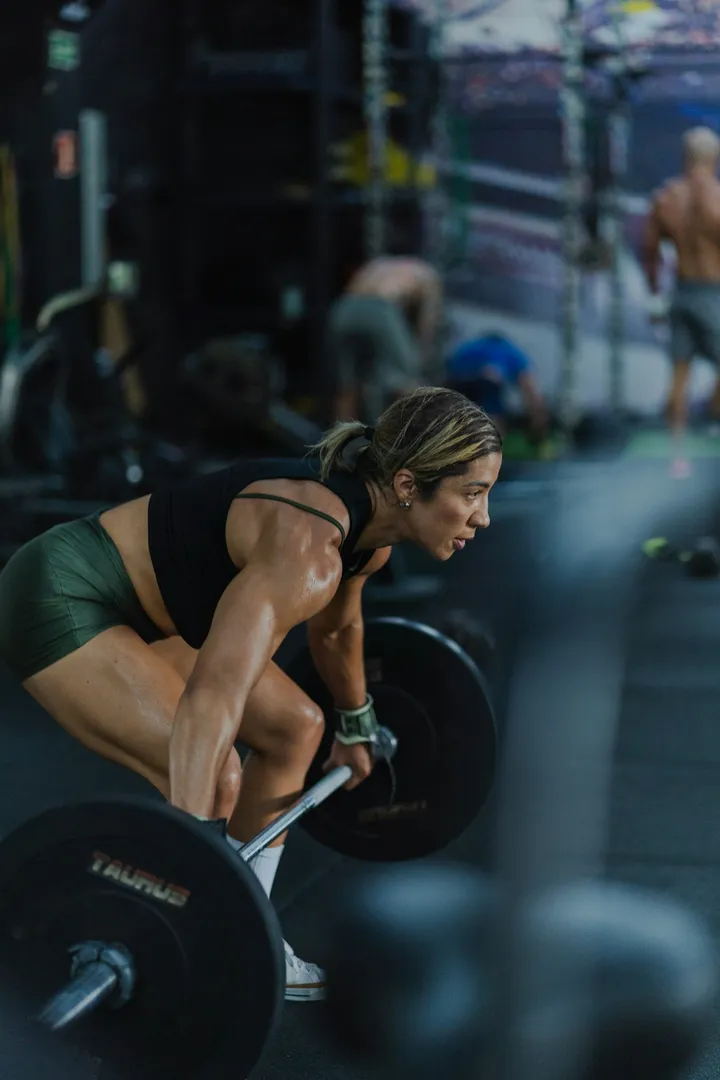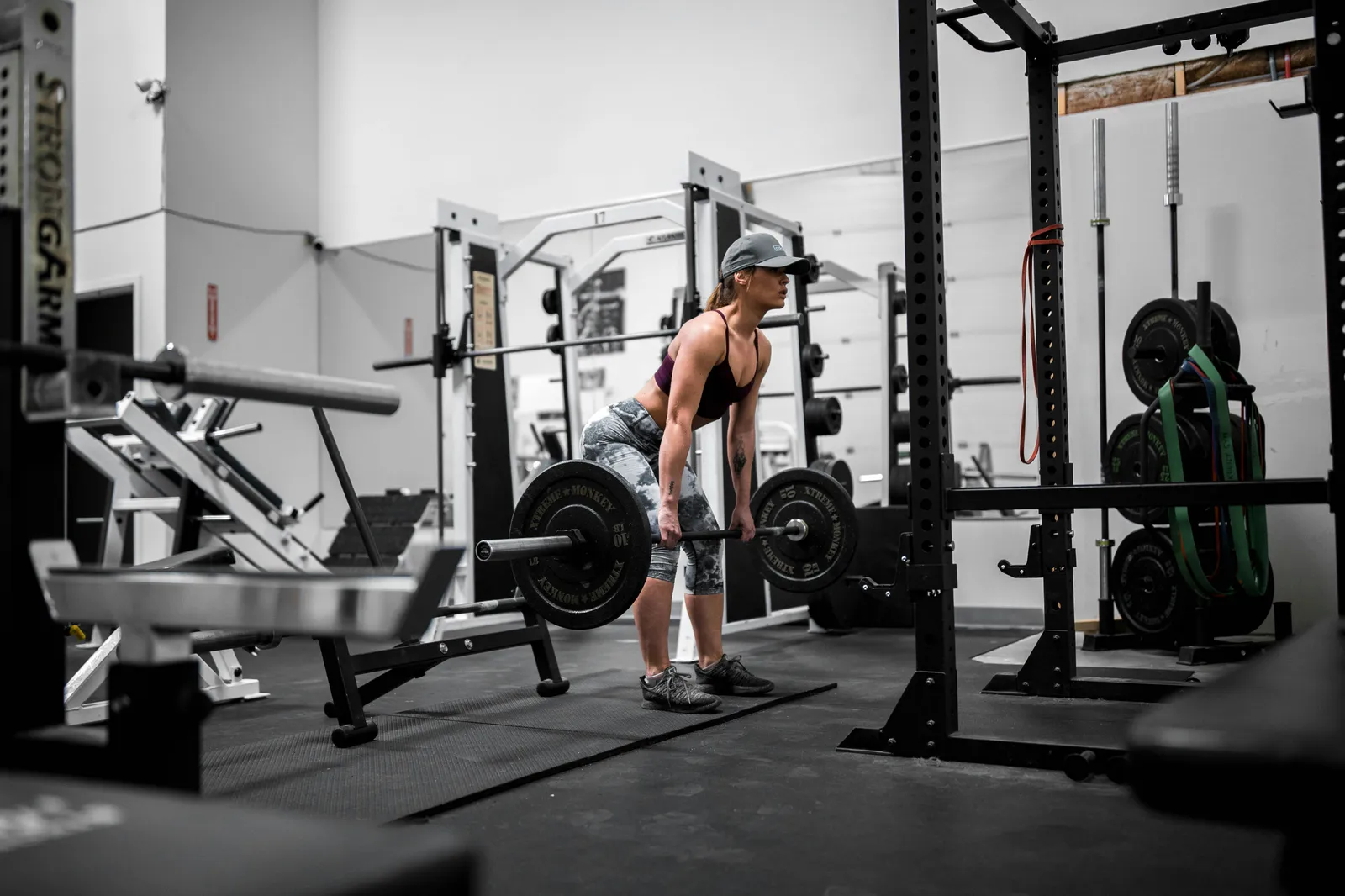
Strength training for women over 40 is the most-discussed and least-clearly-explained topic in fitness. Every article tells you “lift weights, your bones will thank you.” Almost none tell you exactly what to do, how much weight, how many times a week, or how to progress. The result: you start, you don’t see results, you stop.
This is the cornerstone guide. The actual framework, with real numbers. Not a pep talk, not a hormone explainer (we have those elsewhere), not “here are 17 reasons women over 40 should lift.” Just the program: 3 lifts, 3 days a week, 3 progression schemes. With dosages.
By the end of this article, you’ll know exactly what to do for your first 4-8 weeks of training. You’ll know what weights to start with and how to add weight without guessing. You’ll know what to skip and what’s actually optional. And you’ll have the mental model for everything else on this site.
TL;DR
- 3 lifts: squat (or goblet squat), hinge (deadlift or kettlebell swing), press (overhead press or dumbbell press). Add a row when you’re past beginner stage.
- 3 days a week: Monday, Wednesday, Friday (or any 3 non-consecutive days). 45-60 minutes per session.
- 3 progression schemes: linear progression (add 5 lb every week) → double progression (add reps before weight) → RPE-based (autoregulate based on how hard the lift feels).
- Starting weight: much lower than you think. Often the empty 45-lb barbell, or 15-lb dumbbells, or just bodyweight. Beginners progress fastest by starting too light, not too heavy.
- What to skip: machine-only programs, isolation-only programs (curls, kickbacks, calf raises), 5-day-a-week splits, anything called “tone” or “sculpt.”
Why this matters more than you’ve been told
Three things every woman over 40 should know:
1. You lose muscle automatically after 30, faster after 40, fastest after 50.
Sarcopenia, the medical term for age-related muscle loss, starts around age 30 and accelerates after 50. Without resistance training, women lose roughly 3-8% of their muscle mass per decade. By 70, untrained women have lost 20-40% of their peak muscle. That’s the difference between carrying your own groceries at 75 and not.
The single most effective intervention is resistance training. Not walking. Not yoga. Not Pilates. Resistance training. Mayo Clinic and the American College of Sports Medicine both place strength training as the foundational exercise modality for adults over 40, with cardio and flexibility work as supporting roles. Walking is genuinely good for you, but building muscle is not what it does; we explain why in does walking build muscle.
2. Bone density follows muscle.
Women lose bone density rapidly during perimenopause and menopause as estrogen drops. Heavy resistance training is one of the strongest signals to your skeleton to maintain or build bone. The LIFTMOR trial (Watson et al., 2017) put postmenopausal women with low bone density on a program of heavy compound lifts (squat, deadlift, overhead press at 80%+ of 1RM) and demonstrated measurable increases in bone density over 8 months. They didn’t get hurt. They got stronger and their bones improved.
3. Strength training is metabolically protective.
Muscle is the primary site of glucose disposal. More muscle, better insulin sensitivity. Better insulin sensitivity, lower risk of type 2 diabetes (the 2014 PLoS Medicine study showed muscle-strengthening activity reduces type 2 diabetes risk in women independent of aerobic exercise). For women in perimenopause and menopause, when insulin sensitivity drops measurably, this is critical.
The “do strength training” advice you’ve heard has these three reasons behind it. The advice is correct. What’s missing from most articles is how to actually do it. If your goal is to lose fat while building that muscle, pair this with body recomposition for women over 40, which covers the nutrition side.
The 3-3-3 framework: 3 lifts, 3 days, 3 progressions
This is the framework. Memorize it. Every program below builds from these three principles.
The 3 lifts (and why)
For your first 8-12 weeks of training, three compound lifts cover 80% of the muscle and bone-density benefit:
1. The squat (or goblet squat). Trains quads, glutes, core, and bone density in the lower body and spine. The single most-translatable lift for real-world function (getting up off the floor, climbing stairs, standing from a chair).
2. The hinge (deadlift or kettlebell swing). Trains posterior chain (hamstrings, glutes, back), grip, and posture. The deadlift is the single best lift for total-body strength but has the highest learning curve; the full evidence case is in our benefits of deadlifts guide. For absolute beginners, the kettlebell swing or Romanian deadlift teach the hinge pattern with less injury risk while you build proficiency. If a single kettlebell is all you have room for, our kettlebell exercises for women guide builds a full routine around it.
3. The press (overhead or dumbbell bench). Trains shoulders, chest, triceps, and core stability. Critical for upper-body bone density and shoulder health. Overhead press is the gold standard; if you have shoulder issues, the dumbbell bench press is a fine substitute. For more pressing and raise variations, plus the rotator cuff warmup most programs skip, see our guide to dumbbell shoulder exercises.
Add when ready: the row. Bent-over barbell row or seated cable row. Trains upper back, biceps, and posture. Most beginners benefit from adding rows in week 3-4 once they’ve grooved the squat, hinge, and press patterns.
What we’re skipping (intentionally) for the first 8 weeks:
- Bicep curls
- Tricep extensions
- Calf raises
- Lateral raises
- Machine-based isolation movements
These aren’t bad. They’re just less efficient than compound lifts when you have limited time and limited recovery. Add them later.
The 3 days (full-body, alternating)
Three sessions per week, full-body each session, on non-consecutive days. The standard schedule:
- Monday: Workout A
- Tuesday: Rest (or walking)
- Wednesday: Workout B
- Thursday: Rest
- Friday: Workout A (or C, depending on the program)
- Saturday: Rest (or walking, light cardio)
- Sunday: Rest
Workout A:
- Squat: 3 sets of 5 reps
- Overhead press: 3 sets of 5 reps
- Deadlift: 1 set of 5 reps (heavier, longer rest)
Workout B:
- Squat: 3 sets of 5 reps
- Bench press: 3 sets of 5 reps
- Bent-over row: 3 sets of 5 reps
This is essentially the Starting Strength template by Mark Rippetoe, modified slightly for accessibility. It’s been used by hundreds of thousands of beginners across all ages and genders. It works for women over 40 the same way it works for everyone else.
Why 3 days, not 4 or 5: at 40+, recovery matters more than session count. Three sessions per week with proper progression beats five sessions per week with chronic fatigue. The exception is highly trained women returning after a layoff; for an absolute beginner over 40, 3 days is the right starting cadence.
The 3 progressions (when to add weight, how to know when to deload)
This is what most fitness content omits. “Lift weights” is not a program. How you progress is the program.
Stage 1: Linear progression (weeks 1-6 typically).
Add 5 pounds to every lift, every workout, until you can’t.
So if you squat 65 lb 3x5 on Monday, you squat 70 lb 3x5 on Wednesday. Then 75 lb on Friday. Then 80 lb the next Monday. Until one day you can’t complete all 5 reps on all 3 sets, that’s when you deload (drop 10% and re-build).
This works because beginners adapt rapidly. Every workout is a new stimulus. The body responds by getting stronger. You’ll probably progress on linear for 4-8 weeks before hitting a plateau on at least one lift.
For deadlift specifically: progress weight by 10 lb per session, not 5 (deadlift takes more weight to register a real stimulus).
Stage 2: Double progression (weeks 6-12 typically).
Once linear progression stalls, switch to double progression: add reps before weight.
Example: stuck at 100 lb squat for 3x5? Now aim for 3x6 at 100 lb. Then 3x7. Then 3x8. Once you hit 3x8, add weight (105 lb) and drop back to 3x5. Repeat.
This stretches your progression timeline meaningfully, you can ride double progression for 3-6 months before plateauing.
Stage 3: RPE-based / autoregulated (months 4+).
Once double progression stalls, you graduate to RPE (Rate of Perceived Exertion).
RPE 8 = “I could do 2 more reps if I had to.” RPE 9 = “1 more rep.” RPE 10 = “no more reps.” For most working sets, you want RPE 7-8, challenging but not maximal. RPE 10 sets are reserved for testing days.
This is where you stop following a rigid plan and start training based on how your body responds day-to-day. Some days you’ll feel strong and add weight. Some days (sleep was bad, perimenopause is hitting hard) you’ll back off. Both are correct.
Most women over 40 spend the rest of their lifting career on Stage 3 (RPE-based programming) with periodic structured “blocks” of linear or double progression mixed in.
How to start: the first 4 weeks
Week-by-week, exactly what to do. Follow this and you have a real program.
Week 1: Learn the lifts
- Workout A (Monday): Squat 3x5 with empty barbell (45 lb) or just bodyweight if no bar. Overhead press 3x5 with empty barbell or 5-lb dumbbells. Deadlift 1x5 with 65-95 lb (or kettlebell swing 3x10 if no barbell).
- Workout B (Wednesday): Same squat. Bench press 3x5 (use 65 lb or 8-lb dumbbells). Bent-over row 3x5 (45 lb barbell or 10-lb dumbbells).
- Workout A (Friday): Same as Monday but add 5 lb to each lift if all reps were completed.
The weight will feel light. That’s the point. You’re learning movement patterns. Going heavy in week 1 is the single most common beginner mistake.
Week 2: Add weight every session
Continue Workout A / B / A pattern. Add 5 lb to each lift every workout (10 lb on deadlift). Don’t skip the warmup sets.
By the end of week 2, your squat might be 65-85 lb and feeling challenging. Your deadlift might be 105-135 lb. These are good numbers for week 2. Don’t compare to anyone else’s week 2.
Week 3: First plateau, first deload
Sometime in week 3, you’ll fail to complete all reps on at least one lift. Don’t panic. Drop the weight by 10% on that lift, complete the workout, and rebuild over the next two sessions.
This is normal. It’s the system working. Linear progression always stalls eventually; the deload prevents injury and lets you keep progressing.
Week 4: Add the row, refine form
Add bent-over rows (or seated cable rows) to Workout B if you weren’t already doing them. When you want more pulling variety than a single row, our back workout for women breaks down the full 4-movement framework. By now, your form on the squat and press should feel grooved. Deadlift form takes longer; expect form refinement to continue through month 3.
By the end of week 4, you should have:
- Squat: 70-110 lb for 3x5
- Bench: 65-85 lb for 3x5
- Deadlift: 135-185 lb for 1x5
- Press: 45-70 lb for 3x5
These are wide ranges because starting points vary. The number that matters is the trajectory: are you progressing week over week? If yes, the program is working.
How much weight should you actually lift?
The most-asked question. The honest answer:
Starting weight is much lower than you think. Most women over 40 starting strength training begin with the empty 45-lb barbell on squats, presses, and rows, and 95-135 lb on deadlift. Some start with bodyweight squats and dumbbell presses. Both are fine.
Goal weights for your first year (not week 1):
For a 150-lb woman with no prior strength training:
| Lift | 6-month goal | 12-month goal |
|---|---|---|
| Squat (back squat or goblet) | 100 lb for 5 | 150 lb for 5 |
| Deadlift | 165 lb for 5 | 215 lb for 5 |
| Bench press | 75 lb for 5 | 100 lb for 5 |
| Overhead press | 55 lb for 5 | 75 lb for 5 |
Adjust proportionally for your bodyweight. These numbers put you in the top 25% of untrained women your age. They’re not impressive by powerlifting standards. They’re enormously protective for bone density, function, and longevity.
The metric that matters more than absolute weight: relative progress. A woman who deadlifts 95 lb today and 135 lb in 8 weeks is doing something biologically remarkable. A woman who deadlifts 225 lb but hasn’t progressed in 2 years has stopped getting stronger.
How many times a week?
Three is the sweet spot for beginners. Two works if three is impossible. One a week is “maintenance training”, won’t make you stronger but will hold what you have.
More than three sessions per week is rarely the right call for a beginner over 40. Recovery matters more than frequency. The body adapts during rest, not during workouts.
Returning lifters or those with prior strength training experience can handle 4 days per week with appropriate programming (typically split into upper/lower or push/pull/legs splits). For absolute beginners, three full-body days is the standard recommendation across nearly every evidence-based strength coach.
What changes after 40 (and what doesn’t)
Honestly: less than you’ve been told.
What doesn’t change:
- The principle of progressive overload (lift heavier over time → get stronger)
- The effectiveness of compound lifts
- The importance of full-body movement patterns
- Your ability to build muscle (slower than at 25, but real)
- Your ability to gain strength (significantly, especially as a beginner)
What does change:
- Recovery time. A 30-year-old can deadlift Monday and squat Tuesday and feel fine. At 45, you usually want at least 48 hours between heavy lower-body sessions.
- Sleep matters more. Bad sleep + heavy training = injury risk goes up faster than at 25.
- Joint warm-up matters more. A proper 8-10 minute warm-up (5 min of light cardio + dynamic mobility) before lifting is more important now than it was in your 20s.
- Estrogen decline (perimenopause/menopause) affects recovery, body composition, and tissue repair. We cover this in detail in our perimenopause workout plan guide.
The mistake most fitness content for women over 40 makes is overstating these changes. You are not fragile. You don’t need a special program. You need a normal program executed with appropriate recovery.
Lifting with osteoporosis or injury history
The single most important point: resistance training is therapeutic for osteoporosis, not contraindicated.
The LIFTMOR trial tested heavy lifting (deadlift, squat, overhead press at 80%+ of 1RM) in postmenopausal women with low bone density and found:
- Measurable increases in bone density at the spine and femoral neck after 8 months
- No increase in injury rate vs. a control group
- Improved function and quality of life
The catch: form matters more than load when bone density is compromised. Practical recommendations:
- Get cleared by your doctor first. Bring the LIFTMOR study with you if your doctor’s default is “be careful.” Many primary care doctors aren’t aware of the recent literature on resistance training and bone density.
- Work with a qualified coach for the first 4-8 weeks. A real strength coach (USAW, NSCA-CSCS, or similar credentials), not a gym personal trainer. Cost: $50-100 per session, 4-8 sessions total.
- Start lighter than you would otherwise. Six weeks of “easy” lifting that grooves perfect form is worth a year of “heavy” lifting with bad form.
- Modify if you have specific concerns. Vertebral fractures, severe osteoporosis, recent fall history all warrant individualized programming, not the standard 3-3-3.
For non-osteoporosis injuries (knee, shoulder, lower back history): work with a coach. Most lifts can be modified safely. Few injuries are permanent contraindications to strength training.
If you are past 50, the same principles apply with a few adjustments, covered in strength training for women over 50. And for an honest look at loading your bones outside the gym, see the research on the benefits of a weighted vest.
What to skip
A short list of what doesn’t deserve space in your first 8 weeks of training.
- Machine-only programs. Machines have a place but don’t transfer to real-world function as well as free weights. Use them as accessories, not your primary program.
- Isolation-only programs. Bicep curls, tricep extensions, lateral raises, fine as accessories after compound lifts. Useless as a primary program.
- 5-day or 6-day splits as a beginner. You don’t have the recovery capacity yet. Three full-body days outperforms five split days for someone new to lifting.
- “Toning” workouts, “sculpt” workouts, anything that promises spot reduction. Spot reduction isn’t a thing. The word “tone” in fitness usually means low-weight, high-rep work that doesn’t build meaningful muscle.
- HIIT-only programs as your strength training. HIIT is fine as cardio. It’s not strength training. The two have different adaptations.
- Programs designed by Instagram influencers without strength credentials. A YouTube celebrity selling you a “menopause workout” without a CSCS or RD credential is selling you marketing. Real coaches with verifiable credentials are not hard to find; their content is usually less polished but more useful.
- Anything labeled “for older women” specifically that uses light weights only. You are not too old to lift heavy. You are not fragile. You will get stronger faster than you think.
A short FAQ
How many times a week should a 40-year-old woman do strength training?
Three days a week, on non-consecutive days, is optimal for beginners. Two works if three is impossible. The body adapts during rest, not during workouts; more isn’t better at this stage.
What is the best strength training for women over 40?
Compound lifts: squats, deadlifts (or hinges), presses, rows. Three lifts, three days a week, with progressive overload. The 3-3-3 framework in this article. Avoid programs built around isolation movements.
How much weight should a 40-year-old woman be able to lift?
Goal benchmarks at 6-12 months of consistent training: bodyweight squat, 1.25x bodyweight deadlift, 0.6x bodyweight bench press. Starting weights are much lower (often the empty barbell). Progress is the metric, not absolute weight.
Can you lift weights with osteoporosis?
Yes, and you should. The LIFTMOR trial demonstrated heavy compound lifting safely improves bone density in postmenopausal women with low bone mass. Work with a qualified coach for the first 4-8 weeks. Bring research to your doctor if their default is “be careful.”
Do I need a gym, or can I train at home?
Both work. A gym gives you access to barbells, racks, and a deadlift platform. A home gym requires a bench, an Olympic barbell ($150-300), plates ($150-400 depending on quantity), and a power rack ($300-700). Total home setup: $700-1,500 for a complete starter rig.
For accessory training, an adjustable dumbbell set ($300-600) can replace much of the barbell work. A dumbbell-only home gym is fully sufficient for the 3-3-3 framework.
What about cardio?
Cardio is fine. 2-3 walks per week, plus 1-2 sessions of structured cardio (Zone 2 cardio for 30-45 minutes, or one HIIT session under 20 minutes), supports general health and recovery. Don’t replace strength training with cardio. Both have a place; strength is the more critical priority for women over 40.
Is there a free PDF or downloadable program?
A downloadable PDF version of the 3-3-3 framework with weekly logbooks is in the works. Until it ships, the 12-week program lays out every week in full detail.
For more on training-specific topics: strength training for perimenopause covers how the framework adjusts during the menopause transition. Creatine for women covers the single supplement with the strongest evidence for women over 40. Training, recovery, and nutrition work as one system, and the rest of this site builds on the 3-3-3 framework laid out here.