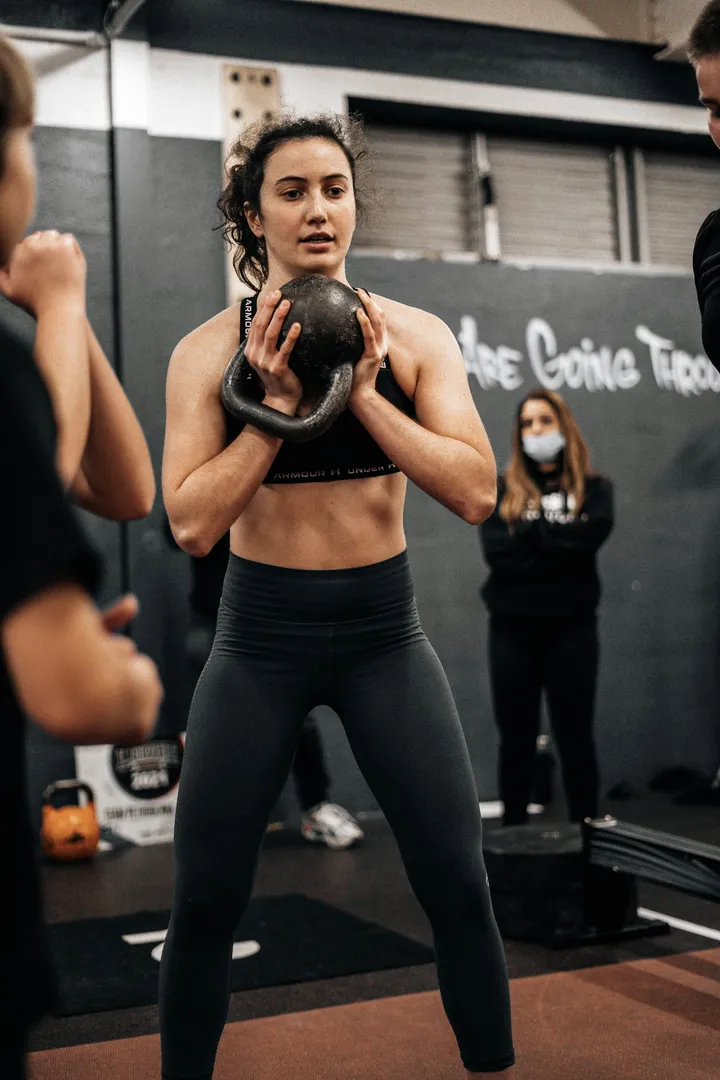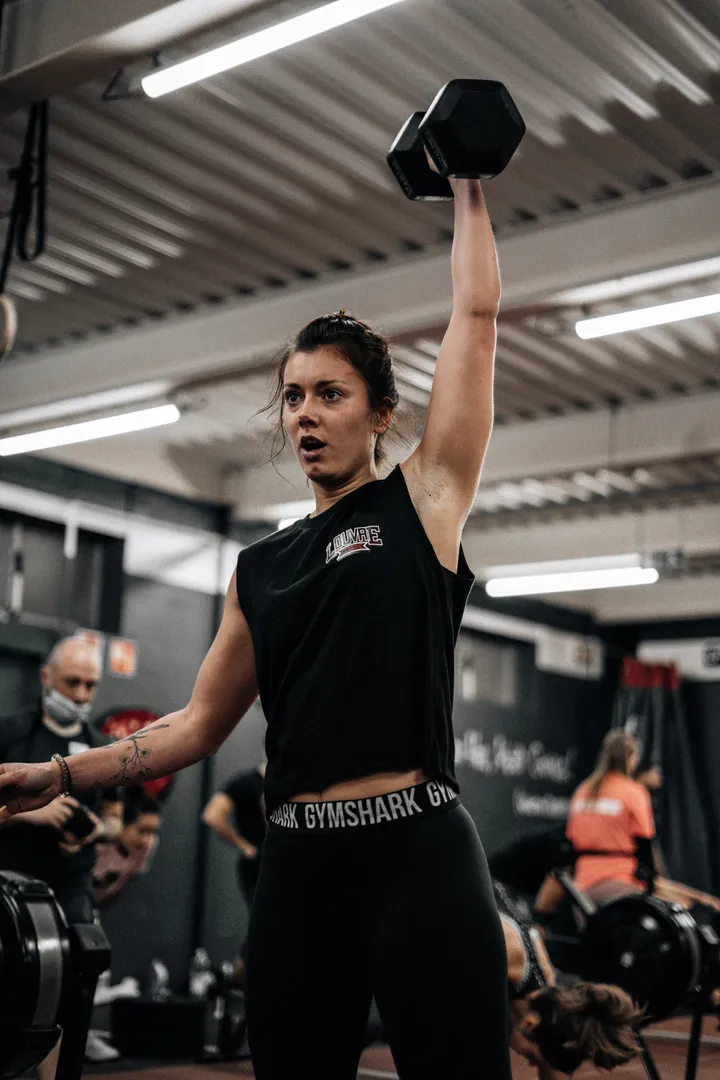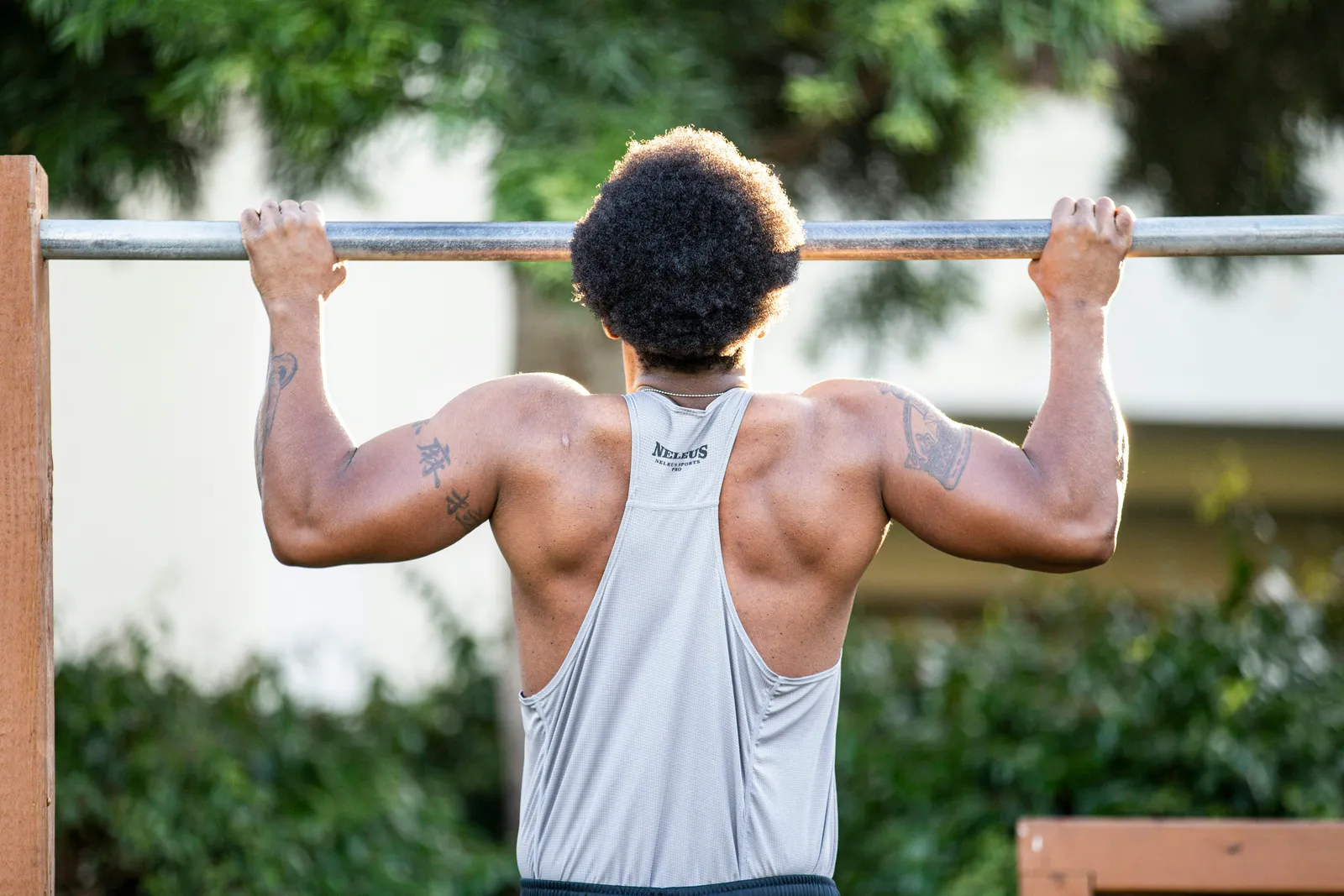
The back is the muscle group most women undertrain. It’s also the one that, when developed, produces the most visible changes in posture, the visual “framework” of the upper body, and the appearance of the area women most commonly worry about (the bra-line and shoulder blade region).
Most back workout articles dump 18-20 exercises and let you sort. The result: chaotic workouts with no organization, or three rows in a row with no vertical pulling. This is the framework instead. Four movement patterns, one exercise per pattern, real progression. Plus the bra-bulge question that’s clearly on a lot of women’s minds, answered honestly.
This guide assumes you’ve read our strength training cornerstone and have started to train. The 4-exercise back framework here builds on the 3-3-3 framework from the cornerstone.
TL;DR
- 4 movements per back day: vertical pull, horizontal pull, hinge, one accessory.
- One exercise per category: pick one row variant, not three. Pick one pull or pulldown variant.
- Sets and reps: 3-4 working sets of each. 5-8 reps for the hinge and main row, 8-12 reps for vertical pull and accessory.
- Total time: 30-45 minutes including warm-up.
- Frequency: 1-2 times per week.
- Bra-bulge note: strengthening the back changes posture and definition; you cannot spot-reduce fat, but the muscles underneath transform the visual appearance over 12-16 weeks.
Why most back workouts fail women specifically
Three reasons most published back workouts don’t deliver:
1. They’re row-heavy. Rows are the easiest back exercise to teach in a magazine article, so listicles include 4-5 row variations and skip everything else. A complete back workout needs vertical pulling (pull-ups, lat pulldowns) and posterior-chain work (deadlifts, hip hinges), not just rowing.
2. They prescribe light weight, high reps. “Use 3-5 lb dumbbells and aim for 15-20 reps per set.” This is rehab volume, not strength training. The back has the largest muscles in the upper body (lats, rhomboids, traps); they need real load, not flicks of motion.
3. They don’t address the actual issue most women care about. Women searching “back workout female” are often thinking about posture, bra-bulge appearance, and upper-body shape, not just “muscle building.” A workout that ignores the visible/postural goal misses what motivates the lifter to keep showing up.
The 4-movement framework solves all three. Real load, balanced patterns, addresses the visible-result question directly.
The 4-movement framework
The four categories cover every back-day need. Skip a category and you’re missing meaningful adaptations.
| Category | Why it matters | Pick one exercise from |
|---|---|---|
| 1. Vertical pull | Lats (the V-shape muscles), grip, biceps | Pull-up, assisted pull-up, lat pulldown |
| 2. Horizontal pull | Mid-back (rhomboids, mid-trap), posture | Bent-over row, single-arm dumbbell row, seated cable row |
| 3. Hinge | Lower back, glutes, posterior chain | Conventional deadlift, Romanian deadlift |
| 4. Accessory | Rear delts, upper traps, shoulder health | Face pulls, reverse fly, shrugs, lateral raises |
Pick one from each. That’s back day. The hinge slot earns its place for reasons beyond the back; the benefits of deadlifts run from bone density to the grip strength that predicts healthy aging.
1. Vertical pull
Trains the lats (the wide back muscles that create the “V-shape”) and grip strength. The category most likely to be missing from a beginner’s back routine.
Top pick: Lat pulldown for absolute beginners or anyone who can’t do a pull-up yet. Cable machine, knees pinned, pull the bar to your collarbone with control. The exercise lets you scale weight precisely from 30 lb to 200+ lb.
Top pick once you’re stronger: Pull-up (or chin-up). The gold-standard vertical-pull exercise. Most women cannot do an unassisted pull-up at the start, that’s normal. Use a resistance band looped over the bar (or an assisted pull-up machine) to scale.
Pull-up progression for women new to lifting:
- Dead hang (just hang from the bar), 3 sets of 15-30 seconds.
- Negative pull-up (jump up, lower with control over 3-5 seconds), 3 sets of 5.
- Banded pull-up (heavy resistance band assistance, gradually decrease band thickness), 3 sets of 5-8.
- Unassisted pull-up, 3 sets of 1-3, building from there.
Sets/reps: 3-4 sets of 6-10 reps for lat pulldowns. 3-4 sets of 5-8 for pull-up variations.
What people get wrong: swinging or using momentum. The pull-up should be controlled both directions. If you can only get up by swinging, you need more banded reps with strict form.
2. Horizontal pull
Trains the middle of the back: rhomboids, mid-trapezius, rear deltoids. The muscles that pull the shoulder blades back and down. The single biggest contributor to posture improvement.
Top pick: Bent-over barbell row. Hinge at the hips (similar to deadlift starting position), grip the barbell with overhand or mixed grip, row the bar to your lower ribs while keeping the back flat. The most-loadable horizontal pull.
Alternative: Single-arm dumbbell row. One hand and one knee on a bench, row the dumbbell to your hip. Allows greater range of motion than barbell row, easier on lower back, addresses left-right asymmetries.
Alternative: Seated cable row. Cable machine, feet braced, pull handle to lower abdomen with controlled torso. Easier to learn than free-weight rows, allows progressive loading.
Sets/reps: 3-4 sets of 6-10 reps. The horizontal row is the workhorse exercise, you can put real weight on it.
What people get wrong: standing too upright on bent-over rows. The torso should be 30-45° from horizontal; if you’re nearly upright, the load shifts away from the back muscles into the biceps. Hinge properly.
3. Hinge
The deadlift family is half of back day, even though most articles file it under “leg day.” The deadlift trains lower back, glutes, hamstrings, lats, grip, and traps simultaneously.
Top pick: Romanian deadlift. Lower back / hamstring emphasis without the technical demand of conventional deadlift. Hold a barbell or two dumbbells, hinge at hips while keeping a soft knee, lower the weight along the front of the legs, return to standing.
Alternative: Conventional deadlift. Bar from the floor, full hip hinge with leg drive. The most-loadable lift in the gym. Higher technical demand than RDL.
If your training already includes deadlifts on a separate leg day, your back day can use a hinge variation instead (dumbbell RDL, single-leg RDL) for less overlap with the leg session.
Sets/reps: 3 sets of 8 reps for RDL. 1-3 sets of 5 reps for conventional deadlift.
What people get wrong: treating deadlifts as a leg-only exercise. The deadlift is at least as much back as it is legs. Train it on back day or leg day; just don’t skip it.
4. Accessory
The fourth slot addresses specific weaknesses or shoulder health.
Common picks:
- Face pulls (cable + rope attachment, pull toward forehead with elbows high). Best single exercise for rear deltoid health and posture. 3 sets of 12-15 reps with light weight.
- Reverse fly (dumbbells, bent-over, raise arms to sides). Targets rear delts and rhomboids. 3 sets of 10-12 reps.
- Shrugs (dumbbells or barbell, lift shoulders straight up). Targets upper traps. 3 sets of 12-15 reps.
- Lateral raises (dumbbells, raise arms to shoulder height). Trains side delts. Technically a shoulder accessory but commonly programmed with back-pull days. For the complete shoulder session these come from, see our dumbbell shoulder exercises guide.
Sets/reps: 3 sets of 10-15 reps. Lighter than the main lifts, more rep volume.
A real 30-minute back day
Here’s exactly what to do. Total time including warm-up: 30-45 minutes.
Warm-up (5-8 minutes):
- 3-5 minutes light cardio (rower or bike, engages the back nicely)
- Cat-cow x 8 reps
- Banded pull-aparts x 12-15 (stand holding a resistance band at chest height, pull apart)
- Dead hang x 15 seconds (just hang from a pull-up bar)
- 1 warm-up set of your main row at 50% of working weight
Main workout:
| Exercise | Sets x Reps | Rest |
|---|---|---|
| Lat pulldown (or pull-up) | 4 x 8 | 90 sec |
| Bent-over barbell row | 4 x 6 | 2 min |
| Romanian deadlift | 3 x 8 | 2 min |
| Face pulls | 3 x 15 | 60 sec |
Cooldown (3-5 minutes):
- Doorway chest stretch
- Cross-body shoulder stretch
- Hip flexor stretch (if back was heavy)
That’s the workout.
The bra-bulge question (it’s posture, not spot reduction)
The PAA on this keyword reveals what a lot of women are actually thinking about: “do back exercises help with bra bulge?”
The honest answer:
You cannot spot-reduce fat. No exercise burns fat from a specific area. The “bra bulge” appearance is two things in combination:
- Localized fat over the upper back / lat / mid-trap area.
- Weak upper-back muscles that don’t pull the shoulders back, exaggerating any soft tissue prominence.
What back training actually does:
- Builds the muscles of the upper back (rhomboids, mid-trapezius, lats, rear delts), which:
- Pulls the shoulder blades back and down (improving posture)
- Creates a “V” or hourglass shape that visually narrows the waist relative to the upper back
- Tightens the skin-muscle interface in the upper back / bra-line region
- Reduces the visual appearance of soft tissue at the bra line by changing the underlying muscle tone and posture.
It does not:
- Burn fat specifically from the bra-line area (impossible).
- Produce overnight changes (real change is 12-16 weeks of consistent training plus adequate protein).
- Replace overall body composition work (if total body fat is high, no amount of back training fixes the visual appearance alone).
The full intervention:
- The 4-exercise back framework, twice a week for 12-16 weeks. Posture and muscle shape change.
- Progressive overload. Light-weight, high-rep “toning” workouts don’t deliver visible muscle change. Heavier weight and lower reps do.
- Adequate protein (0.8-1g per lb bodyweight). Muscle builds with protein.
- Mild calorie deficit if fat reduction is the goal. Strength training preserves muscle while losing fat; cardio alone doesn’t.
The visual change after 16 weeks of this is meaningful. The “tone your back to fix bra bulge” promises in fitness marketing are real but exaggerated, they require months of work, not weeks.
How heavy should you go?
The most-asked question. Real numbers:
Goal benchmarks at 6-12 months of consistent training (for a 150-lb woman):
| Exercise | 6-month goal | 12-month goal |
|---|---|---|
| Lat pulldown | 100 lb for 8 | 130 lb for 8 |
| Pull-up (assisted) | 1-2 unassisted, or banded with light band | 5+ unassisted |
| Bent-over barbell row | 75 lb for 6 | 110 lb for 6 |
| Single-arm dumbbell row | 30 lb for 8 each arm | 45 lb for 8 each arm |
| Romanian deadlift | 95 lb for 8 | 135 lb for 8 |
Adjust proportionally for your bodyweight. Starting weights are much lower; progression is the metric.
For the full progression scheme, see our strength training cornerstone.
At-home variations
A complete back day at home requires adjustable dumbbells (40+ lb each), a bench, and ideally a doorway pull-up bar.
| Exercise | Home substitution |
|---|---|
| Lat pulldown | Banded pulldown (anchor a band overhead) or dead hangs / banded pull-ups |
| Bent-over barbell row | Bent-over dumbbell row or single-arm dumbbell row |
| Romanian deadlift | Same exercise with two dumbbells |
| Face pulls | Banded face pulls (anchor band at face height) |
Total home back-day setup cost: $400-700 for adjustable dumbbells + bench + pull-up bar.
The pull-up bar is a $30-50 item that completely transforms what’s possible at home. Even if you can’t do a pull-up yet, the dead hangs and banded pull-ups are excellent training.
What to skip
A short list of back-day patterns that don’t earn their place.
- 3-pound dumbbell circuits. “30 reps per arm, 4 rounds” with light weights is conditioning, not strength training. Real back development needs real load.
- Machine-only back days. Hammer Strength, lat pulldown machine, seated row machine, back extension machine. Useful as accessories; not a complete program. Free weights and pull-ups deliver more.
- “Toning” back workouts that promise spot reduction. Spot reduction isn’t real. The exercises are usually fine; the marketing is wrong.
- 5+ row variations in one workout. You don’t need 5 different rows. Pick one bent-over row variant and one accessory pull. More rows is duplication, not progression.
- Skipping the deadlift family. The hinge belongs in back training. Don’t file it only under “legs.”
- Pulldowns to the back of the neck. Old-school technique that’s hard on shoulders. Pull the bar to your collarbone (front of neck), not behind.
- Deadlifts with rounded back. Form first. A 100-lb deadlift with a flat back beats a 135-lb deadlift with rounded form, every time.
- “Bra bulge cardio” or any “burn fat from your back” promises. Spot-reduction doesn’t work. The visual change comes from building the muscles underneath.
Where back day fits in your week
Back training is one pull session inside a full program, not a standalone fix. If you are building a routine from scratch, start with strength training for women over 40 (or, past 50, strength training for women over 50), then slot this back day in as your pull workout. Pair it with leg work and glute training for balanced lower-body days.
A short FAQ
What is the best back exercise for women?
The bent-over row. If you only had time for one back exercise, that’s it. The 4-movement framework gives you the rest.
How often should I train back?
1-2 times per week. If you train 3 days a week full-body, back is hit each session through rows and deadlifts. If you train 4-5 days with split sessions, dedicate one or two pull-focused days.
Do back exercises help with bra bulge?
Indirectly, yes. They build upper-back muscle, improve posture, and change the visual silhouette over 12-16 weeks. They do not spot-reduce fat (no exercise does). The full answer requires both back training and overall body composition work.
Will heavy back training make me bulky?
No. Building visible muscle as a woman over 40 takes years of dedicated training plus a calorie surplus. The “bulky” fear is unfounded for almost all women.
Should I use a lifting belt for back day?
Maybe for deadlifts. Not for rows or pull-ups (the belt provides no benefit on those lifts). See our weightlifting belt for women guide for when a belt actually helps.
Can I train back the day after legs?
Yes. Back is upper-body-focused (with the deadlift hinge being the exception). Most splits put back the day after legs without recovery problems. If you find your lower back is fatigued from yesterday’s deadlifts, swap the conventional deadlift for an RDL or skip the hinge slot in the back day.
How long until I see back changes?
Strength changes appear in 4-8 weeks. Visible muscle and posture changes take 12-16 weeks of consistent training. Body composition shifts (less fat, more muscle, better bra-line silhouette) appear over 16-24 weeks.
For broader context, see our strength training cornerstone and our leg exercises for women guide. For the gear question (does a belt help on rows or deadlifts), see weightlifting belt for women. For supplements that support the recovery this kind of training demands, see creatine for women.