The weightlifting-belt aisle is a marketing-driven mess. Brands pitch women-specific belts as “lighter,” “softer,” “more flattering,” when the actual question for a woman buying her first belt is much simpler: do you need one yet, and does this one fit your torso?
This is the honest buyer’s guide. When you actually need a belt. When you don’t. The 4 belts worth buying. And the sizing issue that most retailers don’t address.
TL;DR
- Most lifters don’t need a belt. Use one only when squatting or deadlifting at or near bodyweight, after 6+ months of beltless training.
- Leather vs nylon: leather lasts longer and feels stiffer (powerlifting standard). Nylon is softer, cheaper, easier to break in. Start with nylon if you’re not competing.
- The size issue: women’s average torso is shorter than men’s. A standard 4-inch belt often pinches at the ribs or hip bones. Look for 3-inch or tapered belts.
- 4 belts worth buying: Element 26 nylon ($35-45), Inzer Forever ($90-120), 2POOD Performance Black ($55-75), SBD lever belt ($170-200).
- What to skip: Velcro belts, glitter belts, “fashion” lifting belts, anything sold under $20.
Do you actually need a weightlifting belt?
Short answer: probably not yet.
Most women in their first 6-12 months of training do not benefit from a belt. The belt’s job is to amplify intra-abdominal pressure during heavy compound lifts. If you haven’t yet learned to brace properly without a belt, the belt becomes a crutch that masks weak bracing and underdeveloped core strength.
Three criteria for needing a belt:
-
You’re squatting or deadlifting at or near your bodyweight (e.g., 130-180 lb for a 150-lb woman). Below that, the belt provides little benefit and may interfere with learning proper bracing.
-
You’ve been training without a belt for at least 6 months. This is critical. The 6-month beltless phase forces you to develop bracing, core strength, and breath mechanics. The belt then amplifies those existing patterns. Skipping the beltless phase produces lifters with poor bracing and high lower-back-injury risk.
-
You’re consistently doing heavy compound lifts. Squats, deadlifts, sometimes overhead press, occasionally heavy rows. If your training is bodyweight or light dumbbell work, you don’t need a belt. If you’re squatting 175 lb for a working set, you do.
When you do not need a belt:
- Goblet squats, even with a heavy dumbbell.
- Bench press (a belt provides no meaningful benefit on bench).
- Single-leg work (split squats, lunges, step-ups), the asymmetric load doesn’t engage core bracing the same way.
- Accessory work (bicep curls, lateral raises, calf raises), full stop, no.
- Cardio of any kind.
- Yoga, Pilates, mobility work.
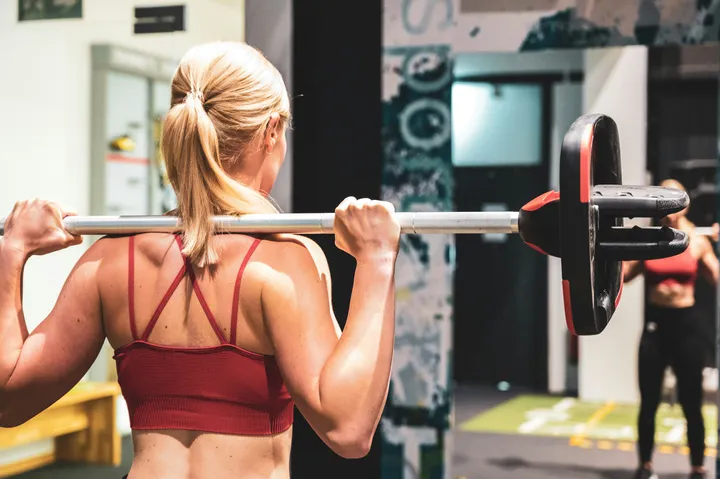
The belt is for the heaviest 1-3 working sets of squats, deadlifts, and overhead press. That’s it. Wearing a belt all session is a sign you’re using it wrong.
How a belt actually works (the bracing science)
The mechanical function: a properly worn belt gives your abdominal muscles something to push against, increasing intra-abdominal pressure by roughly 25-40% (per McGill and Marshall, 2009; Renfro et al., 2018).
The increased pressure stiffens the spine from the inside. A stiffer spine handles compressive load (like a heavy squat or deadlift) more safely. The belt does not “support your back” the way a brace would. You still create the pressure; the belt amplifies it.
The “Valsalva maneuver” with a belt:
- Take a deep breath into your stomach (not your chest).
- Brace your abs against the belt, feel the entire ring of muscle around your waist push outward into the belt.
- Lift the weight while holding the brace.
- Exhale and release at the top of the lift, or after the heaviest portion.
If you’ve never bracedwith a belt before, the first time often feels awkward. Practice with light weights for a week before using it on working sets.
What the belt won’t do:
- It won’t fix bad form. A belt over a rounded back is still a rounded back.
- It won’t compensate for weak bracing. The belt amplifies bracing; if there’s no bracing, there’s nothing to amplify.
- It won’t make you stronger if you’re already braced well. The 5-15% performance bump is on top of an already-good lift, not a replacement for one.
- It won’t prevent injury directly. It reduces injury risk for proper lifts; it does nothing for improper ones.
Leather vs nylon: which to buy
The two main belt categories. Different use cases, different price points.
Leather belts
Stiffer, longer-lasting, better pressure feedback.
- Lifespan: 10-20 years with normal use, indefinitely with serious care
- Stiffness: uniformly stiff (4mm to 13mm thickness, beginner = 10mm, advanced = 13mm)
- Price: $80-200 for quality
- Required for: powerlifting competitions (USAPL, IPF, USPA all require leather)
- Break-in: 2-4 weeks of regular use to soften enough to wear comfortably
- Best for: powerlifting, heavy strength work, anyone who plans to compete
The leather belt is the historical standard for a reason. The stiffness creates the most consistent pressure feedback, which is what you want when you’re at 90%+ of your max. The 10mm thickness is the most common; the 13mm is for advanced lifters who want maximum stiffness.
Nylon belts
Softer, cheaper, easier to break in, more versatile.
- Lifespan: 3-7 years
- Stiffness: softer than leather, with less consistent pressure
- Price: $25-50 for quality
- Allowed in: CrossFit, Olympic weightlifting, recreational gym training, most strongman events
- Break-in: none, works comfortably on day one
- Best for: general strength training, CrossFit, mixed-modality training, beginners
Nylon belts are excellent for women who train across multiple modalities (some powerlifting-style work, some Olympic lifts, some CrossFit). They adjust easily across different lifts and are immediately comfortable.
Recommendation for most women starting out: buy a nylon belt first. $35-45 nylon belt that you’ll actually use. Upgrade to leather if you start competing or specifically want a stiffer feel. Many women never need leather; nylon is sufficient for the strength training in this article’s framework.
Lever vs prong: which closure
The two closure styles for leather belts.
Prong (single or double): traditional buckle with one or two prongs. Cheaper, allows fine-tuned sizing across multiple holes.
- Pros: $20-30 cheaper than lever versions, fits as your weight changes (within 2-3 inches)
- Cons: takes longer to put on and take off (5-10 seconds vs 1-2)
Lever: flip-down latch that opens and closes instantly.
- Pros: extremely fast (1-2 seconds), provides maximum cinch tightness, popular with competitive powerlifters
- Cons: locked at one size, if your weight changes ±2 lbs, the belt doesn’t fit until you swap the lever position with a screwdriver, which is annoying
For women specifically: the size-locking issue with lever belts matters more because women’s weight can fluctuate 3-5 lbs across the menstrual cycle. A prong belt accommodates this without adjustment.
Recommendation: start with prong unless you’re sure you want a lever. You can always upgrade to lever later. Most women never need lever speed.
Width and thickness (the women-specific issues)
The fitting issue most retailers don’t address.
Standard belt height: 4 inches (101mm). This is the powerlifting-competition default and the dominant size in retail.
Problem for women: average women’s torso length (from top of pelvis to bottom of rib cage) is 6-8 inches. A 4-inch belt placed correctly takes up most of that space and often hits the ribs or hip bones uncomfortably.
Better options for women with shorter torsos:
- 3-inch belt: common in CrossFit-style training and Olympic weightlifting. Fits comfortably for women with torsos under 7 inches.
- Tapered belt: 3 inches in the front (where the rib/hip clearance matters) and 4 inches in the back (more support over the lumbar spine). Best of both worlds. Brands like 2POOD and Inzer make these.
How to measure your torso: stand straight, find the top of your iliac crest (top of your hip bone, where you put a hand on your hip), find the bottom of your lowest rib, measure the distance. If it’s under 7 inches, prioritize 3-inch or tapered belts.
Thickness:
- 10mm leather: the sweet spot for most women starting out. Stiff enough to provide real feedback, not so stiff it’s brutal to break in.
- 13mm leather: advanced lifters, powerlifters at high weights. Painful to break in. Skip unless you specifically want the stiffest belt available.
- 6.5-8mm nylon: standard nylon thickness. No real choice to make here.
4 belts worth buying (with prices)
The honest list. Not “20 belts ranked.” Four picks, one per category.
Best beginner / nylon: Element 26 Self-Locking Belt
$35-45. The workhorse nylon belt. Self-locking buckle (no Velcro, holds at full tension), 4-inch standard width, comes in multiple sizes. Holds up well under regular squat/deadlift use. Adjusts easily across lifts.
The “self-locking” buckle is the key feature: it doesn’t slip under load like Velcro belts do. Avoid Velcro lifting belts; they always loosen mid-set.
Best leather mid-tier: Inzer Forever Belt 10mm
$90-120. The powerlifting standard for 30+ years. Leather, 10mm thick, single-prong buckle, lifetime warranty (Inzer will replace the belt if it fails).
Forever Belt is what most powerlifters wear. The single-prong is easier to size across weight fluctuations than lever or double-prong options. Available in 3-inch and 4-inch widths; for most women, the 3-inch fits better.
Break-in: 2-4 weeks of regular use. The first week is uncomfortable; by week 3 it’s broken in.
Best women-specific: 2POOD Performance Black
$55-75. Nylon belt designed specifically for women’s torso lengths. 3-inch width by default (the women-specific default, not 4-inch). Comes in CrossFit-friendly colorways without being gimmicky.
2POOD is run by women lifters and the sizing reflects that. The 3-inch height + nylon material combination is the easiest to wear comfortably for women new to belted lifting.
Trade-off: nylon, so 3-7 year lifespan. If you’ll compete in powerlifting, you’ll need leather eventually.
Best premium / leather: SBD Belt 10mm or 13mm
$170-200. The “Apple of weightlifting belts.” Used by elite powerlifters worldwide. Stiffer feel than Inzer, premium leather, lever closure (also available in prong).
Worth the premium only if: you compete, you’ve been lifting heavy for years, you specifically want the stiffest possible feel, and the difference between a $100 and $200 belt matters less to you than the marginal performance gain.
For most women, the Inzer Forever at half the price is 90% of the belt for half the cost. SBD is the right pick if you’ve already had a belt for years and want to upgrade.
What to skip
A short list of belt types that don’t earn their place.
- Velcro belts. Loosen mid-set under load. Useless for actual heavy work.
- “Fashion” lifting belts with rhinestones, glitter, leopard print, or “her” branding. Usually thinner, lower quality leather, and overpriced for the marketing.
- Belts under $20. The leather is fake or the construction is poor. Element 26 nylon at $35-45 is the floor for actually-usable.
- Memory foam belts marketed as “comfortable.” The whole point of a belt is stiffness. Memory foam defeats the purpose.
- Belts marketed as “weight loss” or “waist trainer” that look like lifting belts. Different product entirely. Don’t lift in one.
- Vintage or used leather belts unless you can verify the leather is still stiff. Heavily worn leather belts lose their pressure-providing stiffness.
- Belts that require special “lubrication” or maintenance. Quality leather belts need almost no maintenance, wipe with a damp cloth, store flat, done. If it requires conditioning every month, it’s overcomplicated.
How to size a belt for a woman (the issue most retailers miss)
Most retailers list belt sizes by waist measurement only. For women, you also need to consider torso length and which lift you’ll use the belt for.
Step 1: measure your waist at the position you’ll wear the belt. This is usually 1-2 inches above your navel, at or just above the iliac crest. Not your pants size; not your “natural waist.” Your belt-position waist.
Step 2: factor in clothing. Most belts are worn over a tight T-shirt or tank. Add 1 inch to your bare-skin waist measurement.
Step 3: pick a size that puts you in the middle of the belt’s adjustment range. If a belt is rated for 28-34 inches, your measurement should be 30-32 (middle of range). Belts at the maximum or minimum of their range are uncomfortable.
Step 4: measure your torso height (top of iliac crest to bottom of lowest rib). If it’s under 7 inches, prioritize a 3-inch belt height. If it’s 7+ inches, a 4-inch belt fits.
Step 5: when in doubt, return policy matters. Element 26, 2POOD, and Inzer all have generous return policies. Buy from a brand that lets you return after one workout if the fit is wrong.
A short FAQ
When should I start using a belt?
After 6+ months of beltless training, once you’re squatting or deadlifting near bodyweight. Earlier than that, the belt creates dependency and masks weak bracing.
Do women need a different belt than men?
For fit, sometimes yes (shorter torsos benefit from 3-inch or tapered belts). For function, no. The belt’s mechanical action is identical regardless of sex.
Does a belt actually help?
Yes, on heavy compound lifts. Increases intra-abdominal pressure by 25-40%, translates to ~5-15% more weight lifted safely. Does not help on light lifts or accessory work.
Leather or nylon for a beginner?
Nylon. Cheaper, more comfortable on day one, easier to learn with. Upgrade to leather if you start competing.
Lever or prong?
Prong, unless you specifically want lever speed. Prong handles weight fluctuations (and menstrual-cycle weight changes) without adjustment.
How tight should the belt be?
Tight enough to create pressure when you brace, not so tight you can’t take a deep breath. Test: take a full belly breath, brace hard, the belt should restrict you slightly but not prevent breathing.
Should I wear a belt all session?
No. Use it for working sets of squat, deadlift, and overhead press only. Wearing it all session means you’re using it wrong; it should amplify the lift, not be a uniform.
How long do belts last?
Quality leather: 10-20 years with normal use, indefinitely with care. Quality nylon: 3-7 years. Cheap belts (under $25): months to a year before failing.
For training context, when a belt actually helps, see our strength training cornerstone and leg exercises for women. For nutrition that supports the lifts where you’d use a belt (creatine improves heavy-lift performance), see creatine for women.