Most “leg exercises for women” articles dump 15 to 25 exercises in a list and let you sort. The result: you pick four random exercises that don’t fit together, do them once, and never come back.
This is the framework. Five movements that cover every leg-day need: a squat, a hinge, a single-leg, a glute isolation, and one accessory. Pick one exercise from each category, follow the sets and reps, and you have a real leg day in 45 minutes. Not 15 exercises. Five movements, done well, progressively loaded.
This guide assumes you’ve read our strength training cornerstone and have either started or are ready to start. The 5-movement framework here builds on the 3-3-3 framework from the cornerstone.
TL;DR
- 5 movements per leg day: squat, hinge, single-leg, glute isolation, one accessory.
- One exercise per category: pick goblet squat OR back squat (not both), pick deadlift OR Romanian deadlift (not both).
- Sets and reps: 3 working sets of each exercise. 5-8 reps for the squat and hinge, 8-10 reps for single-leg and glute, 10-15 reps for accessory.
- Total time: 45-60 minutes including warm-up.
- Frequency: once a week if you train 3 days, twice a week if you train 4-5 days.
- What to skip: machine-only leg programs, “toning” leg routines with light weights and high reps, anything with the word “sculpt.”
Why most “leg workouts for women” articles fail
Three problems with the 15-25 exercise listicle format:
1. It’s not a workout, it’s a menu. A workout is 4-6 exercises in sequence with prescribed sets, reps, and rest. A 25-exercise list with no organization is a buffet you can’t eat. Hosts don’t make 25 dishes for one dinner; lifters don’t do 25 exercises in one session.
2. There’s no progression principle. A list of exercises doesn’t tell you what to add weight on, when, or how. Real strength training requires progressive overload, which requires picking specific exercises and sticking with them long enough to add weight.
3. The recipes don’t compose. Fifteen leg exercises picked at random will overlap (three different squat variants, two hip thrust variants, no hinge work) or miss whole categories (lots of quad work, zero hamstring or glute isolation). A leg day needs to hit every major movement pattern, not just stack quad-dominant exercises.
The 5-movement framework solves all three. Pick the structure, pick what fits, train.
The 5-movement framework
The five categories cover every leg-day need. Skip a category and you’re missing meaningful adaptations. Add categories beyond five and you’re padding the workout.
| Category | Why it matters | Pick one exercise from |
|---|---|---|
| 1. Squat | Bilateral quad-dominant lift, the foundation | Back squat, goblet squat, front squat |
| 2. Hinge | Bilateral hip-dominant lift, hamstrings + posterior chain | Conventional deadlift, Romanian deadlift, sumo deadlift |
| 3. Single-leg | Unilateral strength, balance, hip stability | Bulgarian split squat, reverse lunge, step-up |
| 4. Glute isolation | Direct glute work, addresses the most-underdeveloped muscle group | Hip thrust, glute bridge, cable kickback |
| 5. Accessory | Targeted work for calves, adductors, or weak points | Calf raise, leg curl, adductor machine, lateral lunge |
Pick one from each. That’s leg day.
1. The squat
The most important leg exercise. A real squat trains quads, glutes, core, and bone density in the spine.
Top pick: Back squat. Bar on the upper back, feet shoulder-width apart, descend until the hip crease drops below the top of the knee, drive through the whole foot to stand. The most-loadable lower-body exercise; the one that builds the most strength and bone density.
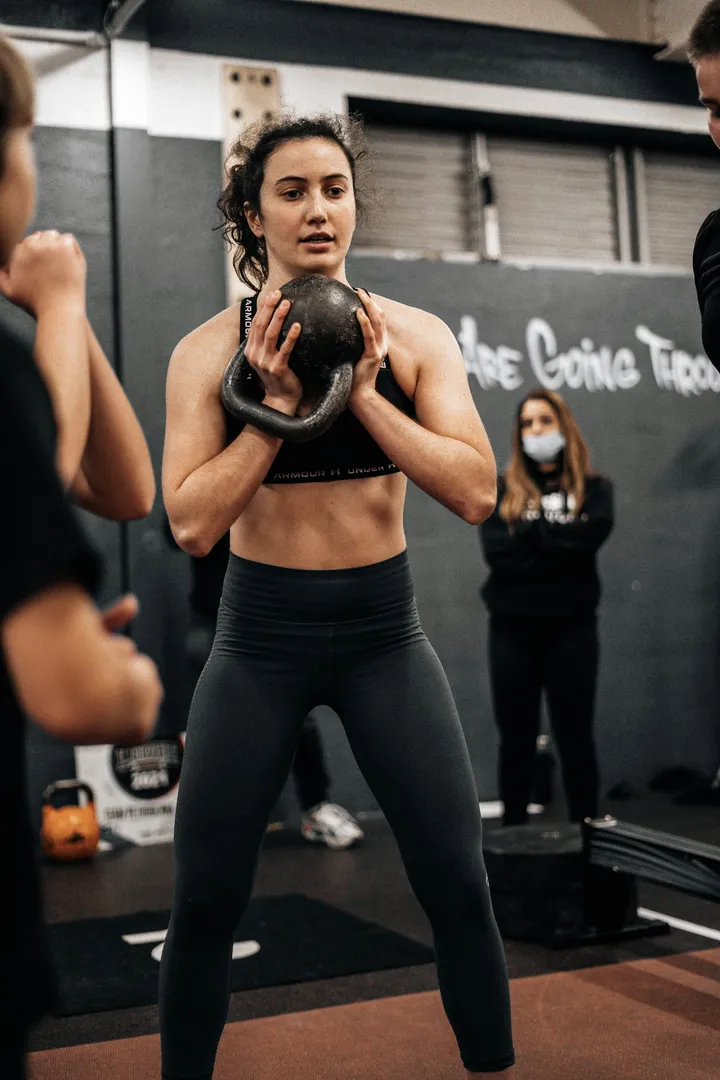
Alternative: Goblet squat. Hold a heavy dumbbell or kettlebell at chest height. Same form, less spinal load, easier to learn. Best for beginners and home gym setups.
Alternative: Front squat. Bar on the front of the shoulders. More quad-dominant than back squat, demands more upright torso. Niche; back squat covers the same ground.
Sets/reps: 3-4 sets of 5 reps for back/front squat. 3 sets of 8 for goblet squat (the goblet squat is rep-limited by your grip on the dumbbell, not your legs).
What people get wrong: going too light. The squat is the lift where most beginners under-load. If you’re squatting the empty bar (45 lb) on week 4, add weight. The squat should feel challenging, not effortless.
2. The hinge
The second most important leg exercise. Trains hamstrings, glutes, lower back, grip, and posture.
Top pick: Conventional deadlift. Bar on the floor, feet hip-width apart, hinge at the hips and grip the bar, drive through the floor to stand. The most-loadable posterior-chain exercise; gold standard for total-body strength.
Alternative: Romanian deadlift. Start standing with the bar, hinge at the hips while keeping the knees soft, lower the bar along the front of the legs to mid-shin, return to standing. Heavier hamstring emphasis, lower learning curve, fewer back-injury concerns. Best alternative for absolute beginners.
Alternative: Sumo deadlift. Wider stance, hands inside the legs. Slightly more glute-emphasized than conventional. Good for women with longer torsos or hip mobility limitations that make conventional uncomfortable.
Sets/reps: Conventional deadlift: 1-2 working sets of 5 reps (heavy, longer rest). Romanian deadlift: 3 sets of 8 reps. Sumo: 3 sets of 5.
What people get wrong: rounding the lower back. The deadlift requires a flat or slightly arched back through the entire lift. If your back rounds, the weight is too heavy or the form needs work. Deload and refine.
3. The single-leg
Trains stability, hip control, and addresses left-right asymmetries that bilateral lifts hide.
Top pick: Bulgarian split squat. Rear foot elevated on a bench, front leg in a deep lunge position, descend until the back knee almost touches the floor. The single-leg exercise that builds the most muscle and exposes the most weakness. Hated for a reason: it’s hard.
Alternative: Reverse lunge. Step backward into a lunge, return to standing. Gentler on the knees than forward lunges, builds the same patterns. Best alternative for beginners.
Alternative: Step-up. Step onto a tall box or bench, drive through the front foot to stand on top, control back down. Quad-dominant, knee-friendly.
Sets/reps: 3 sets of 8-10 reps per leg. Use dumbbells held at the sides (lighter than your bilateral lift weights, start with 15-30 lb per hand).
What people get wrong: doing too many reps. Bulgarian split squats with 3-pound dumbbells for 20 reps is a cardio drill, not a strength exercise. Use real weight (15-35 lb dumbbells in each hand) and stop at 8-10 reps when form holds.
4. The glute isolation
Glutes are the most-underdeveloped muscle group in most women, including women who train. They’re masked by larger quad and hamstring development. Direct glute work matters.
Top pick: Hip thrust. Upper back on a bench, barbell or heavy dumbbell across the hips, drive the hips up by squeezing the glutes. Specifically targets the glutes (especially gluteus maximus) without much quad or hamstring contribution. The exercise that built modern glute training.
Alternative: Glute bridge. Same movement, on the floor instead of with shoulders elevated. Easier setup, slightly less range of motion, fine for home gym setups.
Alternative: Cable kickback. Standing or kneeling, ankle attached to a cable, kick back against resistance. Smaller load, more rep volume. Works as an additional glute exercise once you’ve established the hip thrust.
Sets/reps: 3 sets of 10-12 reps with serious weight. Hip thrusts should eventually be loaded with as much or more weight than the squat (the glutes can move more weight than the quads).
What people get wrong: insufficient weight. Hip thrusts with a 25-lb dumbbell are warm-ups. Working sets should use a barbell with 95-225 lb (or two heavy dumbbells totaling that range) once you’ve progressed. The glutes are the strongest muscle in the body; they need real load.
5. The accessory
The fifth slot is targeted: pick an exercise that addresses a specific weakness or imbalance.
Common picks:
- Calf raises (most underrated leg exercise, calves drive ankle stability and stride). 3 sets of 12-15 reps, weighted.
- Hamstring curl (machine or stability ball). 3 sets of 10-12 reps. Hits the hamstrings in a different range of motion than deadlifts.
- Adductor machine or sumo squat if your inner thighs are a weakness.
- Lateral lunge for hip mobility and inner-thigh strength.
- Cable hip abduction for gluteus medius (the “side” glute that stabilizes the hip).
Sets/reps: 3 sets of 10-15 reps. Higher rep range than the main lifts. The accessory is for muscle building and weak-point reinforcement, not maximum strength.
A real 45-minute leg day
Here’s exactly what to do. Total time including warm-up: 45-60 minutes.
Warm-up (8-10 minutes):
- 5 minutes light cardio (bike, walk, rower)
- Cat-cow x 8 reps
- Glute bridges x 10
- Bodyweight squats x 10
- Leg swings (front-to-back, side-to-side) x 10 each
- 1-2 warm-up sets of the squat with 50-60% of your working weight
Main workout:
| Exercise | Sets x Reps | Rest |
|---|---|---|
| Back squat (or goblet squat) | 4 x 5 | 2-3 min |
| Romanian deadlift | 3 x 8 | 2 min |
| Bulgarian split squat | 3 x 8 each leg | 90 sec |
| Hip thrust | 3 x 10 | 90 sec |
| Calf raise (weighted) | 3 x 12 | 60 sec |
Cooldown (5 minutes):
- 5 minutes walking
- Optional: 1-2 minutes of pigeon pose, hip flexor stretch, hamstring stretch
That’s the workout. Repeat once a week (if you train 3 days/week with one of those days being legs) or twice a week (if you train 4-5 days/week with two days being lower-body focused).
How heavy should you go?
The most-asked question. Honest answer: heavier than you think.
Goal benchmarks at 6-12 months of consistent training (for a 150-lb woman):
| Exercise | 6-month goal | 12-month goal |
|---|---|---|
| Back squat | 100 lb for 5 | 150 lb for 5 |
| Conventional deadlift | 165 lb for 5 | 215 lb for 5 |
| Romanian deadlift | 95 lb for 8 | 135 lb for 8 |
| Bulgarian split squat | 25 lb dumbbells for 8 each leg | 40 lb dumbbells for 8 each leg |
| Hip thrust | 95 lb for 10 | 185 lb for 10 |
Adjust proportionally for your bodyweight. These numbers put you in the top 25% of untrained women your age. They’re achievable; they take 6-12 months.
Starting weights are much lower: often the empty 45-lb barbell on squats, 95-135 lb on deadlifts, 15-25 lb dumbbells on Bulgarian split squats. Progress is the metric, not absolute weight.
For the full progression scheme (linear → double progression → RPE-based), see our strength training cornerstone.
At-home variations
A complete leg day at home requires two adjustable dumbbells (50+ lb each) or a kettlebell, and a sturdy bench or chair.
| Exercise | Home substitution |
|---|---|
| Back squat | Goblet squat with one heavy dumbbell or kettlebell |
| Conventional deadlift | Romanian deadlift with two dumbbells |
| Bulgarian split squat | Same exercise, dumbbells in hands instead of bar |
| Hip thrust | Dumbbell or kettlebell across the hips, shoulders on a bench or couch |
| Calf raise | Holding dumbbells, standing on a step or thick book |
Total home setup cost for legs: $400-600 (adjustable dumbbells) plus $50-150 (bench).
The home version progresses slower than the gym version (dumbbells max out at 50-100 lb each, while a barbell + plates can scale much higher). For most women in their first 12 months of training, this is fine. For the next 12 months, you may want to add a barbell + plates to keep progressing.
What to skip (toning myths, machine-only programs)
The leg-day genre has accumulated some patterns that don’t deserve space:
- Machine-only leg programs. Leg press, leg extension, leg curl, hip abductor machine, all in one workout. Machines have their place but don’t transfer to real-world function as well as free-weight compound lifts. Use machines as accessories, not the primary program.
- “Toning” workouts with 1-3 lb ankle weights. “Toning” is fitness-marketing language for “doing nothing.” Real muscle change requires progressive load. 3-lb ankle weights are useful for rehab; they’re not strength training.
- 30-minute high-rep cardio leg routines (“100 squats, 100 lunges, 100 calf raises”). Useful as cardio and conditioning. Not strength training. The two have different adaptations.
- Daily leg workouts. Legs need 48-72 hours of recovery between hard sessions. Daily training prevents adaptation. Once or twice a week is the right frequency.
- Excessive single-leg work without bilateral lifts. Some programs are 60% single-leg work. Single-leg has a place, but bilateral squats and deadlifts produce more total muscle growth and bone density gains.
- Heavy ego-lifting on the squat without proper form. A 200-lb squat with rounded back is worse than a 100-lb squat with perfect form. Form first, weight second.
- Skipping the hinge. Many women’s leg-day programs are squat-heavy and hinge-light. The deadlift family is half of legs. Don’t skip it.
A short FAQ
What is the best leg exercise for women?
The squat. If you only had time for one, that’s the one. The 5-movement framework in this article gives you the rest, but the squat is the foundation.
How many leg exercises per workout?
Five. One per movement category (squat, hinge, single-leg, glute, accessory). More than seven exercises and you’re rushing or training over 90 minutes.
How heavy should women lift on leg day?
Heavier than you think. Goal at 6-12 months: bodyweight squat for 5 reps, 1.25x bodyweight deadlift for 5 reps. Starting weights are much lower (empty bar, 95-135 lb deadlift). Progress over weeks, not absolute weight.
Will leg exercises make my legs bulky?
No. Building visible muscle as a woman over 40 takes years of dedicated training plus a calorie surplus. The “bulky” fear is unfounded for almost all women.
Should I do legs once or twice a week?
Once if you train 3 days/week (full-body sessions). Twice if you train 4-5 days/week (split sessions where one day is lower-body, another day includes single-leg or glute work).
Can I skip squats and just do deadlifts?
You can but shouldn’t. Squats and deadlifts train overlapping but distinct movement patterns. Skipping squats leaves the front of the legs (quads) underdeveloped. The 5-movement framework includes both because both matter.
What about leg machines (leg press, leg extension)?
Use as accessories after compound lifts, not as a primary program. The leg press is a fine accessory for additional quad volume; the leg extension and leg curl are useful for isolating quads and hamstrings respectively. Don’t build your program around machines; supplement with them.
How long until I see leg changes?
Strength changes appear in 4-8 weeks. Visible muscle changes take 12-16 weeks of consistent training plus adequate protein. Body composition shifts (less fat, more muscle for the same weight) appear over 16-24 weeks.
For broader context, see our strength training cornerstone and the perimenopause workout plan for how leg-day fits into a larger training week. For supplements that support leg-day recovery and muscle growth, see creatine for women.