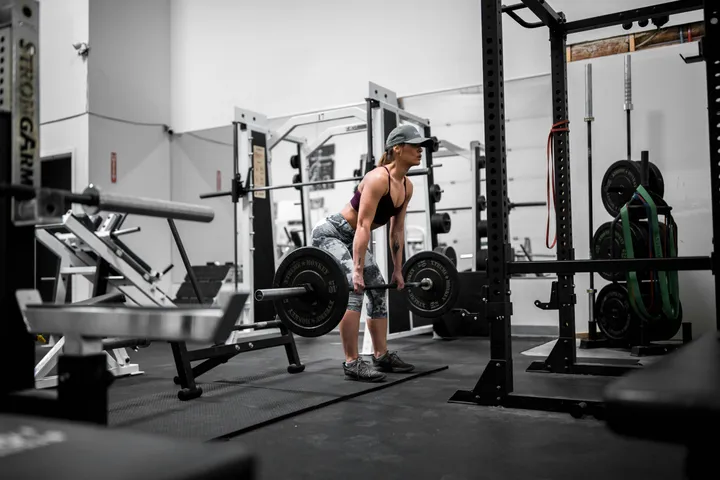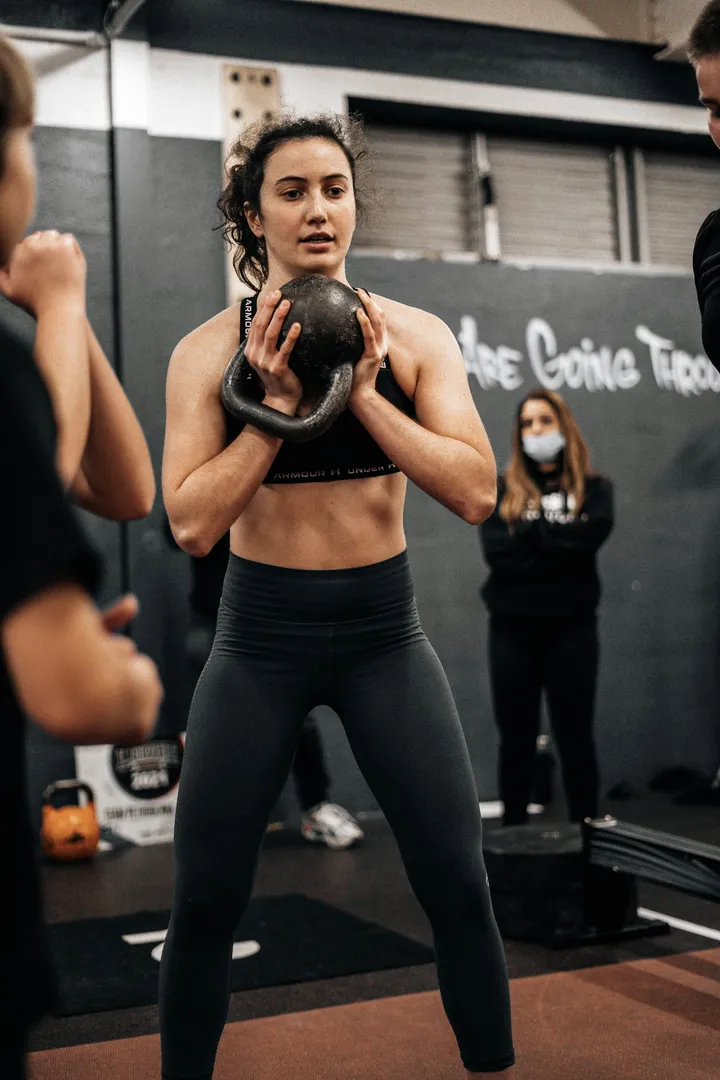
Most “strength training programs for women over 40” don’t actually progress. They’re 4-week or 8-week routines where you do the same workout for the entire duration and hope you get stronger. Some genuine progression happens (mostly neural adaptation in the first 3-4 weeks), but the program’s structure isn’t doing the work, your body’s startup phase is.
This is a real 12-week program. Three phases, week-by-week sets and reps, explicit RPE progression, and symptom-day modifications for the perimenopause realities most programs ignore. By the end, you’ll be measurably stronger, more conditioned, and ready to either repeat the program at heavier loads or transition to advanced training (5/3/1, Starting Strength, or coach-designed work).
This guide builds on our strength training cornerstone. If you haven’t read that, start there for the foundational principles. This article is the implementation.
TL;DR
- 12 weeks, 3 phases: Base (1-4) → Build (5-8) → Peak (9-12).
- 3 days per week, full-body sessions on non-consecutive days.
- Real progression: linear in Phase 1, double progression in Phase 2, RPE-based in Phase 3.
- Per-session structure: 3-4 working sets of 4-5 compound lifts, plus accessory work.
- Symptom-day modifications: when sleep was bad or perimenopause symptoms hit, swap in the low-volume version.
- What you need: a gym (barbell + plates + rack) OR adjustable dumbbells (50+ lb each), a bench, optional pull-up bar.
Why 12 weeks (and why most “4-week” programs underdeliver)
The body adapts to strength training in predictable phases:
Weeks 1-3: Neural adaptation. You get stronger by recruiting muscle fibers more efficiently, not by adding muscle tissue. Lifters always make rapid gains in this phase. Most “4-week” beginner programs end exactly when this phase wraps, capturing the visible improvement, missing what comes next.
Weeks 4-8: Early hypertrophy. Muscle fibers begin growing. Strength gains continue but slower. This is when the program structure starts to matter, you can’t just “do more reps” forever; you need progressive load.
Weeks 9-12: Real adaptation. Bone density signaling, tendon stiffening, mitochondrial density changes, and muscle growth all start producing the long-term changes that make strength training transformative. A 4-week program ends before any of this begins. An 8-week program catches the first half.
Why women over 40 specifically need 12 weeks:
- Slower neural adaptation, older nervous systems take 1-2 weeks longer to fully optimize movement patterns.
- Slower tissue remodeling, connective tissues (tendons, ligaments, fascia) adapt slower than muscle. Stopping at 4 weeks means the muscle is ready to lift heavier than the tendons can handle, which is an injury risk.
- Bone density is a long signal, meaningful BMD changes from resistance training take 6+ months. Twelve weeks of consistent loading is the minimum dose for any measurable signal.
- Habit formation, research suggests new behaviors require 60-90 days to become automatic. Twelve weeks gets you past the “this is a phase” period into “this is part of my life.”
The 12-week program isn’t longer for length’s sake. It’s calibrated to the actual adaptation timeline.
The 3-phase framework
Each phase has a specific job. The progression isn’t just “add weight every week”, it’s “shift the type of stimulus.”
Phase 1: Base (Weeks 1-4), Groove the patterns. Higher rep ranges (6-10), moderate intensity, focus on form and movement quality. Linear progression: add 5 lb every workout when you complete all reps with good form.
Phase 2: Build (Weeks 5-8), Load up. Lower rep ranges (4-8), higher intensity, focus on absolute strength gains. Double progression: hit your top set’s rep ceiling before adding weight.
Phase 3: Peak (Weeks 9-12), Test and autoregulate. Mixed rep ranges (3-8), highest intensity working sets, RPE-based programming. You learn to listen to your body and adjust day-to-day.
After week 12: deload (week 13, 50% volume), test 3-rep maxes (week 14), then either repeat the cycle with new starting weights or transition to a more advanced program.
Before you start: equipment + readiness
Minimum equipment for the gym version:
- Squat rack with safety bars
- Olympic barbell (45 lb / 20 kg)
- Plates totaling at least 200 lb (for deadlift and squat scaling)
- Adjustable bench
- Optional but useful: pull-up bar, dumbbell rack with 5-50 lb pairs
Minimum equipment for the home version:
- Adjustable dumbbells, 50+ lb each (Bowflex SelectTech, NordicTrack iSelect, or fixed dumbbell pairs)
- A sturdy bench
- Optional: doorway pull-up bar ($30-50)
Readiness check before starting:
- Medical clearance if you have any of: diagnosed osteoporosis, recent cardiovascular event, recent surgery, untreated hypertension, recent acute injury. Talk to your doctor; bring research with you (LIFTMOR for osteoporosis, ACSM guidelines for general clearance).
- Form readiness: you should be able to perform an unweighted air squat with proper form (knees track over toes, heels stay down, descent below parallel). If you can’t, spend 2 weeks on mobility work first.
- Time readiness: can you commit 45-60 minutes, 3 days a week, for 12 weeks? If not, restructure your week before starting. Quitting at week 6 is the most common failure mode.
Phase 1: Base (Weeks 1-4): groove the patterns
Goal: learn or re-learn the fundamental lifts. Volume is moderate. Weight is much lighter than you think it should be.
Schedule: Workout A on Monday, B on Wednesday, A on Friday (alternating each week so over 8 sessions you get 4 of A and 4 of B).
Workout A:
| Exercise | Sets x Reps | Rest | Target weight (week 1) |
|---|---|---|---|
| Back squat (or goblet squat) | 3 x 8 | 90 sec | Empty bar (45 lb) or 25 lb dumbbell |
| Romanian deadlift | 3 x 8 | 90 sec | 65-95 lb |
| Dumbbell bench press | 3 x 8 | 90 sec | 15-25 lb dumbbells |
| Bent-over barbell row | 3 x 8 | 90 sec | 45-65 lb |
| Plank | 3 x 30-45 sec | 30 sec | bodyweight |
Workout B:
| Exercise | Sets x Reps | Rest | Target weight (week 1) |
|---|---|---|---|
| Goblet squat | 3 x 10 | 90 sec | 25-35 lb dumbbell |
| Conventional deadlift | 3 x 5 | 2 min | 95-135 lb |
| Overhead press | 3 x 8 | 2 min | 35-55 lb |
| Single-arm dumbbell row | 3 x 8 each arm | 60 sec | 20-30 lb dumbbell |
| Hip thrust | 3 x 12 | 60 sec | 65-95 lb |
Progression rule (Phase 1): add 5 lb to each lift every workout where you completed all reps with good form. If you fail a set, hold the weight constant the next session.
Phase 1 expected progress: by week 4, your squat and deadlift will be 30-60 lb heavier than week 1. Your bench will be up 10-20 lb. This is normal beginner progression.
Phase 2: Build (Weeks 5-8): load up
Goal: push heavier weight in lower rep ranges. The body has the movement patterns; now it builds strength.
Schedule: Same Monday/Wednesday/Friday cadence. Workout A and B as below.
Workout A:
| Exercise | Sets x Reps | Rest | Target RPE |
|---|---|---|---|
| Back squat | 4 x 5 | 2 min | 7 |
| Romanian deadlift | 3 x 6 | 2 min | 7 |
| Bench press | 4 x 5 | 2 min | 7 |
| Bent-over row | 3 x 6 | 90 sec | 7-8 |
| Plank | 3 x 60 sec | 30 sec | bodyweight |
Workout B:
| Exercise | Sets x Reps | Rest | Target RPE |
|---|---|---|---|
| Back squat | 4 x 5 | 2 min | 7 |
| Conventional deadlift | 3 x 5 | 3 min | 7-8 |
| Overhead press | 4 x 5 | 2 min | 7 |
| Pull-up (assisted) or lat pulldown | 3 x 6 | 90 sec | 7-8 |
| Hip thrust | 3 x 8 | 90 sec | 7-8 |
Progression rule (Phase 2, double progression): for each lift, the goal is 4 sets of 5. When you can complete all 4 sets at the same weight, add 5 lb (or 10 lb on deadlift) the next workout and drop back to 4x4 or 4x5 at the new weight.
Example: Week 5 you bench 75 lb for 4x5. Week 6 you keep 75 lb but get 4x6, then 4x7, then 4x8. Once you hit 4x8, jump to 80 lb and start the cycle again.
Phase 2 expected progress: by week 8, your squat and deadlift are likely 50-100 lb heavier than week 1. Bench is up 20-40 lb. You’re starting to look and feel different.
Phase 3: Peak (Weeks 9-12): strength + autoregulation
Goal: lift the heaviest weight of the program at moderate-to-high RPE, while learning to autoregulate based on daily readiness.
Schedule: Same Monday/Wednesday/Friday cadence. Now we introduce a 3-day rotation: Heavy / Moderate / Light, instead of fixed A/B.
Heavy day (Monday):
| Exercise | Sets x Reps | Rest | Target RPE |
|---|---|---|---|
| Back squat | 5 x 3 | 3 min | 8 |
| Conventional deadlift | 3 x 3 | 3 min | 8 |
| Bench press | 5 x 3 | 2.5 min | 8 |
| Pull-up or assisted pull-up | 3 x AMRAP (as many reps as possible) | 2 min | 8-9 |
Moderate day (Wednesday):
| Exercise | Sets x Reps | Rest | Target RPE |
|---|---|---|---|
| Front squat or goblet squat | 4 x 6 | 2 min | 7 |
| Overhead press | 4 x 6 | 2 min | 7 |
| Romanian deadlift | 3 x 8 | 2 min | 7 |
| Bent-over row | 3 x 8 | 90 sec | 7 |
Light day (Friday):
| Exercise | Sets x Reps | Rest | Target RPE |
|---|---|---|---|
| Back squat | 3 x 5 | 2 min | 6 |
| Dumbbell bench press | 3 x 8 | 90 sec | 6 |
| Single-arm dumbbell row | 3 x 8 each arm | 60 sec | 6-7 |
| Hip thrust | 3 x 10 | 90 sec | 6-7 |
| Plank + Pallof press | 3 x 60 sec each | 30 sec | bodyweight |
Progression rule (Phase 3, RPE-based): use the prescribed RPE as the ceiling. On strong days you’ll hit RPE 8 with more weight than expected. On weak days you’ll hit RPE 8 with less. The RPE stays constant; the weight varies. This is how trained lifters program for life.
Phase 3 expected progress: by week 12, you’ll have set personal records on at least 2-3 lifts. You’ll know what an RPE 8 set feels like vs. an RPE 7. You’ll be ready for any program designed for intermediate lifters.
Symptom-day modifications (how to handle bad days)
The program above assumes you slept 7+ hours, ate adequate protein, and aren’t deep in a perimenopause symptom flare. Real life isn’t always that.
Use the symptom-day workout when:
- You slept under 5 hours
- Hot flashes or perimenopause symptoms were notably worse that day or overnight
- You’re recovering from illness or unusually high stress
- The first warm-up set feels heavier than expected
The symptom-day replacement (replaces any A/B/Heavy/Moderate/Light workout):
| Exercise | Sets x Reps | Rest | RPE |
|---|---|---|---|
| Goblet squat (or air squat) | 2 x 8 | 90 sec | 6 |
| Push-up (knees if needed) | 2 x 8 | 60 sec | 6 |
| Single-leg Romanian deadlift | 2 x 8 each leg | 60 sec | 6 |
| Plank | 2 x 30 sec | 30 sec | bodyweight |
Total session time: 25-30 minutes. Light enough to leave the body better than you found it, not worse.
The point isn’t to “phone it in.” It’s to maintain consistency without compounding fatigue. Skipping the workout entirely is worse than the maintenance version. You learn to train around perimenopause, not stop training because of it.
For deeper coverage of how perimenopause changes training, see our perimenopause workout plan.
After week 12 (what’s next)
When you finish Phase 3, you have three options:
Option 1: Repeat with heavier starting weights. Same 12-week structure, but week 1 starts where you left off. Most women run this cycle 2-3 times before transitioning. This is the simplest path to continued progress.
Option 2: Move to an intermediate program. 5/3/1 Forever (Jim Wendler), Starting Strength (Mark Rippetoe), the Westside method, or Greg Nuckols’ Strength Coaches programs. These are designed for lifters past beginner status.
Option 3: Maintain. If your goal was “build a baseline of strength,” you have it. Maintain with a 2-day-per-week version of Phase 3, and your strength holds for years.
Most women run this 12-week program 2x consecutively (24 weeks total) before moving to an intermediate program. The cumulative gains are dramatic.
What to skip
A short list of patterns that don’t earn their place in a real program.
- 5+ day-per-week splits as a beginner. Three full-body days outperforms five split days for someone new to lifting. Save splits for intermediate-and-beyond programming.
- Programs with no progression scheme. “Do this workout for 8 weeks” without specifying how to add weight or reps is not a program; it’s a workout you do 24 times.
- Programs designed by social media influencers without strength credentials. A YouTube celebrity selling a “menopause workout” without a CSCS, NSCA, or RD credential is selling marketing. Real coaches with credentials are usually less polished but more useful.
- “Toning” programs with light weights and high reps. Light-weight high-rep work is conditioning, not strength training. Different adaptations, different outcomes.
- Adding “extra” exercises during the program. The program is the program. Adding 4 sets of bicep curls to every workout doesn’t accelerate progress; it adds recovery cost.
- PR testing before week 12. Resist the urge to find your “max” in week 4 or 8. The whole point of the program is the test at week 12+.
- Skipping deload weeks. After completing the 12-week cycle, take a deload week (50% volume) before testing or starting the next cycle. Skipping deloads is how lifters get hurt.
A short FAQ
How long should a strength training program be for women over 40?
12 weeks is the minimum for meaningful adaptation. 4 and 8 week programs capture only the early phases. The 3-phase structure (Base/Build/Peak) is calibrated to the real adaptation timeline.
How many days per week?
3, on non-consecutive days, for the full 12 weeks. More than 4 rarely helps and often compromises recovery, especially during perimenopause.
Can I do this at home with just dumbbells?
Yes, with substitutions: goblet squat for back squat, dumbbell RDL for conventional deadlift, dumbbell bench press for barbell bench, single-arm dumbbell row for barbell row. Total home setup: $400-700.
What if I miss a workout?
Don’t skip, shift. If Monday is missed, push the schedule a day (Tuesday/Thursday/Saturday). Returning the next week resumes normal cadence. Missing 2+ workouts in a row: take it as a rest week, then resume from where you left off.
Should I do cardio too?
Yes, lightly. 2 walks per week (30-45 min) at conversational pace. Optional 1 short HIIT session (15-20 min) once a week. Don’t replace strength training with cardio. Both have value; strength is the priority.
What’s the difference between this and the perimenopause workout plan?
The perimenopause workout plan is an 8-week program specifically designed around perimenopause symptom variability, lower volume, more recovery focus. This 12-week program is the next step: more aggressive progression, calibrated for women whose symptoms are stable enough to push hard. Many women run the perimenopause plan first, then transition to this 12-week program.
Is there a free PDF?
Coming soon as a free email-list signup. The PDF will include weekly logbook templates, exercise demo links, RPE charts, and the symptom-day modification flowchart. Sign up at the bottom of the page.
Get the PDF version (lead magnet placeholder)
We’re building a downloadable, printable PDF of this 12-week program with logbook templates and exercise demos. It’ll be a free email list signup when ready. Check back, or sign up for the email list at the bottom of any page on this site to be notified.
For broader context: the strength training cornerstone covers the foundational principles. The perimenopause workout plan is the gentler 8-week starter version. For the supplements that support recovery in this program, see creatine for women and protein drinks for women over 50. For the gear that some lifts benefit from once you’re heavier, see weightlifting belt for women.