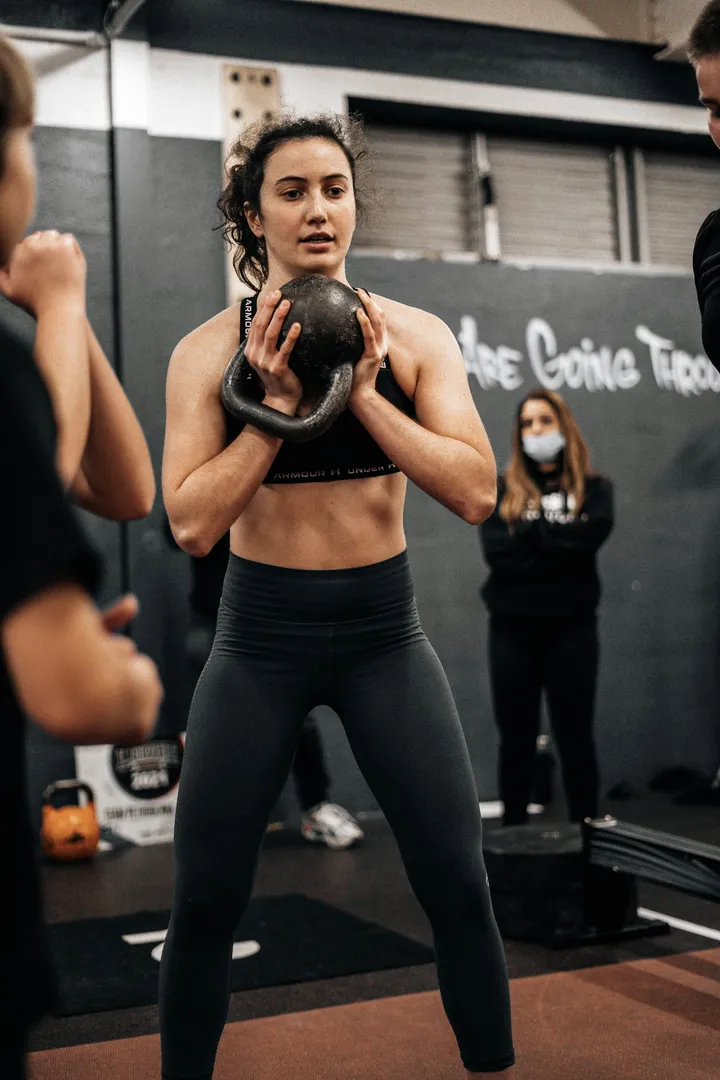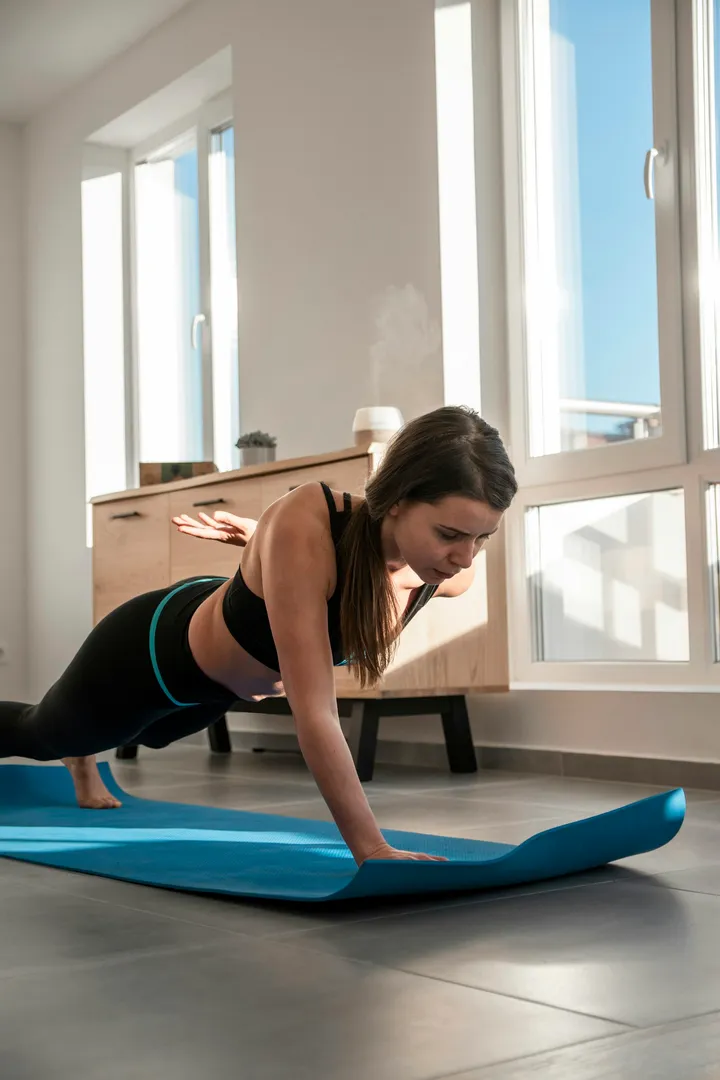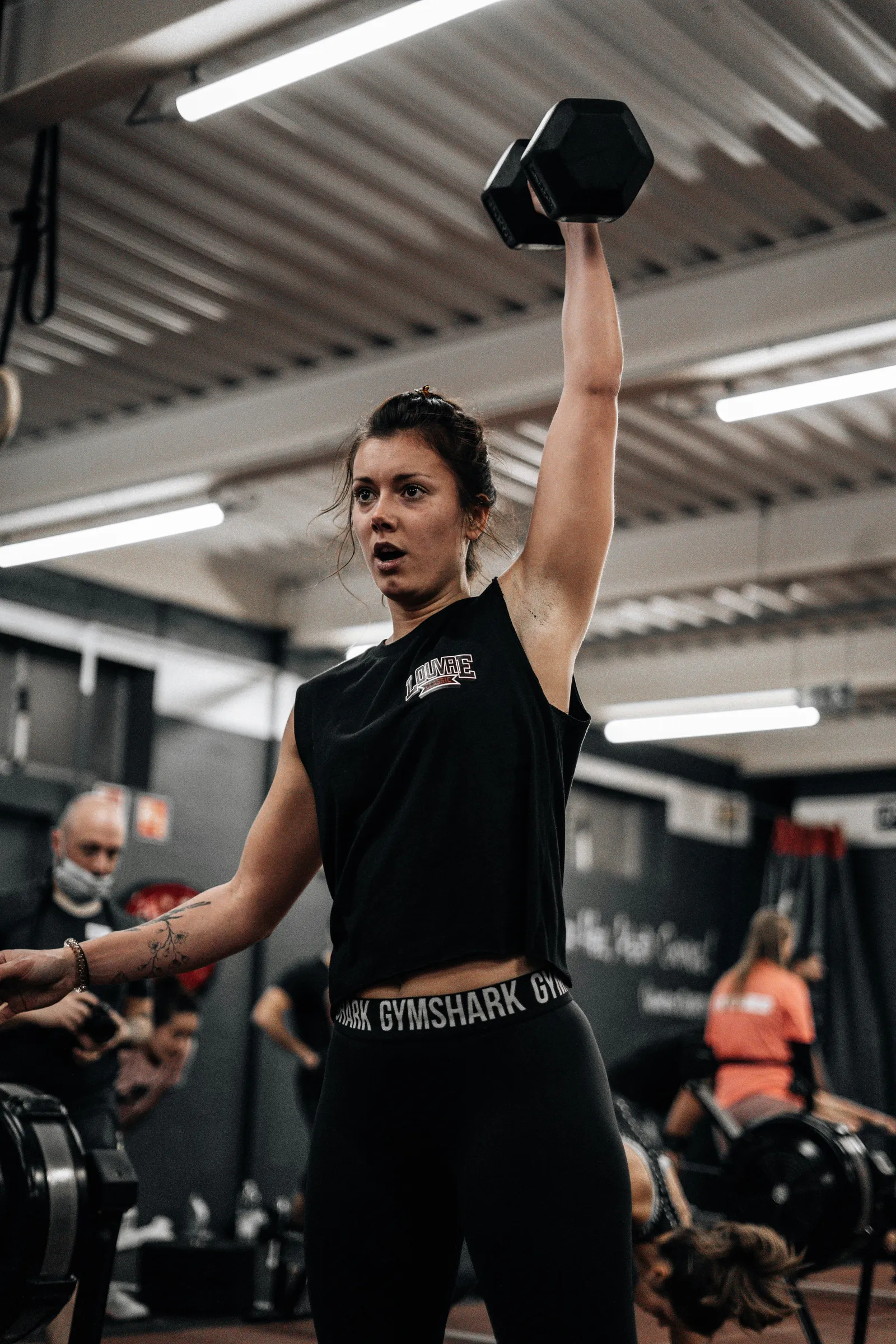
If you’re lifting weights in your 40s, 50s, or beyond and you want shoulder training that builds strength without trashing your rotator cuff, this article is for you. Most “dumbbell shoulder exercises” articles online are written for 25-year-old men trying to grow bigger delts. Athlean-X’s top-ranking guide literally lives at a URL with “/shoulders-for-men/” in it. The shoulder concerns of a 48-year-old woman who has been desk-jobbing for 20 years are different from those of a 25-year-old who plays basketball. This is the version for the first reader.
The honest framing: dumbbell shoulder training matters most for posture (the rear delt, the most neglected head), proximal humerus bone density (one of the under-discussed fracture-risk sites in postmenopausal women), and rotator cuff longevity (the single most-injured muscle group in adult women lifters). The good news is that the same 5-7 movements that build shoulder strength also serve all three priorities. The trick is picking the right movements and avoiding the few that cause more problems than they solve.
TL;DR
- The centerpiece exercise is the dumbbell shoulder press. It trains all three deltoid heads in one movement, with the anterior and lateral heads working the hardest.
- Train shoulders 2 times per week, 8-12 hard sets total. This is the volume frequency sweet spot per the Schoenfeld meta-analyses.
- Use progressive overload. Add weight, reps, or sets every session you can.
- Top 7 exercises by leverage and safety: dumbbell shoulder press, lateral raise, bent-over rear delt fly, Arnold press, front raise, single-arm overhead press, scaption raise.
- Always warm up the rotator cuff. 5 minutes of banded external rotation, scapular wall slides, and prone Y-T-W matters more after 40 than it did at 25.
- Skip: strict upright row at heavy load, behind-the-neck press, swung lateral raises with momentum, and “30-day shoulder shred” rehab-tier challenges.
Who this is for
You are a woman over 40 (give or take) who lifts or wants to start. You have a pair of dumbbells, access to a bench, and you want shoulders that work properly for the next 30 years. You may have a desk job that has eroded your posture. You may have a creaky shoulder that flares up during certain movements. You want the article that takes you seriously as an adult lifter, gives you actual movement instruction and programming, and acknowledges that your rotator cuff at 50 is not your rotator cuff at 30. That is what this is.
Why shoulder training matters (especially over 40)
The three deltoid heads and what each does
The shoulder is anchored by the deltoid, which has three distinct heads:
- Anterior deltoid (front): raises the arm forward; works hardest in pressing movements (shoulder press, bench press, front raise)
- Lateral deltoid (side): raises the arm out to the side; works hardest in lateral raises and the side portion of pressing
- Posterior deltoid (rear): pulls the arm backward and externally rotates; works hardest in rear delt flies, rowing, and reverse pec deck
The Coratella 2020 EMG study measured exactly which exercises activate each head and confirmed the conventional wisdom: pressing dominates anterior, lateral raises dominate lateral, rear delt flies dominate posterior. A complete shoulder workout needs at least one movement targeting each head.
Posture and the rear delt (the over-40 reality)
If you have been sitting at a desk for 20 years, your anterior shoulders have rounded forward and your rear delts have atrophied. This is not a moral failing; it is mechanical. The posture pattern shortens the chest and front shoulder and lengthens (and weakens) the upper back and rear delt. Training the rear delt hard, with movements specifically targeting it, partially reverses this pattern.
Most women over 40 are dramatically under-trained on the rear delt because every gym Instagram clip features lateral raises and presses. Spend 30% of your shoulder volume on the rear delt and you will look and feel different in 8 weeks.
Proximal humerus bone density (the often-missed reason)
The proximal humerus is the top of the upper-arm bone where it meets the shoulder. It is one of the most common fracture sites in postmenopausal women, especially from falls onto an outstretched hand. Loaded overhead pressing stresses this bone in a way that signals bone remodeling. Walking does not do this; the overhead press does. We covered the broader bone density angle in our low estrogen symptoms article. The practical takeaway is that heavy overhead work is one of the most leveraged interventions for upper-body fracture-risk reduction in women over 40.
Rotator cuff longevity
The rotator cuff is a group of four small muscles (supraspinatus, infraspinatus, teres minor, subscapularis) that stabilize the shoulder joint. After age 40, rotator cuff degeneration starts to show in imaging studies of asymptomatic adults at rates that climb with each decade. You can train the cuff to stay healthy with deliberate, low-load work (5-10 minutes per workout), and the difference between doing it and not doing it shows up over years, not weeks. Skip it now, pay for it later.
The 7 best dumbbell shoulder exercises (ranked by leverage and safety)
These are ranked by a combination of effectiveness (how much shoulder training you get per set) and safety (how unlikely the movement is to cause an injury when performed with reasonable form). For most women over 40 the priority order is: centerpiece press first, then balanced isolation work across all three heads, then optional variants for variety.
1. Dumbbell shoulder press (the centerpiece)
The single best dumbbell shoulder exercise. The Coratella 2020 EMG data showed the dumbbell shoulder press produces high activation of the anterior deltoid with meaningful lateral deltoid involvement. Unlike a barbell press, the dumbbell version allows a more natural arm path and exposes left-right strength imbalances (which most lifters have).
Form cues:
- Seated on a bench with back support, feet flat on the floor
- Dumbbells start at shoulder level, palms facing forward (or neutral for a friendlier variant)
- Press straight up until arms are nearly locked out, dumbbells slightly inside shoulder width at the top
- Keep ribs down, do not arch the lower back
- Lower with control, do not slam the dumbbells back to the start position
- Stop the lowering phase at ear level, not below
Sets and reps: 3-4 sets of 6-10 reps for strength; 3 sets of 8-12 for hypertrophy. Use moderate-to-heavy weight; expect to handle around 50-65% of your dumbbell bench press weight here.
Neutral grip vs pronated: if your shoulders feel cranky on a strict pronated (palms forward) press, switch to the neutral grip (palms facing each other). The neutral position is friendlier to the rotator cuff for most lifters and almost as effective for deltoid activation.
2. Dumbbell lateral raise
The single best exercise for isolating the lateral deltoid. The Coratella 2020 study confirmed it produces the highest lateral deltoid activation of all common shoulder exercises. The lateral deltoid is what gives shoulders width and shape, but it also stabilizes the joint capsule during overhead movement.
Form cues:
- Stand with a slight knee bend, dumbbells at sides, palms facing your body
- Raise both arms out to the sides until just above parallel with the floor (slightly less than shoulder height)
- Slight elbow bend throughout, like you are pouring water out of a glass at the top
- Lead with the elbows, not the wrists
- Lower with full control over 2-3 seconds, do not let gravity drop them
- No swinging the body, no momentum, no shrugging at the top
Sets and reps: 3-4 sets of 10-15 reps. Most women start much lighter than they think (5-10 lb dumbbells). If you can swing 25s up, you are not training the lateral delt, you are training your traps.
3. Bent-over rear delt fly
The single most under-prioritized exercise for women over 40. The rear delt drives shoulder posture and the rounded-forward pattern that comes from desk work, and the bent-over fly trains it directly. Do this exercise more than you think you should.
Form cues:
- Stand with feet hip-width, hinge forward at the hips until torso is roughly parallel to the floor
- Slight knee bend, neutral spine, dumbbells hanging beneath the shoulders
- Raise both arms out to the sides (like a reverse hug), keeping a slight elbow bend
- Squeeze the shoulder blades together at the top
- Lower with control
Sets and reps: 3-4 sets of 12-15 reps. Lighter weight than you think (5-12 lb dumbbells for most women). This is a mind-muscle exercise; if you cannot feel the rear delt working, lighten the weight and slow the eccentric.
4. Arnold press
A press variant that adds rotation, which engages all three deltoid heads more completely than a strict press. Named after Arnold Schwarzenegger, who used it heavily. Slightly less effective for pure overhead strength than a standard press, but better for general deltoid development per set.
Form cues:
- Seated on a bench, dumbbells start at shoulder level with palms facing your body (like the top of a bicep curl)
- As you press up, rotate the dumbbells outward so palms face forward at the top
- Reverse the motion on the way down: rotate palms back toward your body as you lower
- Smooth continuous motion, not two distinct phases
Sets and reps: 3 sets of 8-12 reps. Good substitute for the standard shoulder press if you want variety.
5. Front raise (with caveat)
The front raise isolates the anterior deltoid. The honest take: most women over 40 do not need to add direct front delt work because every pressing movement in your program already trains it. If you bench press, shoulder press, push-up, or do any anterior horizontal pulling, the anterior delt gets plenty of work.
That said, if you specifically want to develop the front of your shoulder (maybe you are coming back from an injury or you want it for athletic carryover), the front raise is the move.
Form cues:
- Stand with dumbbells in front of thighs, palms facing your body or down
- Raise one or both arms straight forward to shoulder height
- Slight elbow bend throughout
- Lower with control
Sets and reps: 2-3 sets of 10-15 reps. Lower priority than the other 4 above. Include only if your program has the space.
6. Single-arm overhead press
The unilateral version of the shoulder press. Slightly different demands: more core engagement, more stability work, exposes side-to-side imbalances directly. Useful as a finisher or as the main press on a unilateral-focused training day.
Form cues:
- Standing (or seated for less core demand), dumbbell at one shoulder
- Press straight up, keep the rest of the body still
- Do not lean to the side or twist the torso
- Lower with control, complete all reps on one side before switching
Sets and reps: 3 sets of 8-10 reps per arm. Use about 75% of the weight you would use for a two-arm press.
7. Scaption raise (the rotator-cuff-friendlier lateral raise)
A lateral raise variant performed in the “scapular plane” (about 30 degrees forward of straight out to the side), instead of strictly out to the side. The scapular plane is the natural position the arm sits in when relaxed, and movements in this plane put less stress on the rotator cuff and impingement-prone areas of the shoulder joint.
Form cues:
- Stand with dumbbells at sides
- Raise both arms out at about 30 degrees forward of straight out to the side (imagine making a “Y” shape but a narrower Y than a full overhead Y)
- Up to shoulder height, slight elbow bend, lead with the elbows
- Thumbs slightly up at the top (a small external rotation)
- Lower with control
Sets and reps: 3 sets of 12-15 reps. Use this as your lateral raise substitute if the strict lateral raise irritates your shoulder.
How to program shoulder training (with the numbers)
Listing exercises is not a program. Programming is the volume, frequency, intensity, and progression that turns the exercise list into actual strength gains.
Weekly frequency (2x shoulder-focused work)
The Schoenfeld 2019 frequency meta-analysis showed that training a muscle 2 or more times per week produces more hypertrophy than training it once, but going from 2 to 3+ adds little when total weekly volume is equated. For shoulders specifically, the practical sweet spot is 2 sessions per week. More than that and you start under-recovering, which matters more for shoulders than for legs because the joint is more vulnerable.
Common splits where shoulders fit:
- Upper/lower split: shoulders on each upper day (twice a week)
- Push/pull/legs: shoulders on push day (and incidentally hit on pull day via rear delt)
- Full-body 3x/week: one shoulder movement per session
Sets, reps, and RPE (the numbers)
The Schoenfeld 2017 dose-response meta-analysis showed that weekly resistance training volume has a roughly linear relationship with hypertrophy up to about 10+ sets per muscle group per week. For shoulders, which are smaller muscle groups than legs or back, the practical target is slightly lower:
- 8-12 hard sets per week total, split across 2 sessions
- 4-6 sets per session, distributed across 2-3 exercises
- 6-10 reps for the heavy press (dumbbell shoulder press, Arnold press) at RPE 7-8 (2-3 reps left in the tank)
- 10-15 reps for isolation work (lateral raise, rear delt fly, scaption) at RPE 8-9 (1-2 reps left)
- Rest: 90-120 seconds between heavy press sets; 45-60 seconds between isolation sets
RPE means Rate of Perceived Exertion: a 1-10 scale of how hard the set was, where 10 means you could not have done another rep.
Progressive overload for shoulders specifically
Progressive overload (adding stress over time) is what drives adaptation. For shoulders:
- Add weight when you hit the top of the rep range with good form. Press 3 sets of 10 with 25s last week? Try 27.5s or 30s for 3 sets of 8 this week.
- Or add reps within a range. Lateral raise 3 sets of 12 last week? Aim for 3 sets of 13-14 with the same weight this week.
- Or add a set. If you did 3 sets last week, try 4 sets next week.
Shoulders progress more slowly than legs because the muscles are smaller and the joint is fussier. Add weight in smaller jumps (2.5-5 lb increments, not 10-pounders). Track your numbers. The Wirecutter rule applies: you cannot progressively overload if you do not remember what you did last week.
A 4-week starter template
A concrete plan. Use it for 4 weeks, then evaluate and adjust based on what is working.
Day 1 (heavy shoulder + chest):
- Dumbbell shoulder press: 4 sets of 8, RPE 7-8
- Bent-over rear delt fly: 3 sets of 12, RPE 8
Day 2 (light shoulder + pulling):
- Lateral raise (or scaption raise): 4 sets of 12-15, RPE 8-9
- Single-arm overhead press: 3 sets of 10 per arm, RPE 7
Total weekly hard sets: 14, sitting in the sweet spot. Add an Arnold press or front raise as a third exercise on Day 1 if you recover well and want to push closer to 18 sets after 4 weeks.
For broader programming context, our strength training program for women over 40 lays out a 12-week framework that this shoulder work fits inside.
Dumbbell shoulder exercises at home (no bench, no rack)
A bench is helpful but not required. You can build shoulders at home with dumbbells, a sturdy chair (for incline variations), and floor space.
Standing variants
All the major presses can be done standing instead of seated. The trade-off: more core engagement and lower-back demand, slightly less load tolerance because you cannot stabilize against a bench. For most women, standing presses work fine up through about 25-30 lb dumbbells; heavier than that, seated is more productive.
Floor-friendly options
- Floor or chair-back lateral raise: stand near a wall or chair to keep the back vertical
- Tabata press: 20 seconds press, 10 seconds rest, 8 rounds (4 minutes); good for conditioning + shoulder volume
- Single-arm work: dominates an at-home program because bodyweight balance becomes meaningful resistance
A 25-minute at-home shoulder workout
- Warmup: 5 minutes of banded external rotation, scapular wall slides, prone Y-T-W (see warmup section below)
- Standing dumbbell shoulder press: 3 sets of 10
- Standing lateral raise: 3 sets of 12
- Bent-over rear delt fly: 3 sets of 12
- Arnold press: 2 sets of 10
- Front raise: 2 sets of 12
13 hard sets in about 22-25 minutes. Run it twice a week.
Rotator cuff and warmup protocol (the part nobody else does well)
The single highest-leverage thing you can do for shoulder longevity over the next 20 years. It takes 5 minutes per workout and the payoff shows up over years.
Why warmup matters more over 40
Rotator cuff tissue quality declines visibly with age in imaging studies. The muscles get smaller, the tendons get less elastic, and small partial tears become more common (often without any symptoms). The protective work for this is deliberate, light-load activation of the rotator cuff muscles before heavy overhead loading. It is the difference between a shoulder that works at 60 and one that does not.
5-minute pre-workout sequence
Do this before every shoulder day. Light bands or no resistance at all is fine; the point is activation, not loading.
Banded external rotation (10-12 reps per side):
- Hold one end of a light band in each hand, elbow tucked at side, forearm parallel to floor
- Rotate the forearm outward against band tension, keeping the elbow glued to the side
- This wakes up the infraspinatus and teres minor (the external rotators of the cuff)
Scapular wall slides (10 reps):
- Stand with back against a wall, arms in a “W” position (elbows at shoulder height, forearms touching the wall)
- Slowly slide arms up the wall to a “Y” position, keeping forearms and elbows in contact with the wall throughout
- Lower back to the W position with control
- Targets the lower trapezius and serratus, which support the rotator cuff
Prone Y-T-W (8 reps each position):
- Lie face down on the floor, arms extended overhead in a “Y” position
- Lift arms slightly off the floor, hold 2 seconds, lower
- Repeat in “T” position (arms straight out to the sides) and “W” position (elbows bent, arms in W shape near the body)
- Targets the rear delt, mid-trap, and lower-trap pattern
Bodyweight shoulder press (8 reps):
- Optional finisher: stand against a wall, hands at shoulder level, press the wall away as if doing a vertical pushup
- Activates the deltoid before loaded work
Total: ~5 minutes. Do it before every shoulder workout, including the at-home ones.
What to skip
The shoulder-training space has a few specific moves that show up in lots of articles but consistently cause more problems than they solve for women over 40.
- Strict upright row at heavy load. The strict upright row puts the shoulder in internal rotation while loaded overhead, which is the position most likely to cause impingement, especially in lifters with narrower acromion angles (more common in women). If you love the upright row, do a wide-grip version with light weight only, or substitute the W-press or a rear delt row. Most lifters should just skip it.
- Behind-the-neck press. Forces the shoulder into a mechanically disadvantageous position and stresses the rotator cuff. No advantage over a strict overhead press done correctly. Skip.
- Swung lateral raises with momentum. If you swing the dumbbells up using your back and traps, you are not training the lateral deltoid; you are training the upper back to compensate. Use lighter weight and a 2-3 second eccentric instead.
- “30-day shoulder shred” rehab-tier challenges. Bodyweight or 5 lb dumbbell work daily for 30 days is rehab-level dosing. It will not build shoulders. The training principle is volume over time at sufficient load; “30 days of 100 lateral raises” is the wrong dose.
- High-volume light-weight isolation as your main shoulder day. Some popular programs have you doing 4 sets of 20 lateral raises with 5 lb dumbbells as the entire workout. That trains endurance, not strength. Include a real press as the centerpiece.
- Random Instagram complex circuits. Looks impressive on video, builds approximately nothing. Stick to the 5-7 movements above with progressive overload.
Equipment notes
- Adjustable dumbbells are the highest-value home gym purchase for shoulder training because you need 5-7 different weights for different exercises in the same workout. Bowflex SelectTech, NordicTrack iSelect, and similar work well.
- A bench with back support helps with seated presses, especially for heavier loads. Adjustable incline is a nice-to-have.
- A long resistance band (8-foot loop or longer) covers the warmup work and is useful for assisted pull-ups, banded rows, and stretching. Cheap and durable.
- A lifting belt is rarely needed for shoulder work alone, but if you progress to heavy seated presses (75+ lb dumbbells) you may want one. See our weightlifting belt for women guide.
Related reading
- Strength Training for Women Over 40: The Cornerstone Guide, the foundational principles every shoulder workout sits inside.
- Strength Training Program for Women Over 40: A 12-Week Plan, the structured plan to apply this shoulder work to.
- Back Workout for Women: The 4-Exercise Framework, the upper-body sibling article (back and shoulders train together).
- Glute Workouts for Women: A Strength-First Guide, the lower-body cluster sibling.
- Leg Exercises for Women: The 5-Movement Leg Day, the leg-day pillar.
- Perimenopause Workout Plan, the 8-week perimenopause-specific program where this shoulder work fits.
- Low Estrogen Symptoms, the bone-density and joint-health angle that motivates the heavy overhead work.
- Weightlifting Belt for Women, if your seated press progresses into heavy territory.
The point of training your shoulders is not to look toned. It is to have shoulders that work at 75 the way they did at 45. Build the program: 2 sessions a week, 8-12 hard sets, progressive overload, the seven exercises ranked above, and 5 minutes of cuff warmup before every session. Track your weights. Skip the swung lateral raises. The results take 6-8 weeks for strength gains and 12-16 weeks for visible changes. Show up consistently and your shoulders will keep showing up for you.