If you are over 40 and your glutes feel like they have gone to sleep, there is a reason. Sitting at a desk all day, walking less than you used to, and an estrogen drop that affects hip soft tissue all add up to glutes that do not fire well and do not produce force. The fix is not bands and clamshells (those are warmups). The fix is training your glutes hard, twice a week, with progressive overload. This is the guide for women who want to actually build strong glutes, not the version that promises a “perky bum in 2 weeks.”
Most articles on glute workouts for women either treat the topic as aesthetic shaping or as rehab activation. Both miss the point. Strong glutes are the single most important muscle group for hip strength, lower-back protection, athletic longevity, and fall prevention as you age. The exercises that build them are heavy compound lifts (hip thrust, RDL, Bulgarian split squat), not banded clamshells. That distinction is the article.
TL;DR
- The centerpiece exercise is the barbell hip thrust. Per EMG studies, it activates the glute max more than any other lift, including the back squat.
- Train glutes 2 times per week, 12-20 hard sets total. This is the volume range with the strongest evidence base.
- Use progressive overload. Add weight or reps every 1-2 weeks. If you are doing the same workout you did 3 months ago, your glutes have stopped adapting.
- Top 7 exercises by leverage: barbell hip thrust, Romanian deadlift, Bulgarian split squat, reverse lunge, single-leg hip thrust, loaded step-up, glute bridge.
- Skip: booty bands as primary work, 30-day “glute challenge” plans, “lift your butt without weights” content, and BBL/cosmetic adjacencies. Activation moves belong in the warmup, not the main work.
Who this is for
You are a woman over 40 (more or less) who has been training a while or wants to start lifting seriously. You want strong glutes for the reasons that actually matter: hips that move, lower back that does not hurt, the ability to climb stairs and stand up from a low chair without thinking about it. You may also want the aesthetic outcome, and that is fine. But you want the article that takes you seriously as a lifter and gives you the real numbers, not the one that calls you “queen” and promises a transformation in 14 days. This is that article.
Why glute training matters (especially over 40)
The three glute muscles and what they actually do
There are three gluteal muscles: gluteus maximus (the largest and most powerful, the prime mover for hip extension), gluteus medius (the side of the hip, the prime stabilizer that prevents the pelvis from dropping when you stand on one leg), and gluteus minimus (smaller, underneath the medius, assists with hip stabilization and rotation).
Training the max gives you power: stronger squats, faster sprints, more explosive jumps, easier stair climbing under load. Training the medius gives you stability: better single-leg control, less knee valgus, fewer ankles rolled on uneven ground. Both matter. Most articles focus on the max because it is the visible one; we cover both because the medius is what keeps you safe over decades of training.
Hip strength and lower-back protection
When the glutes do not fire well, the lower back compensates. This is one of the main mechanisms behind the chronic lower-back pain that hits a lot of desk-job women in their 40s and 50s. Training the glutes to extend the hip properly off-loads the lumbar spine during deadlifts, squats, and the act of standing up from a chair. Strong glutes are a low-back protection program disguised as a workout. The core is the other half of that protection; our ab exercises for menopause guide covers the anti-movement core work that pairs with it.
Bone density at the femoral neck (the often-missed reason)
The femoral neck (the angled part of the femur just below the hip joint) is a high-risk fracture site in midlife and beyond, especially post-menopause. Loaded hip extension exercises stress the femoral neck in a way that signals bone remodeling. Walking does not do this; deadlifts and hip thrusts do. We covered the broader bone-density angle in our low estrogen symptoms article, but the practical takeaway is that heavy hip work is one of the most leveraged interventions for hip-fracture risk reduction over a 20-year horizon.
Athletic longevity, fall prevention, posture
The glutes are the engine for everything athletic: jumping, sprinting, climbing, carrying loads. They are also the primary muscle group involved in catching yourself when you trip. A 65-year-old with strong glutes catches herself; a 65-year-old without strong glutes goes down. The training you do at 45 is the foundation for whether you stay independent at 75. This is not a marketing pitch; it is what the falls and frailty literature shows.
The 7 best glute exercises for women, ranked by leverage
Not all glute exercises are created equal. Some produce a lot of muscle activation and strength gain per unit of effort; some are basically rehab moves dressed up as training. The ranking below is by leverage, which means: how much glute work do you get per set?
1. Barbell hip thrust (the centerpiece)
The single most effective glute-max exercise in the literature. The Contreras 2015 EMG study compared back squat to barbell hip thrust in 13 trained women and found that the hip thrust produced significantly higher upper and lower gluteus maximus EMG activity than the squat at the same relative loads. The follow-up Contreras 2016 study compared barbell, band, and American hip thrust variations and confirmed the barbell version produces the highest gluteus maximus activation.
Form cues:
- Bench at mid-shoulder-blade height, feet flat on the floor about hip-width
- Bar across the hips (use a pad; the bar will dig in without one)
- Tuck the chin slightly, keep the rib cage down, do not arch the lower back
- Drive through the heels, push hips up until thighs are parallel to the floor
- Squeeze the glutes hard at the top, hold 1 second, lower with control
- Knees should track over the toes; do not let them collapse inward
Sets and reps: 3-4 sets of 6-10 reps for strength; 3 sets of 10-15 for hypertrophy. Use heavy weight; this exercise can handle more load than a squat for most lifters once you are comfortable with the form.
The pad question: yes, use one. The Iron Bull and Hampton Fitness barbell pads both work; some gyms also have a Hip Thruster bench that eliminates the pad question entirely.
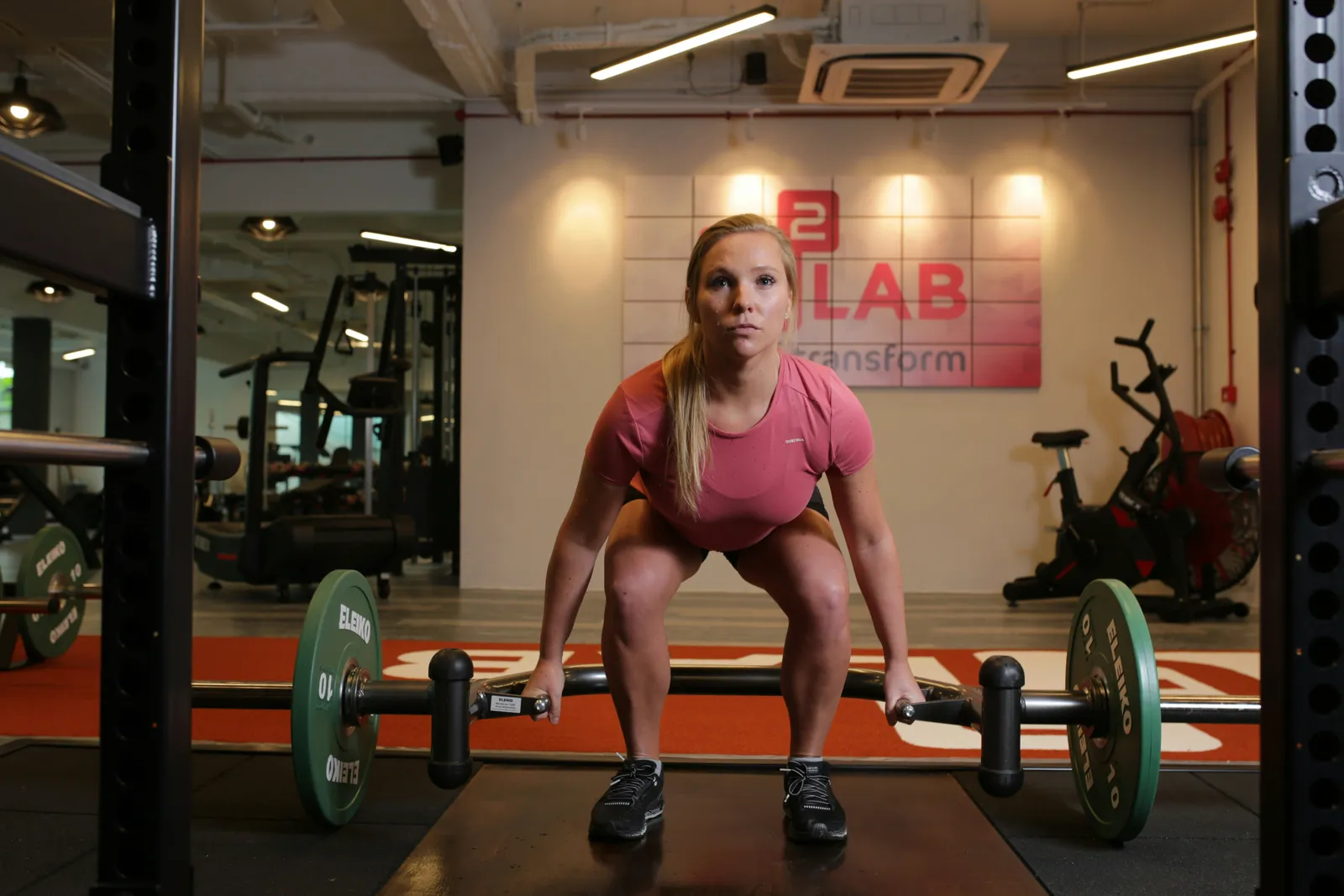
2. Romanian deadlift (RDL)
The RDL is the hip-hinge counterpart to the hip thrust. While the thrust trains hip extension from a horizontal position, the RDL trains it from a vertical loaded position, which carries over to deadlifts, squats, and everyday picking-things-up. It also trains the hamstrings hard, which is a feature, not a bug. Strong hamstrings protect the knees. For the full case for hinging heavy, from bone density to grip strength, see the benefits of deadlifts. The kettlebell swing is the ballistic, glute-driven version of the same hinge; our kettlebell exercises for women guide covers how to do it safely.
Form cues:
- Stand with feet hip-width apart, bar in front of thighs
- Soft bend in the knees (not a deep squat), maintained throughout
- Push hips back as if closing a door behind you; bar slides down the thighs
- Stop when you feel a strong hamstring stretch, typically just below the kneecap
- Drive hips forward to stand up, squeezing glutes at the top
- Bar stays close to the legs the entire time
Sets and reps: 3-4 sets of 8-10 reps. The RDL rewards moderate weight and impeccable form over going heavy with bad mechanics.
3. Bulgarian split squat
Yes, this exercise gets disproportionate attention in lifting culture. It earns it. The Bulgarian split squat (rear-foot-elevated split squat) trains each leg unilaterally, exposes left-right imbalances (which most lifters have), and produces high gluteus medius and maximus activation. It is also extremely hard at moderate weights, which is part of why people avoid it.
Form cues:
- Standing leg about 2-3 feet in front of a bench; rear foot rests on bench (laces or toes, your preference)
- Hold dumbbells at your sides
- Most of your weight on the front leg
- Lower until the front thigh is parallel or just below; back knee approaches but does not slam the floor
- Drive through the front heel to stand up
- Keep the torso roughly vertical
Sets and reps: 3 sets of 8-10 reps per leg. Start with 15-25 lb dumbbells; you will be humbled. Build up over weeks.
4. Reverse lunge (walking or stationary)
Trains unilateral hip extension with a forward shin angle that emphasizes the glutes more than a regular forward lunge. The reverse direction also reduces knee stress for women with cranky knees, which is a meaningful proportion of the over-40 population.
Form cues:
- Start standing, dumbbells at sides
- Step one leg back 2-3 feet; lower until both knees are at 90 degrees
- Drive through the front heel to return to standing
- Alternate legs, or do all reps on one side before switching
Sets and reps: 3 sets of 8-12 reps per leg.
5. Single-leg hip thrust
Once the barbell hip thrust feels easy at a heavy weight, the single-leg version exposes imbalances and demands more stabilization from each side. It is also a useful at-home alternative when you do not have a barbell, since bodyweight on one leg is meaningful resistance.
Form cues:
- Same setup as barbell hip thrust but one leg extended straight in front
- Drive through the planted heel to lift hips
- Keep hips level; do not let the lifted side drop
- Squeeze at the top, lower with control
Sets and reps: 3 sets of 8-12 per leg.
6. Loaded step-up
Carries the most direct everyday-life crossover (stairs, getting up off the floor) and trains the same hip-extension pattern as the lunge but with more emphasis on the working leg.
Form cues:
- Box or step at knee height or slightly above
- Hold dumbbells at sides
- Step up by driving through the front heel; do not push off the back foot
- Stand fully on the box; lower with control
- Alternate legs
Sets and reps: 3 sets of 8-12 per leg. Use a higher box for more glute emphasis; lower box increases the quad demand.
7. Glute bridge (the entry-level hip thrust)
If you have never trained your glutes seriously, or you are coming back from an injury, start here before adding the bench. The glute bridge is the floor-version of the hip thrust: same movement pattern, smaller range of motion, lower load. Useful as a warmup move or as the main glute exercise for the first 2-4 weeks of training.
Form cues:
- Lie on the floor, knees bent, feet flat about hip-width, heels close to the glutes
- Drive through the heels, lift hips toward the ceiling
- Squeeze the glutes at the top, hold 1-2 seconds
- Lower slowly
Sets and reps: 3 sets of 10-15 unweighted; progress to a dumbbell on the hips, then to the bench (hip thrust).
How to program glute training (the part nobody else covers properly)
This is where most articles fail. They list 12 exercises and call it a workout. A list is not a program.
Weekly frequency (2x glute-focused work)
The Schoenfeld 2019 frequency meta-analysis showed that training a muscle 2 or more times per week produces more hypertrophy than training it once, but going from 2 to 3+ adds little when total weekly volume is matched. The practical conclusion: train glutes hard 2 times per week. More is not better unless you are an elite competitor.
A common split for women lifting 3-4 days a week:
- Day 1 (Monday): heavy glute focus (hip thrust, RDL, accessory)
- Day 2 (Thursday): unilateral glute focus (Bulgarian split squat, reverse lunge, single-leg hip thrust)
You can also fold glute work into a full-body split or an upper/lower split; the volume matters more than the day naming.
Sets, reps, and RPE (the numbers)
The Schoenfeld 2017 dose-response meta-analysis showed that weekly resistance training volume has a roughly linear relationship with hypertrophy up to about 10+ sets per muscle group per week, with diminishing returns beyond. The practical target for glutes:
- 12-20 hard sets per week, split across 2 sessions
- 6-10 sets per session, distributed across 3-4 exercises
- 6-10 reps for the heavy compound work (hip thrust, RDL) at RPE 7-8 (2-3 reps left in the tank)
- 8-15 reps for accessory work (Bulgarian, lunge, step-up, single-leg hip thrust) at RPE 8-9 (1-2 reps left)
- Rest: 2-3 minutes between heavy compound sets; 60-90 seconds between accessory sets
If you do not know what RPE means, it is a 1-10 scale of how hard the set was, where 10 means you could not have done another rep and 7 means you had 3 reps in reserve.
Progressive overload for glutes specifically
Progressive overload is the principle that you need to give your muscles a slightly bigger challenge over time. For glutes, this looks like:
- Add weight when you hit the top of the rep range with good form. If you got 10 reps last week, add 5 lb and shoot for 8 reps this week.
- Or add reps within a range. If you did 3 sets of 8 last week, aim for 3 sets of 9 or 10 this week with the same weight.
- Or add a set. If you did 3 sets of 8 last week, try 4 sets of 8 next week.
Pick one variable to push per session, not all three. Track your numbers; you cannot progressively overload if you do not remember what you did.
A 4-week starter template
This is a concrete plan. Use it for 4 weeks, then evaluate and adjust.
Day 1 (heavy glute):
- Barbell hip thrust: 4 sets of 8, RPE 7-8
- Romanian deadlift: 3 sets of 10, RPE 7-8
- Step-up: 3 sets of 10 per leg, moderate dumbbells
Day 2 (unilateral glute):
- Bulgarian split squat: 3 sets of 8 per leg, RPE 8
- Reverse lunge: 3 sets of 10 per leg, moderate dumbbells
- Single-leg hip thrust: 3 sets of 10 per leg, bodyweight or light dumbbell
Total weekly hard sets: 13. That is in the sweet spot for someone starting or returning to focused glute training. After 4 weeks, increase to 16-18 sets total if you recover well; otherwise hold and progress the weights.
For broader programming context, our strength training program for women over 40 lays out a 12-week framework that this glute work fits inside.
Glute workouts for women at home (no barbell)
You can build glutes at home without a barbell. The exercises shift to dumbbell and bodyweight variants, and the weights stay lower, but the same principles apply: progressive overload, twice weekly, 12-20 sets.
Dumbbell hip thrust
Same setup as the barbell version but with one dumbbell across the hips. Works up to about 50-70 lb before you run out of dumbbell options at home. Beyond that, switch to single-leg variants for added difficulty.
Single-leg bodyweight variants
The single-leg hip thrust, single-leg Romanian deadlift, and Bulgarian split squat are home-friendly because bodyweight on one leg is meaningful resistance. These will dominate an at-home glute program once you have outgrown the dumbbell hip thrust.
Goblet squat
Hold a dumbbell or kettlebell at chest height, squat to depth, drive up through the heels. Excellent home-gym staple for glute and quad development.
A 30-minute at-home glute workout
- Warmup: 5 minutes of glute bridge, banded clamshell, monster walk
- Goblet squat: 3 sets of 10
- Dumbbell hip thrust: 3 sets of 12
- Bulgarian split squat: 3 sets of 8 per leg
- Single-leg hip thrust: 3 sets of 10 per leg, bodyweight
- Reverse lunge: 2 sets of 10 per leg
That is 14 hard sets in about 28-30 minutes. Run it twice a week.
Activation / warmup exercises (where the rehab moves belong)
These exercises do useful work, but they are warmup material, not main-work material. Cleveland Clinic’s article ranks clamshells and fire hydrants as “best glute exercises,” which is wrong for someone trying to actually build glutes. They are fine to wake up the glute medius before heavy work; they will not produce growth or strength gains as a primary workout.
Glute bridge (unweighted)
10-15 reps as a warmup move. If this is also your main glute exercise, you are not training, you are doing morning mobility.
Banded clamshell
Lie on your side, knees bent, band around the lower thighs, top knee opens against band tension. 10-12 reps per side. Wakes up the glute medius.
Monster walk (banded)
Band around ankles or just above the knees, half-squat stance, step laterally with tension on the band. 10-12 steps each direction. Glute medius and minimus.
5-minute pre-workout protocol
- Glute bridge: 10 unweighted reps
- Banded clamshell: 10 per side
- Monster walk: 10 steps each way
- Bodyweight hip thrust: 8 reps with a 2-second hold at top
Total time: ~5 minutes. Done before your heavy work, every session.
What to skip
- Booty bands as primary training. They are fine as a warmup tool. They will not produce meaningful glute growth as your only training. The resistance maxes out around 20-30 lb of effective tension; you need to load heavier than that to build muscle in healthy adults.
- 30-day “glute challenge” plans. Most are rehab-tier work disguised as a program. If the plan does not include progressive overload and barbell or heavy dumbbell loading, it will not build glutes.
- “Lift your butt without weights” aesthetic content. Bodyweight glute work is fine for beginners and at-home situations, but the marketing promise that you can transform glute shape with no weight is misleading. You need load.
- BBL and cosmetic adjacencies. Brazilian butt lifts are a surgical procedure with real mortality risk per medical literature. We do not write about cosmetic surgery; we are not the right resource for that decision.
- Kneeling cable kickbacks loaded heavy. The form breaks before the load gets useful for most lifters. Use them as a finisher with light weight and high reps if you like them; do not make them the centerpiece.
- Doing only squats and expecting glute growth. Squats are great. They train the quads more than the glutes per the Contreras EMG data. If your only lower-body lift is the squat and your glutes are not growing, this is why. Add hip thrusts.
Equipment notes
- A bench is the only real requirement for serious glute work, for the barbell hip thrust.
- A barbell pad keeps the bar from digging into your hips. Many gyms have them; if yours does not, bring one or use a folded towel.
- A lifting belt is useful once your RDL or hip thrust is in serious-weight territory (typically 1x bodyweight or above). See our weightlifting belt for women buyer’s guide for what to look for.
- Lifting shoes (heeled, hard sole) help with squats and accessories where ankle mobility limits depth. See our women’s olympic lifting shoes guide.
Related reading
- Strength Training for Women Over 40: The Cornerstone Guide, the foundational principles every glute workout sits inside.
- Strength Training Program for Women Over 40: A 12-Week Plan, the structured plan to apply the glute work to.
- Leg Exercises for Women: The 5-Movement Leg Day, the lower-body movement guide that pairs with this glute pillar.
- Back Workout for Women: The 4-Exercise Framework, the upper-body sibling article.
- Perimenopause Workout Plan, the 8-week perimenopause-specific program where glute work fits naturally.
- Strength Training for Perimenopause: A Starter Program, the perimenopause-specific training context.
- Low Estrogen Symptoms, the bone-density and hip-strength reasons this matters more after 40.
- Weightlifting Belt for Women, when to start using a belt for heavy hip thrusts and RDLs.
The point of training your glutes is not aesthetic. It is functional independence at 70 and a back that does not hurt at 50. Build the program: 2 sessions a week, 12-20 hard sets, progressive overload, the seven exercises ranked above, and 4-week reassessment cycles. Track your weights. Skip the booty bands as primary work. The results take 3 months to start seeing and 6 months to become obvious. That is not a marketing failure; that is how muscle works.