If you’ve been squatting in running shoes and your knees keep caving in, or your heels lift off the floor at the bottom of the squat, or your torso pitches forward like you’re trying to pick up something off a low shelf, the problem is probably your footwear. Olympic lifting shoes solve all three. Most articles on women’s olympic lifting shoes either pretend Converse Chuck Taylors are an olympic lifter (they aren’t) or list eight cross-training shoes that happen to be marketed at women. This one tells you what an olympic lifter actually is, how to pick one for your body, and which specific shoes are worth buying.
The brand-voice short version: an olympic lifting shoe has a raised heel (15-20 mm), a hard non-compressible sole, and a secured midfoot. If a shoe in the list is missing any of those, it isn’t an olympic lifter, regardless of what the marketing copy says.
TL;DR
- The best women’s olympic lifting shoe for most lifters is the Adidas Adipower 3 (0.75 inch heel, hard TPU sole, durable across years of training). Best lower-heel alternative: Nike Romaleos 4.
- Best for crossover with CrossFit: Reebok Legacy Lifter II or Nike Savaleos (more flexible forefoot).
- Best budget pick: Adidas Powerlift 5, the entry-level version of the Adipower line.
- Heel height matters: 0.75 inch suits taller women, women with stiff ankles, or anyone with longer femurs; 0.6 inch suits shorter women with good ankle mobility.
- Skip: Converse for olympic lifting (flat sole), Vivobarefoot (flat), running shoes (compressible sole), and “lifestyle” lifters marked up over the training version.
Who this is for
You are a woman over 40 (give or take) who has started taking the squat seriously. Maybe you’ve been training for a year on a starter program and the weights are getting heavy enough that footwear matters. Maybe your knees track inward and you’ve heard the fix is a raised heel. Maybe you’re entering perimenopause and your ankle mobility has noticeably decreased. You don’t need a marketing rundown of fifteen “weightlifting-style” shoes; you need to know which actual olympic lifters are worth the money and how to pick one for your body. That’s what this article is.
What olympic lifting shoes actually do
The raised heel (and why it matters for the squat)
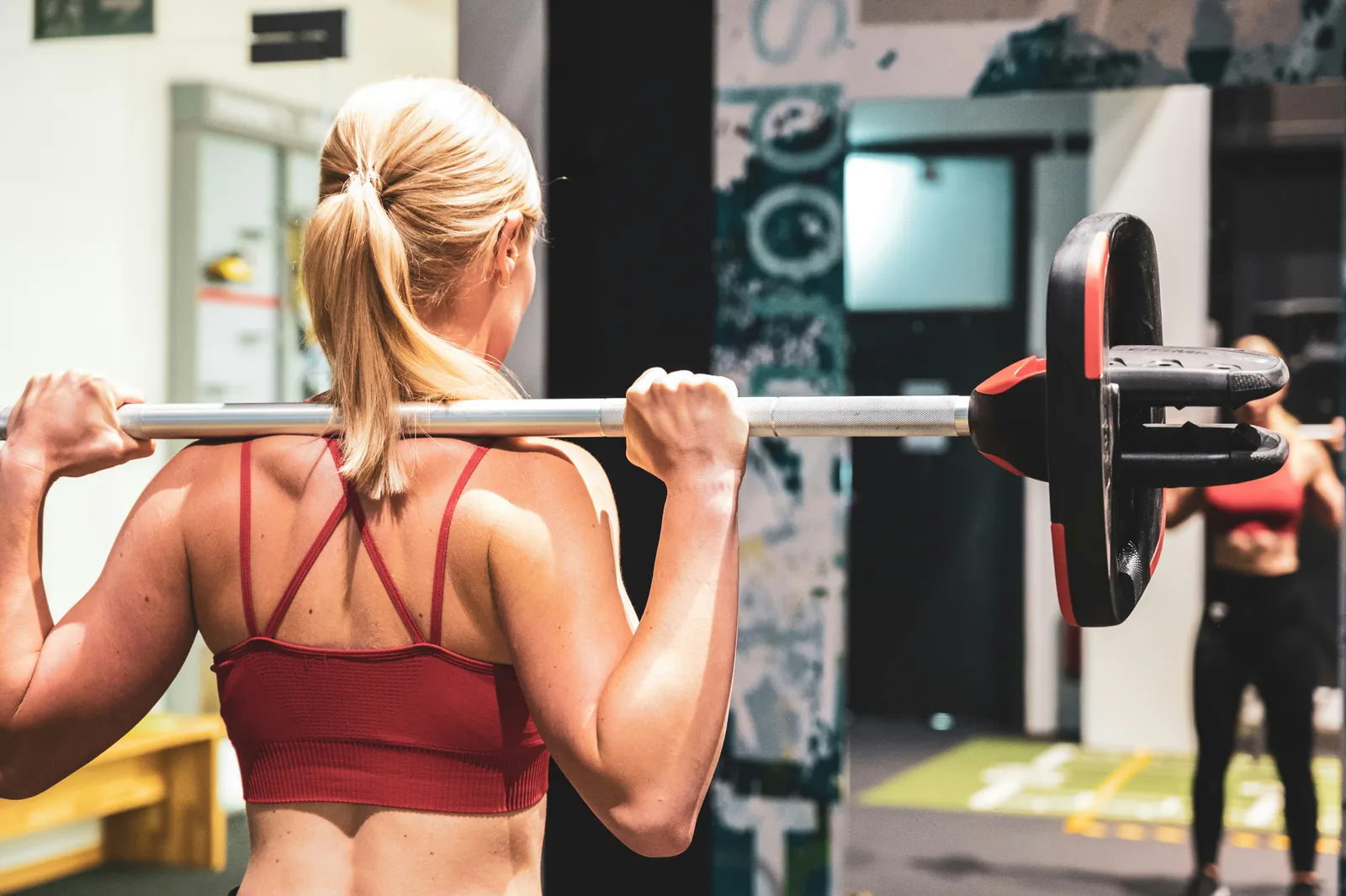
An olympic lifting shoe has a wedge-shaped heel that elevates the back of the foot 15 to 20 millimeters (0.6 to 0.75 inches) above the forefoot. This single feature is the reason these shoes exist. The raised heel does three useful things in a squat:
- Compensates for limited ankle dorsiflexion. Many women, especially those who sit at a desk most of the day, can’t reach the ankle flexion needed for a deep, upright squat. The heel lift effectively gives you back the ankle range you don’t have. The Sato 2012 study in the Journal of Strength and Conditioning Research (PMID 22201687) measured this directly: lifters in weightlifting shoes hit deeper, more upright back squat positions than the same lifters in flat shoes.
- Allows a more upright torso. With more available ankle range, your knees can travel further forward, which means your hips don’t have to rotate back as far. The result is a more vertical torso, which keeps the bar over the midfoot and reduces stress on the lower back.
- Improves quad activation. The more upright squat position shifts load slightly toward the quads and away from the lower back. For women who want their squat to actually train their legs (rather than feel like a back exercise), this is the point.
The hard sole (and why running shoes fail here)
The sole of an olympic lifting shoe is made of compressed wood, dense TPU plastic, or a similar non-compressible material. This matters because any energy that compresses into your shoe at the bottom of a heavy squat is energy that doesn’t go into standing up. A running shoe’s cushioned midsole compresses unevenly under load, which translates to wobbling, instability, and a meaningfully harder squat.
Try this if you’re unsure: put 80% of your one-rep-max squat on the bar and squat in your normal running shoes, then squat in flat shoes, then squat in actual lifters. The difference is obvious by the second rep.
The midfoot strap (and what it’s for)
The strap across the midfoot isn’t decorative. It secures your foot to the shoe so the energy you generate transfers cleanly through the heel. Without it, the shoe’s hard sole becomes a slipping hazard at the bottom of the squat. Tighten the strap so it’s firm but not painful. Most lifters tighten more than they think they need to.
When you need them vs. when you don’t
You need olympic lifting shoes if:
- You squat 2-3 times a week and your working weights are above 0.75x bodyweight
- Your ankles are limited (heels rise off the floor at the bottom of an unweighted squat)
- You do the olympic lifts (snatch, clean and jerk) or any meaningful overhead work
- You crossover into CrossFit and need stable footing for cleans and snatches
You probably don’t need them yet if:
- You’ve been training for less than 3 months
- Your working squat weights are under 0.5x bodyweight
- You only deadlift and do upper-body work (flat shoes or barefoot are correct for deadlifts)
- You haven’t decided whether strength training is going to stick
If you’re in that second category, our strength training cornerstone and the 12-week program will get you to the point where the shoes start to matter.
How to choose by heel height (the part nobody else covers)
The biggest decision after “should I get olympic lifting shoes” is how high a heel. Most articles skip this entirely. It’s the most important fitting question because heel height interacts with your body’s proportions and mobility.
0.75 inch heel (Adidas Adipower territory)
The standard high heel. Fits:
- Taller women (5’7” / 170 cm and up) whose femurs are proportionally long
- Women with limited ankle dorsiflexion (heel rises off the floor in an unweighted squat)
- Women over 40 with desk-job mobility (overlap with the above)
- Lifters who prefer a high-bar squat or do any olympic lifts
The Adidas Adipower 3, Nike Romaleos 4, Reebok Legacy Lifter II, and TYR L-2 all sit at this heel height. If you don’t know which heel suits you, this is the default to pick.
0.6 inch heel (Nike Romaleos territory, lower variants)
The lower standard. Fits:
- Shorter women (5’5” / 165 cm and under) whose anthropometry already favors a deep upright squat
- Women with excellent ankle mobility
- Powerlifters who emphasize low-bar squat and need less heel elevation
- Anyone who finds the 0.75 inch heel makes them feel “too forward”
The Adidas Powerlift series and Reebok Lifter PR variants sit closer to this height. If the Adipower feels like your knees are getting pushed too far forward, the Powerlift is your shoe.
Hybrid / lower heel: for CrossFit and crossover use
A small category of “hybrid” lifters has a moderate heel (around 0.5 inch / 13 mm) and a slightly more flexible forefoot for double-unders, box jumps, and short runs. Nike Savaleos is the example. You give up some squat performance for the ability to do an entire CrossFit workout in one shoe.
The ankle mobility angle (especially over 40)
Ankle mobility declines with age, sedentary work, and a history of ankle sprains. If you’ve ever sprained an ankle badly, or you sit eight hours a day, or you’re over 50, assume your ankles are stiffer than you’d like and lean toward the higher heel. You can also do ankle mobility work to improve dorsiflexion (calf stretches, ankle rocks against a wall, weighted dorsiflexion), but the shoe is the faster fix.
Sizing for women: the unisex-shoe problem
Most olympic lifting shoes are manufactured in unisex sizing. This means a women’s US 9 isn’t always labeled as a women’s 9. Some brands sell you “men’s US 7.5” and call it a women’s 9. Others split the difference.
The rough conversion (women’s US to men’s US)
| Women’s US | Men’s US |
|---|---|
| 6.5 | 5 |
| 7 | 5.5 |
| 7.5 | 6 |
| 8 | 6.5 |
| 8.5 | 7 |
| 9 | 7.5 |
| 9.5 | 8 |
| 10 | 8.5 |
Most brands round to the nearest half size, so check the brand’s specific size chart before ordering. The general rule: take your normal US women’s running shoe size, subtract 1.5, and that’s the unisex (men’s) number you’d order. Different brands round differently.
Width and toe-box notes
- Adidas Adipower: standard width, runs slightly narrow through the midfoot. Women with wide feet sometimes find them tight.
- Nike Romaleos 4: narrower than Adipower, especially through the midfoot. Avoid if you have wide feet.
- Reebok Legacy Lifter II/III: widest toe box of the major brands. The best pick for wide feet.
- TYR L-2: medium width, comfortable for most.
- Inov-8 Fastlift 360: roomy toe box, snug midfoot. Good for women with wide forefoots but narrow heels.
When to size up or down
Order from a retailer with free returns and try them on with your lifting socks. Look for:
- Heel slips up when you walk: too big, size down
- Toes touch the front when you stand: too small, size up half
- Midfoot strap can’t be tightened without pain: too narrow brand for you, try a wider model
Our top picks for women’s olympic lifting shoes
Seven picks across price tiers. All prices approximate for US retail as of 2026. Order from a retailer with free returns whenever possible because unisex sizing makes the first pair a guess.
Best overall: Adidas Adipower 3
Price: ~$200. Heel: 0.75 inch / 20 mm. Sole: Hard TPU. Width: Standard, slightly narrow midfoot.
The default pick for most women’s lifters and the most-seen shoe on the platform at meets. The Adipower 3 is the third generation of Adidas’s flagship lifter, with a TPU heel wedge (durable, doesn’t compress over years), a single midfoot strap, and a leather/synthetic upper. The fit through the midfoot is snug; if you have wide feet, try the Legacy Lifter II first. Available on Amazon: Adidas Adipower Weightlifting 3. Adidas’s own store also stocks the women’s colorways if Amazon is out of your size.
Best lower-heel: Nike Romaleos 4
Price: ~$200. Heel: 0.78 inch / 20 mm (specs slightly vary by colorway). Sole: Hard plastic. Width: Narrow.
The Romaleos 4 is the successor to the legendary Romaleos 2 (which is still the favorite of many older lifters). It’s a slightly narrower shoe than the Adipower with a similar heel height and slightly different strap geometry (dual straps on some colorways). If your foot is on the narrower side and the Adipower felt sloppy, the Romaleos is your shoe. Available on Amazon: Nike Romaleos 4.
Best for wide feet: Reebok Legacy Lifter II
Price: ~$200. Heel: 0.86 inch / 22 mm (slightly taller than Adipower). Sole: Hard plastic. Width: Widest in this category.
The Legacy Lifter II is what you buy if Adipowers and Romaleos both feel too narrow. The toe box is meaningfully wider, the heel is a hair taller, and the dual midfoot straps secure the foot well even at the wider width. The shoe is slightly heavier than the Adipower (which doesn’t matter for squats but does for snatch/clean if you’re competing). Available on Amazon: Reebok Women’s Legacy Lifter II.
Best newer model: Reebok Legacy Lifter III
Price: ~$220. Heel: 0.86 inch / 22 mm. Sole: Hard plastic with slightly more flex than the II. Width: Wide.
The III is Reebok’s update to the II, with a slightly more flexible forefoot and updated upper materials. If you want Reebok’s wide-foot fit but the latest construction, this is the pick. Reviews are split on whether the III is meaningfully better than the II; if you can find the II discounted, that’s the better value. Available on Amazon: Reebok Women’s Legacy Lifter III.
Best hybrid (CrossFit crossover): Nike Savaleos
Price: ~$125. Heel: 0.6 inch / 15 mm. Sole: Semi-rigid (more flexible than dedicated lifters). Width: Standard.
The Savaleos is Nike’s answer to “I want one shoe for lifting and CrossFit.” Lower heel, more forefoot flex, and a sole that lets you do double-unders and short runs without feeling like you’re wearing concrete. You give up some pure-squat performance for the versatility. If your weekly training is half lifting and half mixed-modal, this is the smart pick. Available on Amazon: Nike Savaleos Weightlifting Shoes.
Best budget: Adidas Powerlift 5
Price: ~$100. Heel: 0.6 inch / 15 mm. Sole: EVA midsole with hard heel insert. Width: Standard.
The Powerlift line is Adidas’s entry-level lifter. The sole is less rigid than the Adipower (it uses a dense EVA midsole rather than full TPU), which means slightly more compression under heavy weight but a much friendlier price. For lifters whose working squat is under 0.75x bodyweight, the Powerlift’s stiffness is more than enough. Most lifters who eventually upgrade to the Adipower start here, and it’s a fine 1-2 year shoe. Available on Amazon: Adidas Powerlift 5.
Best splurge / newer entrant: TYR L-2 Lifter
Price: ~$220. Heel: 0.83 inch / 21 mm. Sole: Hard TPU. Width: Medium.
TYR (better known for swim gear) entered the weightlifting shoe market in 2022 with the L-1, and the L-2 is the refinement. Wider toe box than Adidas, narrower than Reebok, with a hard TPU heel wedge and aggressive lateral support. Newer brand on the platform, so longevity data is less established, but early reviews from competitive lifters are strong. If you want something not-Adidas-not-Nike, this is the leading newer option. Available on Amazon: TYR L-2 Lifter.
Alternative: Inov-8 Fastlift 360
Price: ~$170. Heel: 0.65 inch / 16.5 mm. Sole: Hard sole with grippy rubber outsole. Width: Roomy toe box.
The Fastlift 360 is the British alternative for lifters who want a lighter-weight, more breathable shoe. Lower heel than the Adipower, roomier toe box than most, and a meshy upper. The trade-off is a slightly less rigid feel under heavy load. Good for women who do a mix of weightlifting and conditioning work, less ideal as a pure max-effort squat shoe. Available on Amazon: INOV8 Fastlift 360.
What to skip
The supplement-industry-equivalent in lifting-shoe marketing is real. Things to skip:
- Converse Chuck Taylors as an “all-around lifting shoe.” Chucks are excellent for deadlifts and low-bar powerlifting squats because they’re flat. They are NOT an olympic lifter and should not be the only shoe you own if you squat seriously. Shape’s roundup recommended Chucks for weightlifting; that’s a category error.
- Vivobarefoot or other barefoot/zero-drop shoes for olympic lifting. They have no heel elevation. Same category error.
- Running shoes for any lifting. The compressible midsole is the opposite of what you want.
- “Women’s-specific” colorway upsells. Most women’s lifters are the same unisex shoe in a different color, sold at a $20-40 markup. The functional shoe is the men’s or unisex listing.
- “Lifestyle” lifters. NoBull’s Outwork (and similar) are training shoes designed to look like weightlifting shoes. They have a slightly raised heel but a compressible midsole. Marketed at people who want the gym aesthetic without the platform commitment.
- Used weightlifting shoes that show heel-wedge wear. The hard sole is the longevity feature; if the heel is visibly compressed or cracked, the structural integrity is gone.
- The Adipower or Romaleos 1 or 2 from eBay. These are old shoes and the polyurethane heel wedges of the older Adipower 1/2 generations sometimes delaminate. Buy current generation.
How to actually use them (the practical part)
Break-in period
Olympic lifting shoes feel weird for the first 2-3 sessions. You’ll notice your squat depth changes, your knees feel “more involved,” and your balance is off. This is normal. Squat in them for two weeks before deciding whether they’re right. If they’re still uncomfortable after 4-6 sessions, the fit is wrong, not the concept.
What to lift in them and what not to
- Yes: back squat, front squat, overhead squat, snatch, clean, jerk, push press, push jerk, split jerk, any overhead pressing where you want a stable base.
- No: deadlifts (use flat shoes or barefoot), running, jumping, conditioning, anything with significant lateral movement.
A common home-gym setup: olympic lifters for the squat/overhead day, flat shoes (or barefoot) for the deadlift/pull day.
Care and longevity
- Wipe down after each session if you sweat heavily; the leather/synthetic upper holds moisture.
- Loosen the strap fully when storing so it doesn’t permanently deform.
- Don’t wear them outside the gym; the hard sole picks up debris that can scratch a platform.
- 5-10 years of normal home-gym use is realistic before the strap or upper fails. The sole almost never wears out first.
When to replace
Replace when:
- The midfoot strap won’t tighten anymore (the most common failure)
- The heel feels less stable side-to-side
- The upper has a structural tear (not just a scuff)
- You can see the heel wedge has compressed (rare, mostly older models)
Most lifters get 5+ years out of a single pair. Compared to running shoes that die in 12 months, olympic lifting shoes are the best cost-per-year investment in your gym.
Related reading
- Strength Training for Women Over 40: The Cornerstone Guide, the foundational programming guide that the squat sits at the center of.
- Strength Training Program for Women Over 40: A 12-Week Plan, the structured plan to apply the lifters to.
- Leg Exercises for Women: The 5-Movement Leg Day, the squat-focused movement guide.
- Weightlifting Belt for Women: An Honest Buyer’s Guide, the companion gear piece on what to wear, not just on your feet.
- Strength Training for Perimenopause: A Starter Program, the perimenopause-specific training plan where stiff ankles and slower recovery make a heeled shoe more useful.
The honest short version: most women lifting weights over 40 will eventually want olympic lifting shoes. The Adipower 3 is the right answer for most of you. If you have wide feet, the Reebok Legacy Lifter II. If you crossover into CrossFit, the Savaleos. If you’re still figuring out whether you’re going to keep lifting, the Powerlift 5 at $100 is the rational starting price. The shoes last a decade. The squat depth improvement starts the first session. Buy the right pair once and they pay off across years of training.