If you train for strong hips and glutes, the hip thrust is the most efficient way to load them heavily without putting a bar on your back. It is also the most over-sold exercise on the internet. This guide is written for women 40 and up: how to set the lift up for a real body, how much weight is a good number at your age, and what the research says it does and does not do.
Most hip thrust guides stop at three lines of form cues and a video. You will get the setup details that keep the bar from bruising your hip bones, a standards table built from more than 224,000 lifts logged by women, and the training studies that every “best glute exercise ever” headline leaves out.
The short answer
- What it is: hip extension with your upper back on a bench and a padded barbell across your hips. It trains the glutes harder than almost any other lift.
- How to start: 3 sets of 12-15 with bodyweight, then a 20-35 lb dumbbell, then the empty 45 lb barbell.
- How to train it: twice a week, 3 sets of 8-12, stopping 2-3 reps short of failure. Add 5-10 lb when every set reaches 12 reps.
- What a solid number looks like: for a woman of 50, a one-rep max around 124 lb is “novice” and around 199 lb is “intermediate” in Strength Level’s data. Sets of 10 run at roughly 70-75% of that.
- What it won’t do: beat the squat for glute growth, build bone density on its own, or burn belly fat.
What is a hip thrust?
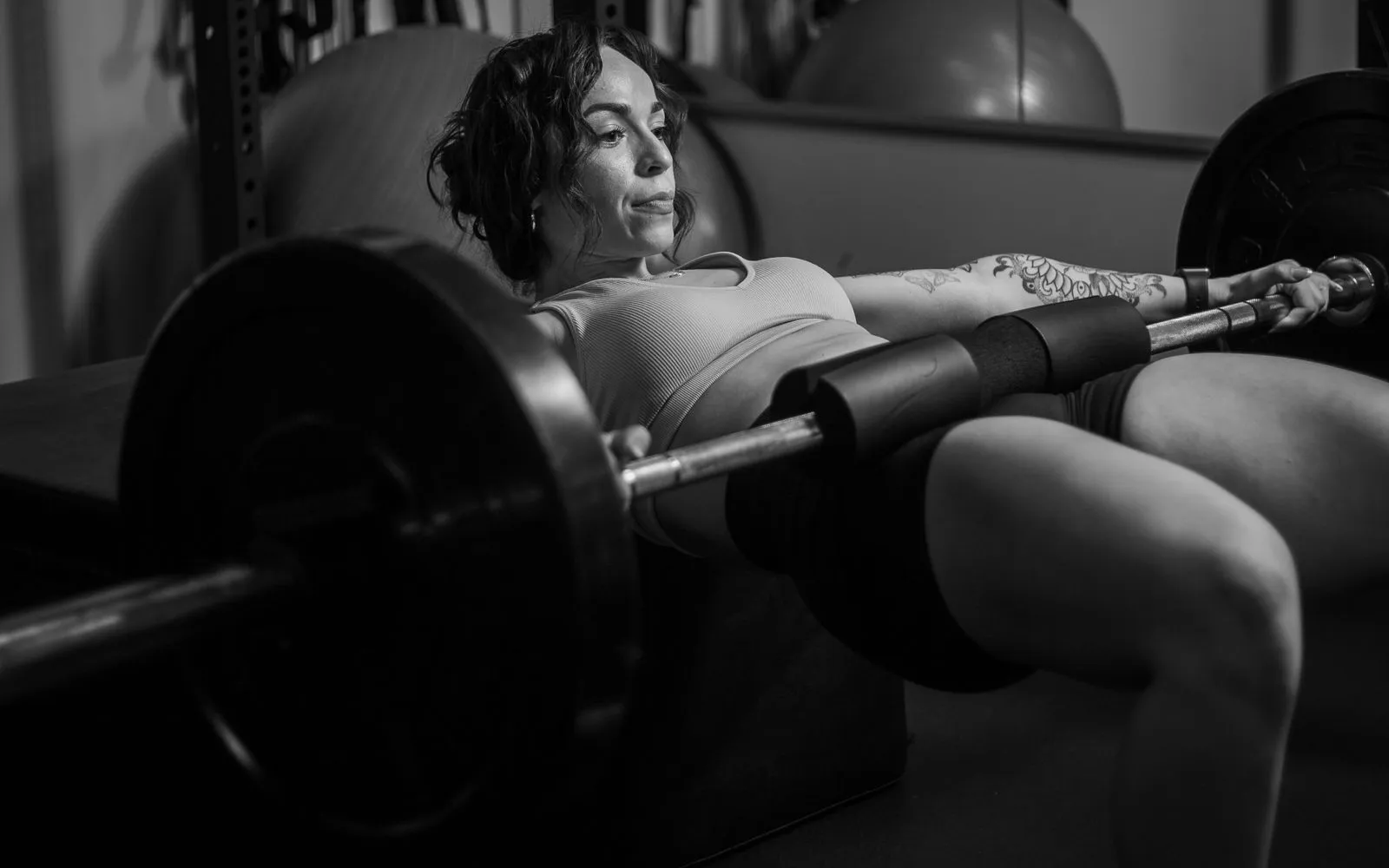
A hip thrust is a glute exercise where you rest your upper back on a bench, roll a weight over your hips, and drive your hips up until your knees, hips, and shoulders form a straight line. Think of it as a loaded glute bridge with a longer range of motion. Because the weight sits on your pelvis instead of your shoulders, you can push heavy loads with nothing pressing down on your spine.
The barbell version is the standard. Dumbbells, bands, and bodyweight versions follow the same pattern and are covered below.
Hip thrust muscles worked
- Gluteus maximus: the prime mover, upper and lower fibers. This is the largest single muscle in your body and the one the hip thrust is built around.
- Hamstrings: assist hip extension, but far less than in a Romanian deadlift.
- Quads: they hold your knee angle. In the EMG study below, quad activity in the hip thrust was statistically no different from the back squat.
- Adductors and glute medius: stabilize your knees and pelvis, more so with a band around your knees.
- Spinal erectors and core: hold your torso rigid, like a plank that moves at the hips.
Why the hip thrust matters after 40
It loads your glutes harder than almost anything else
The case for the hip thrust starts with muscle activation. In a study of 13 trained women, the barbell hip thrust produced roughly double the glute EMG activity of the back squat at the same relative effort: mean upper glute max activation of 69.5% versus 29.4% of maximum, with lower glute max showing the same pattern. No other common lift puts the glutes under that much tension at the top of the movement, where they are fully shortened.
Keep that finding in proportion. EMG measures how hard a muscle is working during the lift, not how much it grows over months. The training studies tell a more modest story, which we get to in the next section.
Hip extension is the strength you use on stairs and getting up
Climbing stairs, standing up from a low chair, getting up off the floor, pushing a heavy door, catching yourself when you trip: all of it is hip extension, and the glute max does most of the work. The hip thrust trains that exact action with heavy load, through the range you use when you stand up straight.
That makes it a useful complement to the hinge in a deadlift, which trains hip extension from a bent-over position. One trains the bottom of the movement, the other finishes the top.
Heavy lower-body work without a bar on your back
The bar sits across your hips, not your shoulders, and you never bend over to pick it up from the floor. For women with a cranky shoulder, a sensitive neck, or a back that is not ready for heavy squats, that matters. You can train your hips hard on the days your back needs a break, and you can usually load more weight than you squat: among women logging lifts on Strength Level, the average hip thrust (225 lb) is about a third heavier than the average squat (167 lb).
Menopause and muscle loss: where this fits
Muscle loss in midlife is measurable. A Finnish study that followed 234 women aged 47 to 55 from perimenopause into early postmenopause found significant drops in lean mass, leg lean mass, and thigh muscle size across the menopausal transition, and physically active women held on to more of it.
Your glutes and thighs are the biggest block of muscle you own, so training them heavily is one of the highest-return things you can do this decade. The hip thrust is one good tool for it, not the whole toolbox. For the bigger picture of training through the transition, see strength training for perimenopause.
What the hip thrust won’t do
It isn’t better than squats for glute growth
Two training studies have compared the lifts head to head, and neither crowned the hip thrust.
- In 22 well-trained women over 12 weeks, the squat-only group grew their glute max thickness by 9.4% versus 3.7% in the hip thrust group. Both groups improved their hip thrust one-rep max by a similar amount, but only the squat group made large squat gains.
- In 34 untrained adults over 9 weeks, MRI showed similar glute growth from hip thrusts and squats, while the squat also grew the quads and adductors.
The honest read: a lift that lights up the glutes is not automatically the one that grows them most. The hip thrust earns a place as an addition to squats and hinges, not as a replacement for them.
No trial shows it builds bone density
You will see “improves bone density” on hip thrust benefit lists. There is no trial behind it. The best bone evidence for postmenopausal women comes from the LIFTMOR trial: 101 women around age 65 with low bone mass did 8 months of twice-weekly heavy lifting at 5 sets of 5 above 85% of their max, and their lumbar spine bone density rose 2.9% while the control group lost 1.2%. At the hip (femoral neck), the lifters held steady at +0.3% while the control group lost 1.9%.
The program was built on the deadlift, squat, and overhead press plus jumping chin-ups with firm landings, the same protocol the researchers carried into the LIFTMOR-M trial in older men. The hip thrust was not part of it. The same thing that makes the hip thrust easy on your back, no load running down through your spine and legs, is why it should not count as your bone work. Keep a squat and a deadlift in your week, and consider a weighted vest for loaded walking.
It won’t burn belly fat
People ask whether hip thrusts reduce belly fat or slim the waist. They do neither. No exercise removes fat from one spot. The hip thrust’s contribution to body composition is the muscle it builds and keeps while your diet does the fat-loss work. Our guide to ab exercises for menopause covers what actually changes your midsection.
How to do a hip thrust
- Set up against the bench. Sit with the bottom edge of your shoulder blades on a stable flat bench, about 16 to 17 inches high.
- Roll the bar into your hip crease. Pad on the bar, rolled over your legs until it sits just below your front hip bones.
- Plant your feet. Flat, about hip-width, close enough that your shins will be vertical at the top.
- Brace and tuck. Grip the bar just outside your hips, breathe in, tuck your chin, ribs down.
- Drive your hips up. Push through your whole foot until knees, hips, and shoulders form one straight line.
- Finish with your glutes. Squeeze for one second at the top with your pelvis slightly tucked. No lower-back arch.
- Lower under control. About two seconds down, hips stopping a few inches above the floor.
- Reset and repeat. New breath and brace each rep.
Bench height and setup
A standard flat bench, roughly 16 to 17 inches high, fits most women. Your upper back should contact the bench just below your shoulder blades, and the bench edge acts as a hinge point: your torso pivots around it rather than sliding up and down it. Push the bench against a wall, a rack, or a heavy dumbbell so it cannot slide away on the first rep.
At home, the edge of a firm couch works for bodyweight and dumbbell versions. It is lower and softer than a bench, so take a slightly wider stance and keep the reps controlled.
Getting the bar over your hips (and the pad question)
Getting a loaded bar onto your lap is the awkward part of this lift. Full-diameter bumper plates raise the bar high enough to roll it over your thighs while you sit on the floor. With small iron plates the bar sits too low, so either use bumpers or have a partner hand you the bar.
Use a pad. A heavy bar on bare hip bones hurts enough to make people quit the lift, and it is completely avoidable. You do not need anything fancy: the Iron Bull Strength Advanced Squat Pad is a thick, clip-on bar pad at about $20, and the Gymreapers bridge pad is a wider, contoured option at a similar price that spreads the load across more of your pelvis. A folded yoga mat works in a pinch. Spending more than $20-25 on a pad does not buy you anything that matters.
Hip thrust form cues
- Chin tucked, eyes forward. As your hips rise, keep looking ahead at the wall, not up at the ceiling. Your head and ribs move as one unit with your torso.
- Ribs down, pelvis slightly tucked at the top. The finish comes from your glutes, not from arching your lower back.
- Shins vertical at lockout. This is the single best check on foot position.
- Knees track over your toes. Do not let them cave in as you push.
- Full lockout, every rep. The last few inches are where the glutes do their hardest work. Pause for one second there.
Why don’t I feel hip thrusts in my glutes?
This is one of the most common questions about the lift, and it is almost always fixable.
- Hamstrings cramping: your feet are too far from the bench. Walk them in.
- Quads burning: your feet are too close. Move them out an inch or two.
- Lower back working: you are arching to finish. Tuck your chin, keep your ribs down, and think about pointing your pubic bone up at the top.
- Nothing much at all: the load is too heavy for your control. Drop 20%, pause one second at lockout, and slow the lowering to two seconds.
If you still feel it everywhere but your glutes, add a fabric loop band just above your knees and push your knees out against it. That extra glute medius demand is often enough to make the rest of your glutes switch on.
How much should you hip thrust? Standards for women
The average hip thrust one-rep max for women in Strength Level’s database is 225 lb, based on more than 224,000 lifts logged by women since 2017. Your numbers depend heavily on age, bodyweight, and training history. Here are Strength Level’s hip thrust standards for women by age, for a one-rep max in pounds including the bar:
| Age | Beginner | Novice | Intermediate | Advanced |
|---|---|---|---|---|
| 40 | 78 lb | 140 lb | 225 lb | 329 lb |
| 45 | 74 lb | 133 lb | 213 lb | 312 lb |
| 50 | 69 lb | 124 lb | 199 lb | 292 lb |
| 55 | 64 lb | 115 lb | 184 lb | 269 lb |
| 60 | 58 lb | 105 lb | 168 lb | 246 lb |
| 65 | 53 lb | 95 lb | 152 lb | 222 lb |
| 70 | 47 lb | 85 lb | 137 lb | 200 lb |
How to read it honestly: these are self-logged numbers from people who track their lifts in an app, so they skew toward trained lifters, and they are not lab norms. Strength Level defines beginner as about a month of practice, novice as about six months of regular training, and intermediate as about two years. Treat the table as a map of where women your age land, not a test you pass or fail.
Your starting weight
- Weeks 1-2: bodyweight only, 3 sets of 12-15 with a one-second pause at the top. Learn the setup and the finish.
- Weeks 3-4: a 20-35 lb dumbbell held across your hips, 3 sets of 10-12.
- Week 5 on: the empty barbell (45 lb, or a 35 lb women’s bar if your gym has one) with bumper plates, 3 sets of 10.
After about six months of regular training, Strength Level’s novice numbers put a woman in her late 40s at roughly 130 lb for a single rep. In practice that means working sets of 10 somewhere near 95 lb, which is the range our leg exercises guide treats as the point where hip thrusts start doing serious work.
How to progress
Use double progression. Pick a weight you can lift for 3 sets of 8 with 2-3 reps left in the tank. Each session, try to add a rep or two. When every set reaches 12 reps, add 5-10 lb and drop back to 8. It is slow, it works, and it keeps your form honest.
The most-logged hip thrust workout among women on Strength Level is 3 sets of 10, followed by 3 sets of 8 and 3 sets of 12. That lines up with what we recommend.
How to program hip thrusts (sets, reps, frequency)
- Frequency: twice a week, on non-consecutive days.
- Sets and reps: 3-4 sets of 8-12. Experienced lifters can run one heavier day of 3-4 sets of 6-8.
- Effort: stop with 2-3 reps left, about a 7-8 out of 10.
- Rest: 90 seconds to 2 minutes between sets.
- Placement: after your main squat or deadlift, or as the main lower-body lift on a day your back needs a break.
A simple two-day split:
| Day | Main lift | Hip thrust | Accessories |
|---|---|---|---|
| A | Squat, 3 x 5-8 | 3 x 10-12 | Walking lunge, row, plank |
| B | Deadlift or Romanian deadlift, 3 x 5-8 | 3 x 8 (heavier) | Step-up, press, side plank |
Across all your glute work, 12-20 hard sets a week is plenty for most women, which our glute workouts guide breaks down by exercise. If you want hip thrusts already built into a full plan, our 12-week strength training program for women over 40 programs them in all three phases, starting at 3 sets of 12 with 65-95 lb.
Hip thrust variations for home and gym
Dumbbell hip thrust
A single heavy dumbbell across your hips, held by both ends. It is the best home option and the natural step before the barbell. The limit is practical: past about 50-60 lb, a dumbbell gets hard to balance and to get into position, which is your sign to move to a bar.
Single-leg hip thrust
Same setup, one foot planted and the other leg extended or bent in the air. Bodyweight alone is a real challenge here, and it exposes side-to-side differences. Do 3 sets of 8-12 per leg, starting with your weaker side.
Banded hip thrust
Either a loop band above your knees (you push your knees out as you thrust) or a heavy band across your hips anchored under the bench legs. In a study of 13 women, the barbell version produced higher glute max activation than the band version, so treat bands as a home alternative or an add-on, not an upgrade. Buy one fabric loop band; latex mini bands roll up and snap, which is why we would skip most of them.
B-stance hip thrust
A staggered stance with one foot flat and the other heel lifted a few inches forward, so the flat leg does most of the work. It sits between the two-leg and single-leg versions and lets you load one side more heavily than a true single-leg rep.
Bodyweight hip thrust at home
A couch edge and your bodyweight. Make it harder without weight by pausing three seconds at the top, slowing the lowering to four seconds, or doing “1.5 reps” (all the way up, halfway down, all the way up, then all the way down).
If your gym has a plate-loaded hip thrust machine, it is a perfectly good way to train the lift without fiddling with a barbell. It is not worth buying one for a home gym; a bench, a bar, and a $20 pad do the same job.
Hip thrust vs glute bridge
The glute bridge is the floor version of the hip thrust: same movement, shoulders on the ground instead of a bench.
| Hip thrust | Glute bridge | |
|---|---|---|
| Setup | Upper back on a bench | Shoulders on the floor |
| Range of motion | Longer: hips start near the floor | Shorter: hips travel a few inches |
| How heavy it goes | Heaviest; a barbell loads well past bodyweight | Moderate; the short range limits load |
| Best for | Your main glute strength lift | Learning the pattern, warmups, high reps, no bench |
Choose the glute bridge if you are brand new, coming back from injury, or training without a bench. Move to the hip thrust once bodyweight bridges for 15 controlled reps feel easy.
Romanian deadlifts and hip thrusts are not either-or either. The RDL trains the hamstrings and glutes in a stretched position through a hinge; the hip thrust trains the glutes hardest at full hip extension. A good program uses both.
What to skip
- Hip thrusting every day. Your glutes recover like any other muscle. Two hard sessions a week beats seven tired ones.
- Band burnout circuits as your main glute work. Fifty banded pulses feel like work. A heavy set of 10 is work.
- Half reps with an ego load. If your hips stop four inches short of lockout, you skipped the part of the lift that matters most. Drop the weight.
- Arching your lower back to finish. It looks like a bigger lockout and moves the work to your spine.
- Training without a pad. A bruised hip will end this lift for you faster than any plateau.
- A hip thrust machine for your home gym. A bench, a bar, and a pad cost a fraction as much and do the same job.
- Treating EMG headlines as proof of growth. High activation is not the same as more muscle, and the training studies say so.
- Expecting it to fix belly fat or slim your waist. It builds muscle. Diet removes fat.
The bottom line
The hip thrust is a high-value glute lift with an inflated reputation. It works your glutes harder than almost anything else, lets you train your hips heavily without a bar on your back, and builds the hip extension you use every time you stand up or climb stairs. It does not beat the squat for glute growth, it is not a bone-density lift, and it will not touch belly fat. Set it up with a pad and a bench at the right height, start with your bodyweight, add 5-10 lb whenever all your sets reach 12 reps, and give it two days a week alongside a squat and a hinge. Check yourself against the standards table in six months; most women are surprised by how far up it they have moved.