If you want one piece of equipment that trains almost your whole body, fits in a corner of your bedroom, and doubles as cardio, buy a kettlebell. For a woman over 40 who does not have hours to spend in a gym, it may be the highest-return tool there is. One bell, twenty minutes, and you have trained strength, power, and conditioning at once.
This is the complete guide to kettlebell exercises for women, written for the reader most kettlebell articles ignore: someone over 40 who wants real strength, joint-friendly training, and honest instructions, not a 25-year-old’s highlight reel. You will get the moves that matter, the exact weight to start with, a simple weekly workout, and the safety details nobody mentions.
The short answer
Kettlebells train your whole body through the movements you actually use: hinging, squatting, pressing, and carrying. They are efficient, joint-friendly when scaled right, and proven to build strength and fitness even in older adults.
- Start with the swing and the hinge. The kettlebell swing is the single best move; learn the deadlift-style hinge first so your hips power it.
- Most women start swings with an 8 to 12 kg bell (18 to 26 lb) and presses with 6 to 8 kg (13 to 18 lb).
- Master six moves: swing, goblet squat, deadlift, clean, press, and Turkish get-up. Add the rest later.
- Two to three 20 to 30 minute sessions a week builds real strength and conditioning.
- It is proven for our age group: supervised kettlebell training improved grip strength and fitness in adults aged 59 to 79.
Who this is for
You are a woman over 40 (roughly) who wants an efficient, no-nonsense way to get stronger, whether you train at home, travel a lot, or just want more from less equipment. You do not need to be athletic or coordinated to start. You do need to be willing to learn the hip hinge properly, because that one skill unlocks most of what a kettlebell can do. If you already lift, kettlebells add power and conditioning your barbell work does not. If you are brand new, this is a friendly, joint-kind place to begin. For the broader plan the kettlebell work fits into, see strength training for women over 40.
Why kettlebells are great for women over 40
The kettlebell’s odd shape is the point. Because the weight hangs below the handle instead of sitting in your palm like a dumbbell, it swings, it shifts, and it forces your stabilizing muscles and grip to work constantly. That makes it uniquely good at the things that matter most in midlife.
It trains power, not just strength. After 40 we lose fast-twitch muscle and explosive power faster than we lose slow strength, and power is what catches you when you trip. The kettlebell swing is a power movement built for exactly this. Kettlebell training also transfers to real strength gains: a study on the transference of kettlebell training found it improved strength, power, and endurance measures.
It is proven in older adults. This is not a young person’s tool. In a supervised trial, hardstyle kettlebell training improved grip strength and health-related physical fitness in insufficiently active adults aged 59 to 79. If it works for a 70-year-old beginner, it works for you.
It builds the grip that predicts how you age. Every kettlebell hold is a grip workout you did not have to schedule, and grip strength is one of the strongest simple predictors of healthy aging. The PURE study of roughly 140,000 adults found grip strength predicted mortality more strongly than systolic blood pressure.
It loads your bones and hips. The swing is a ballistic hip-hinge; research on the mechanical demands of the kettlebell swing shows it is driven by explosive hip extension, which trains the glutes, hamstrings, and back. Resistance training combined with impact loading is one of the best signals for bone, which matters as estrogen falls; postmenopausal women in the LIFTMOR trial improved bone density on heavy resistance and impact work, and kettlebell ballistics are a scalable form of that stimulus.
It is efficient and joint-friendly. One bell trains your whole body in 20 minutes in a space the size of a bath towel. Scaled correctly, the loads are lighter than a barbell and the movements flow rather than grind, which many midlife joints prefer.
What size kettlebell should a woman start with?
This is where most beginners get it wrong, usually by buying one that is too light for their hips and then wondering why swings feel like nothing.
Your hips are strong. Your shoulders and grip are not (yet). So the right starting weight depends on the move:
- Swings and hip-powered moves: 8 to 12 kg (18 to 26 lb). A bell that feels genuinely heavy sitting in your hand is often too light once your hips drive it. Most women start swings at 8 kg and move to 12 kg quickly.
- Presses, cleans, Turkish get-ups: 6 to 8 kg (13 to 18 lb). These are limited by your shoulders and grip, so start lighter and earn the jumps.
- If you buy only one bell to start: 10 kg (about 22 lb). It is the most useful single weight for a woman new to kettlebells. You will soon want a heavier one for swings, which is a good sign, not a waste.
Kettlebells jump in roughly 4 kg increments, so a practical first two-bell set is a lighter bell (8 kg) and a heavier one (12 kg). Buy adjustable if you want to save space and money.
The best kettlebell exercises for women
Here are the movements worth your time, in a sensible order to learn them. Master the first few before touching the last few.
1. Kettlebell deadlift (learn this first)
Before you swing, you hinge. Stand with the bell between your feet, push your hips back, keep a flat back, grip the handle, and stand up by driving your hips forward. This teaches the hinge pattern that powers everything else, and it is the safest place to start. It is the same pattern as the barbell deadlift, just easier to learn.
2. Kettlebell swing (the number one move)
The swing is not a squat and it is not a front raise. You hinge at the hips, hike the bell back between your legs like a football snap, then snap your hips forward to float the bell to about chest height. Your arms are ropes; your hips do the work. Two-handed swings first, always. This one move trains glutes, hamstrings, back, grip, and conditioning at once.
3. Goblet squat
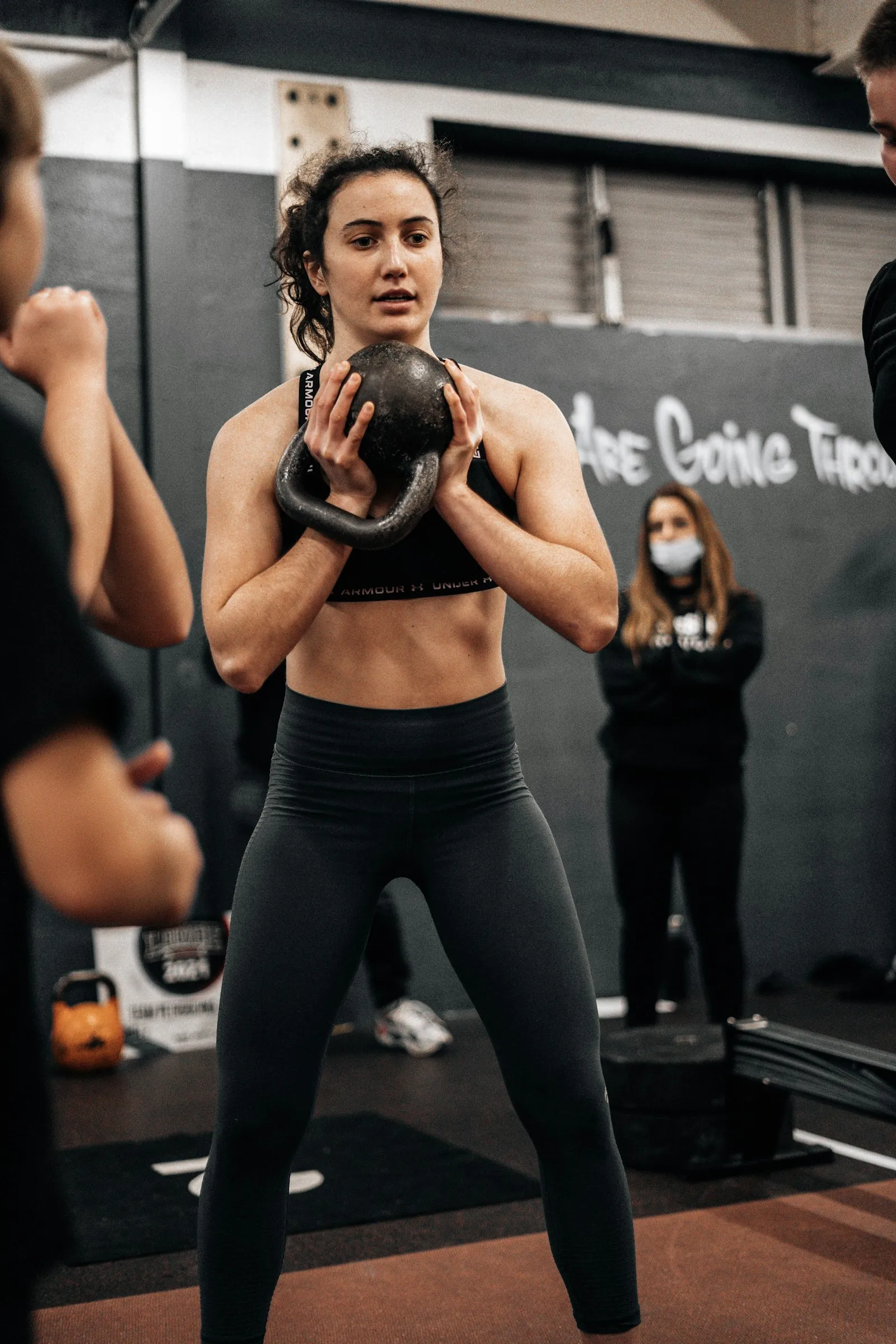
Hold the bell against your chest with both hands, elbows down, and squat between your legs. The front-loaded weight keeps your torso upright and is gentler on the lower back than a barbell squat, which makes it ideal after 40. It is one of the best all-round leg builders and a staple in our leg exercises guide.
4. Kettlebell row
Hinge over with one hand on a bench or your thigh, and row the bell to your ribs with the other. Trains the whole back and pairs naturally with the pressing work. For the full pulling picture, see our back workout.
5. Kettlebell press (overhead press)
Clean the bell to the rack position (resting on the back of your forearm, tucked at your shoulder), then press it overhead. Builds shoulders and a braced core. Start light; pressing is where women are relatively weakest, so this is the move that stays lighter longest.
6. Kettlebell clean
The clean gets the bell from the floor to the rack position smoothly, so you can press or squat from there. Done right it flips around your hand and lands soft; done wrong it bangs your forearm. Learn it with a light bell and a loose grip.
7. Front-rack lunge
Hold the bell in the rack position and lunge. The offset load challenges your balance and trains each leg independently, which exposes and fixes the side-to-side imbalances that creep in with age.
8. Kettlebell halo
Circle the bell slowly around your head, close to it, to open up tight shoulders and mid-back. A gentle, joint-friendly move that doubles as a warm-up.
9. Turkish get-up
The get-up is a slow, five-minute-looking sequence of standing up from the floor while holding the bell overhead. It looks intimidating and is worth every second: it trains total-body stability, shoulder health, and the exact skill of getting off the floor under control. Learn it with no weight first, then a light bell.
10. Kettlebell windmill (advanced)
A hip-hinge and shoulder-stability move that opens the hips and obliques. Save it until your basics are solid.
Notice what is not here: the snatch. It is a fine goal, but it is an advanced ballistic move you earn after your swing and clean are automatic, not a place to start.
A simple weekly kettlebell workout
You do not need a complicated program. Two or three sessions a week, full body, is plenty. Here is a beginner-friendly week with a single bell.
Do this circuit 2 to 3 times a week, 3 rounds, resting as needed:
- Kettlebell deadlift: 8 reps
- Goblet squat: 8 reps
- Kettlebell swing (two-handed): 10 reps
- Kettlebell row: 8 per side
- Kettlebell press: 6 per side
- Halo: 5 per direction
That is roughly 20 to 25 minutes. Progress by adding a round, adding reps, or moving to a heavier bell (especially on swings and squats, which outgrow a light bell first). When swings feel easy at 12 kg, add a 16 kg. When the circuit feels manageable three times through, that is your cue to add load, not more reps. Pair it with enough protein to actually build muscle; our protein calculator gives you the number.
Form and safety (grip, wrist, the hinge)
Three things prevent almost every kettlebell problem.
The hinge, not the squat. The swing is powered by your hips moving back and snapping forward, not by squatting up and down or lifting with your arms. If your knees are doing the work, you are squatting the swing. Groove the deadlift first until the hinge is automatic.
The rack and the wrist. In the rack position and on cleans, the bell should settle onto the back of your forearm, wrist straight, not bang your wrist bone. If it clanks, your grip is too tight and you are muscling the bell up instead of guiding it around your hand. Lighter bell, looser grip.
Grip is the honest early limiter. Your hands will fatigue before your hips do on high-rep swings. That is normal. Set the bell down, shake out your forearms, and continue. Do not sacrifice a flat back to hold on one extra rep. Chalk helps once you get serious.
If you have uncontrolled high blood pressure, a heart condition, a recent injury, or pregnancy complications, talk to your doctor before starting ballistic kettlebell work.
What to skip
- Swinging before you can hinge. The number one cause of a cranky lower back on swings is doing them as a squat or a back-lift. Earn the hinge with deadlifts first.
- Ego weight. A bell too heavy to hinge cleanly is not building anything but a bad pattern. Scale down until the movement is crisp.
- Snatching or cleaning with a death grip. That is what bangs your forearm. Light bell, loose hand, learn the path.
- “Kettlebell fat-melting” belly workouts. No move spot-reduces fat. Full-body kettlebell training plus a modest calorie deficit and enough protein is what leans you out; we cover the core-specific truth in ab exercises for menopause.
- Endless sloppy high-rep swings. When your form breaks, the set is over. Quality reps build the pattern; ragged ones build injuries.
- Skipping the get-up because it looks hard. It is one of the most valuable things you can do for shoulder health and getting off the floor with confidence. Start with no weight.
The bottom line
A kettlebell is the most efficient strength tool a busy woman over 40 can own. It trains power, strength, grip, and conditioning in one implement, in one corner of a room, in twenty minutes, and the research shows it works even for beginners decades older than you. Buy one bell around 10 kg, learn the hinge and then the swing, add the goblet squat and press, and run the simple circuit two or three times a week. Master those basics and you will have built something most fitness advice never delivers to women in midlife: real, usable, joint-friendly strength that carries straight into the rest of your life. For where it fits alongside barbell and bodyweight work, start with our strength training for women over 40 guide.