If you only ever learn one barbell lift, learn this one. The benefits of deadlifts cover almost everything a woman over 40 is told to worry about: muscle you are losing, bones that are thinning, a grip that is weakening, and a back that complains when you pick things up. One movement trains all of it, and you can learn the basic pattern in an afternoon.
This is the honest version of the case for deadlifting. Most of the benefits you have read are real, a couple are myths repeated from article to article, and the genuinely important ones for women past 40 barely get mentioned. We will rank what the evidence actually supports, kill the testosterone claim with the study that tested it, and give you real starting numbers.
The short answer
Deadlifts are the most efficient strength exercise available: one movement that trains the glutes, hamstrings, entire back, core, and grip with heavy, progressive load.
- Total-body strength and muscle, trainable at any age
- Bone loading at the hip and spine, exactly where postmenopausal bone loss does its damage
- Grip strength, one of the strongest physical predictors of how well you age
- The hip hinge pattern, the safe way to lift anything off the floor for the rest of your life
- A more capable lower back, with honest caveats
- Posture and core stiffness under real load
What they do not do: spike your hormones into a muscle-building state (we will get to that myth) or burn fat off your belly. Everything else on that list is earned.
What does deadlifting do to your body?
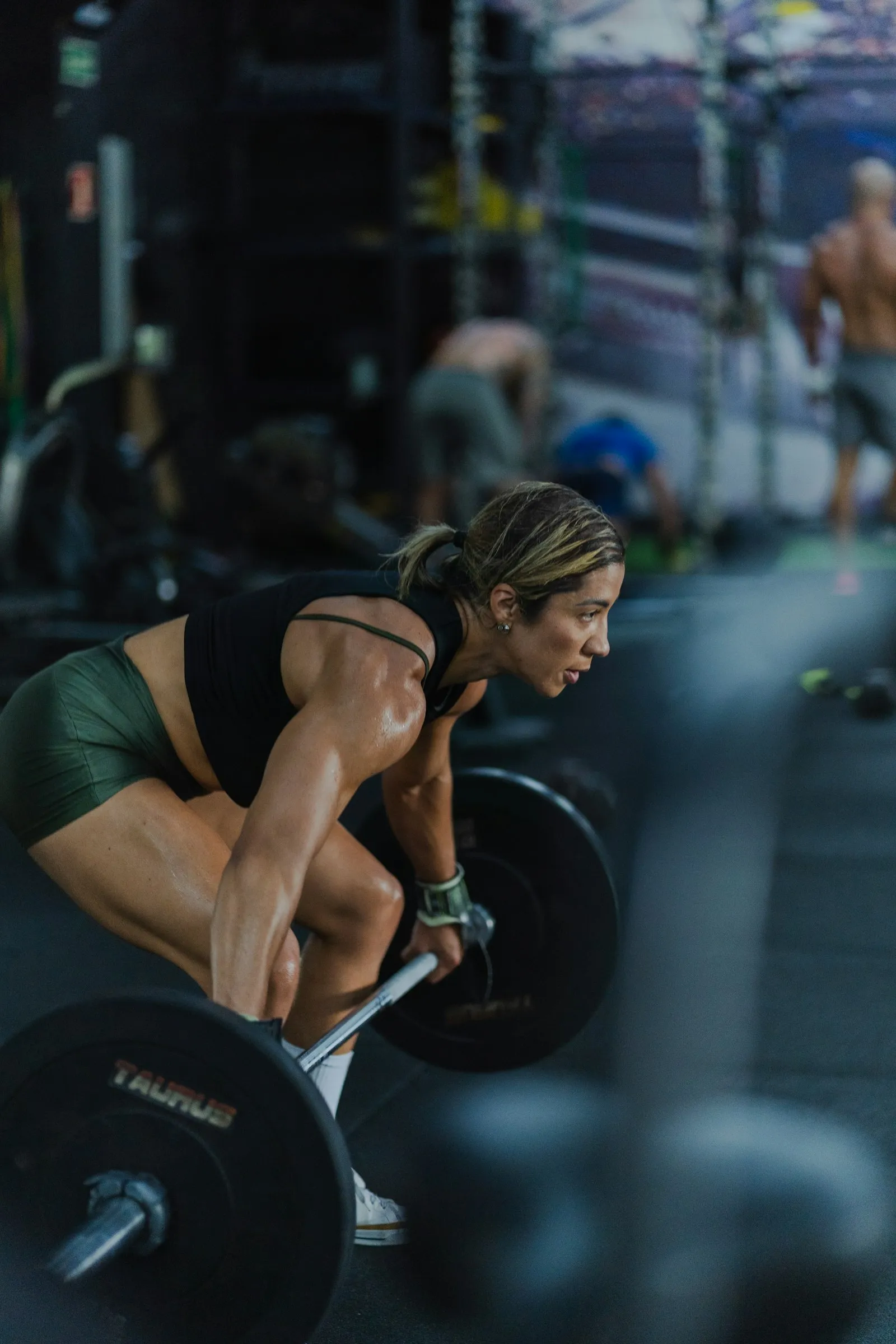
A deadlift is simple: a loaded barbell on the floor, you hinge at the hips, grip the bar, and stand up straight. That simplicity hides how much is working.
Your glutes and hamstrings produce most of the force, driving your hips forward. Your quads straighten the knees off the floor. Your entire back, from the lats down through the spinal erectors, holds your spine rigid against the load. Your core braces like a corset. Your forearms and grip hold on to every pound. That is more muscle under load at once than a squat, a press, or any machine circuit.
Because so much muscle works at once, the deadlift is also where you will move the most weight of any lift. That matters, because heavy load is the signal that tells muscle and bone to adapt. For the full picture of where the deadlift fits in a week of training, see strength training for women over 40.
The benefits of deadlifts, ranked by evidence
Here is what the research actually supports, strongest case first.
1. Total-body strength and muscle, at any age
The deadlift’s main job is the one it does best: it makes you stronger almost everywhere at once. Hips, hamstrings, back, grip, core. Progressive load on a multi-joint lift is the most reliable muscle-building stimulus known, and no lift loads more muscle than this one.
Age does not close that window. In a landmark JAMA study, frail people in their 90s gained an average of 174% in strength after just 8 weeks of high-intensity resistance training. If nonagenarians can adapt, a healthy woman in her 40s or 50s is nowhere near any limit. Muscle is also your metabolic engine and your insurance policy against the 3-8% per decade loss that starts in midlife, which is why we put a hinge at the center of every program we write.
2. It loads your bones where it matters most
This is the benefit nobody on page one of Google bothers to explain to the reader who needs it most. After menopause, falling estrogen accelerates bone loss, concentrated at the hip and spine, the two fracture sites that change lives.
The deadlift loads exactly those sites, through the long axis of the skeleton, with the heaviest weight you can handle. And there is direct evidence in the right population: the LIFTMOR trial put postmenopausal women with low bone mass through 8 months of supervised heavy lifting (deadlifts included, twice a week, 30 minutes) and found improved bone mineral density and physical function, with the gains showing up at the lumbar spine and femoral neck. Walking does not produce that signal. Swimming and cycling do not either. Bones adapt to load, and the deadlift is the most load you can give them. We cover the broader bone case in strength training for women over 50.
3. It builds the grip strength that predicts how you age
Grip strength sounds like a niche concern until you read the epidemiology. The PURE study tracked roughly 140,000 adults across 17 countries and found grip strength predicted all-cause and cardiovascular mortality more strongly than systolic blood pressure. Grip is not magic; it is a proxy for total-body muscle and strength. But it is the proxy your future self cares about: opening jars, carrying groceries, catching yourself on a railing.
No exercise builds grip like deadlifts, because nothing else asks your hands to hold this much weight for this long. Every heavy set is a grip workout you did not have to schedule.
4. It trains the one movement you will use forever
The hip hinge is how a human picks anything up safely: a grandchild, a suitcase, a bag of soil, a laundry basket. Most back tweaks happen doing exactly these things badly.
The deadlift is the hinge, rehearsed under progressive load until it is the way you move by default. That is what “functional strength” actually means: the gym movement and the life movement are the same movement. The deadlift’s cousins carry the pattern through your whole week; our glute workouts guide covers the Romanian deadlift and hip thrust that build the same muscles from different angles.
5. It can help a cranky lower back (honest version)
This one surprises people, because the deadlift’s reputation is “back breaker.” The evidence points the other way for most lower backs: a systematic review found that posterior-chain resistance training, which is deadlift-pattern work, outperformed general exercise and walking programs for reducing chronic low back pain and disability.
The mechanism is unglamorous: a stronger back tolerates more before it complains, and a trained hinge spares your spine the awkward rounding that causes most everyday tweaks. The honest caveats: start light, progress gradually, and if you have an actual diagnosis (disc herniation, stenosis, anything with radiating symptoms), get cleared by your doctor or physical therapist first. Pain that shoots down a leg is a stop sign, not something to train through.
6. Posture and a core that braces
Every rep of a deadlift is an isometric plank performed standing up with a barbell in your hands. Your spinal erectors and deep core hold a rigid neutral spine against hundreds of pounds trying to fold you forward. That anti-flexion strength is what good posture under fatigue is made of, and it transfers to every other lift you do. It is the same family of work as the bracing exercises in our core training guide, just with the dial turned up.
7. Calorie burn, framed honestly
Yes, deadlifts burn calories: heavy compound lifts cost more energy than isolation work, and the muscle you build raises your resting energy needs a little. But nobody ever got lean from the calorie cost of deadlifting alone, and any article promising that deadlifts strip fat off your midsection is selling something. The real body-composition play: deadlifts protect and build muscle while a modest calorie deficit removes fat, and enough protein makes both work. Our protein calculator gives you the daily number in seconds.
The testosterone myth (what deadlifts don’t do)
Almost every “benefits of deadlifts” article repeats the same claim: big lifts spike testosterone and growth hormone, and that hormonal surge builds extra muscle. The first half is technically true and the second half is not.
Heavy compound lifts do cause small, brief hormone fluctuations. But when researchers actually tested whether those post-workout fluctuations drive muscle growth, they found neither load nor systemic hormone changes determined who gained muscle and strength. The adaptations tracked with the training itself, not the hormone spike.
Why this matters for you: deadlifts will not meaningfully move your testosterone, and they do not need to. Muscle grows from mechanical tension, progressive overload, protein, and recovery. Women build muscle on a fraction of men’s testosterone using exactly that recipe. If a supplement or program sells you on “hormone optimization” through exercise, you now know the evidence says otherwise. For what actually helps on the supplement side, see creatine for women.
Is deadlifting dangerous? The actual injury data
“Why deadlift is dangerous” is one of the most-searched questions about this lift, so here are numbers instead of vibes.
A British Journal of Sports Medicine systematic review of injuries among weightlifters and powerlifters found injury rates of roughly 1 to 4 injuries per 1,000 hours of training. For context, that is low for sport in general, in the same range as other non-contact training, and most of the injuries reported were minor strains that resolved with short rest, not catastrophic events. If you train 3 hours a week, 1,000 hours is more than 6 years of lifting.
The lift is not risk-free; nothing loaded is. The risks concentrate in three behaviors: maxing out with form you have not earned, adding weight faster than your tissues adapt, and lifting through pain. Avoid those three and the deadlift is one of the safer things you can do in a gym, and dramatically safer than the decades-long alternative of being weak.
How to start deadlifting after 40 (real numbers)
You do not need to earn the barbell. You need a load you can hinge well with, and a plan that adds weight slowly.
- Week 1-2: groove the hinge. A 15-25 lb kettlebell or dumbbell, 3 sets of 8. Push your hips back until you feel hamstrings stretch, flat back, stand up by driving hips forward. If you only have dumbbells at home, this works fine; the pattern is the point.
- Week 3-4: move to a bar. A standard 45 lb barbell (or a 35 lb women’s bar, or a trap bar at 45-60 lb) for 3 sets of 5. The bar starts over the middle of your foot, you keep it close, your hips and shoulders rise together.
- Month 2 and beyond: add 5 lb per week. Three to five sets of 3-8 reps, once or twice a week, at an effort of about 7-8 out of 10 (you could do 2-3 more reps). When weekly jumps stall, switch to adding 5 lb per month. That patient math takes many women past a bodyweight deadlift inside a year.
- Plug it into a week. One heavy hinge day plus one squat day plus pressing and pulling work covers everything that matters. The 3-3-3 framework in our over-40 guide shows the full layout.
Form rules that cover 90% of safety: the bar stays against your legs, your spine stays neutral (no rounding, no exaggerated arching), and the rep ends standing tall, not leaning back. A belt is optional and only useful once the weights get genuinely heavy; our weightlifting belt guide covers when it earns a place.
Which deadlift variation should you use?
All of them are deadlifts. The right one is the one your body and equipment make easy to do well.
| Variation | Best for | The trade-off |
|---|---|---|
| Conventional (barbell) | The most load, the most complete benefit list | Demands the most hip mobility and coaching attention |
| Trap bar (hex bar) | Beginners and anyone with a cranky back; the easiest to learn | Slightly more quads, slightly less posterior chain |
| Romanian (RDL) | Hamstring and glute emphasis, lighter loads | Starts from the top; does not train the floor pull |
| Sumo | Lifters with long torsos or limited hip mobility | More technical setup; less back-muscle demand |
| Dumbbell or kettlebell | Home gyms, learning the pattern, weeks 1-4 | Runs out of load fast once you get strong |
If you have access to a trap bar, it is the friendliest serious option after 40: the handles sit at your sides, the back angle is more upright, and most people pull it well on day one. Whichever you pick, the leg-day context lives in our leg exercises guide.
What to skip
- Maxing out to prove anything. Heavy singles are for powerlifters with a meet date and a coach. Sets of 3-8 build the same strength with a fraction of the risk.
- Deadlifting heavy every day. The lift takes more out of your recovery than any other. Once or twice a week is the dose; more is subtraction.
- Smith machine deadlifts. The fixed bar path fights the natural arc of the lift and teaches a pattern that does not transfer. Use a trap bar or dumbbells instead.
- “Deadlifts for belly fat” plans. No exercise spot-reduces fat. The deadlift’s body-composition value is the muscle it keeps while your diet does the fat-loss work.
- Training through radiating pain. Soreness in muscles is normal. Pain that shoots, tingles, or numbs is a medical question, not a programming one.
- Waiting for perfect form before adding any weight. Form improves fastest with modest, gradually increasing load. Perfect is not a prerequisite; patient is.
The bottom line
The deadlift earns its reputation honestly. It builds more strength and muscle per rep than any other lift, it loads the hip and spine exactly where postmenopausal bone needs the signal, it forges the grip strength that tracks with longevity, and it rehearses the one movement pattern you will use until your last day of independent living. The myths attached to it, hormone surges and spot fat loss, can go; the lift does not need them. Learn the hinge with a kettlebell this week, meet the bar next month, add 5 pounds at a time, and a year from now the strongest thing in your gym bag will be the fact that the floor is no longer where heavy things stay.