If you are over 50 and every article you find tells you to do wall sits, pelvic floor squeezes, and “abdomen pulses” with a pair of two-pound dumbbells, this is the correction. That is not strength training. That is movement designed by people who decided, without asking you, that you are fragile.
You are not fragile. You are most likely undertrained, and the fix is to lift weights that are actually heavy enough to matter. Strength training for women over 50 is the same fundamental thing it is for anyone: pick up challenging loads, do a few hard sets, add weight over time. The only real adjustments are how you warm up, how you recover, and how patient you are with progress. Here is the real version, with a program you can start this week.
The short version
- Lift real weights, not gentle ones. Two-pound dumbbells and endless bands keep you exactly as strong as you are now.
- Train 2 to 3 days a week, full body, on non-consecutive days.
- Build everything around five movements: squat, hinge, push, pull, carry.
- Use 2 to 3 sets of 8 to 12 reps, with a weight that is genuinely hard by the last couple of reps.
- Add weight when it gets easy. That single rule, progressive overload, is what makes you stronger.
- It is not too late. Women build muscle and bone in their 50s, 60s, and beyond. The research is unambiguous.
- Eat enough protein to give the muscle something to rebuild with.
Why strength training matters more after 50, not less
After menopause, two clocks speed up. Muscle mass, which already declines slowly from your 30s, drops faster once estrogen falls. Bone density does the same. Left alone, that combination is what eventually turns into frailty, the lost independence and broken hips nobody wants to talk about until it is happening.
Strength training is the single most effective thing you can do about both. Lifting challenging weights tells your muscles to grow and your bones to hold their mineral density. Nothing else, not walking, not yoga, not “toning,” loads the body hard enough to send those signals.
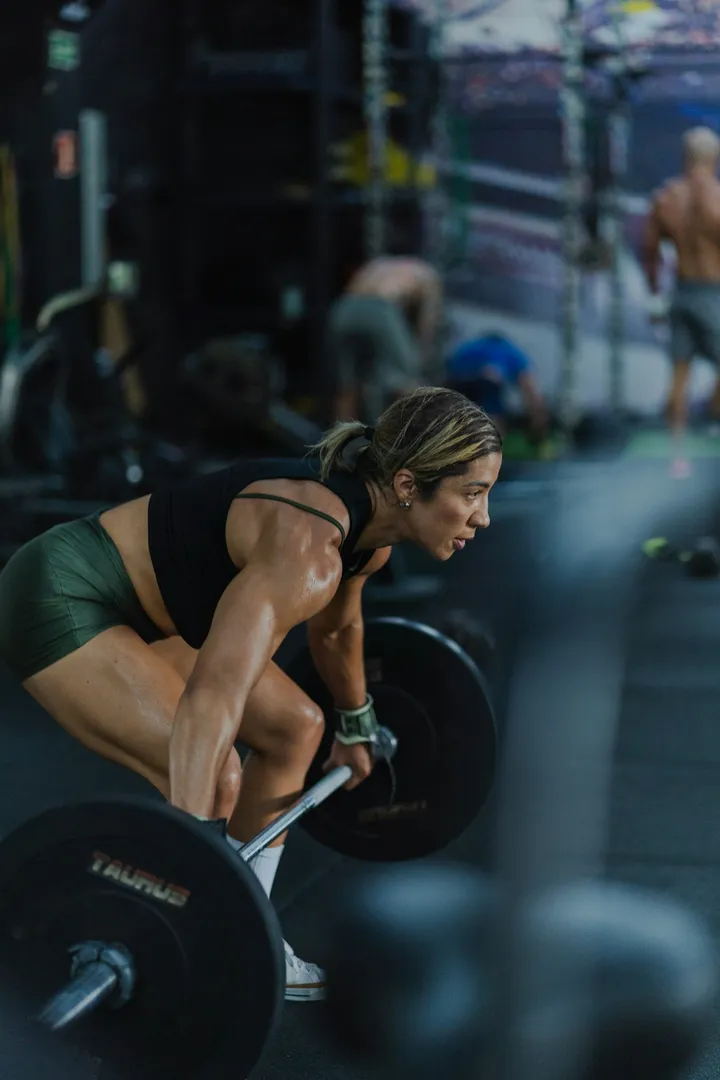
The bone point is worth sitting with, because it is where the gentle-movement crowd gets it most wrong. In the LIFTMOR randomized trial, postmenopausal women with osteopenia and osteoporosis did heavy, high-intensity resistance and impact training, deadlifts and overhead presses, not chair exercises, and improved both their bone density and their physical function. The load is the medicine. Light weights do not provide the dose.
This is the same case we make in our strength training guide for women over 40. What changes after 50 is only the urgency and a few practical details, not the principle.
Is it too late to start strength training at 50 or 60?
No. This is the question that stops the most women, and the answer is one of the most encouraging findings in exercise science.
In a now-famous study, high-intensity strength training in people in their 90s produced large gains in strength and measurable muscle growth in just eight weeks. The average age in that study was 90. If frail nonagenarians can build muscle, a healthy 55- or 65-year-old can absolutely do it.
A few sensible precautions, and then you start:
- If you have a heart condition, uncontrolled blood pressure, a recent injury, or a joint replacement, clear a strength program with your doctor first.
- Start lighter than you think for the first week or two so you can learn the movements with good form.
- Progress gradually. The goal is steady, not heroic.
That is the entire safety conversation. “Too old” is not on the list.
The 5 movements that matter
You do not need 30 exercises. You need to train five basic human movement patterns, and almost everything useful is a version of one of them.
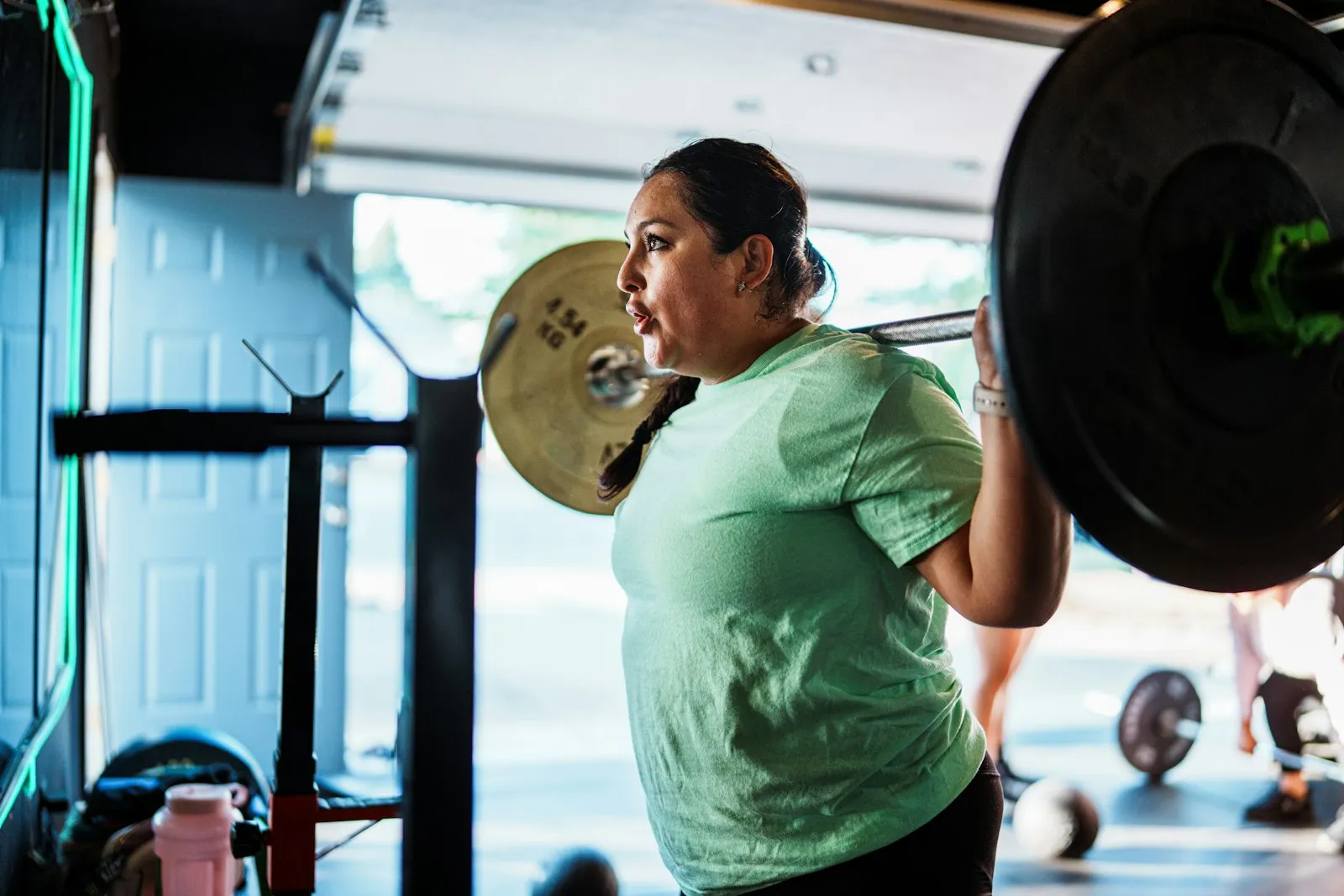
- Squat: sitting down and standing up under load. Goblet squat, box squat, barbell squat.
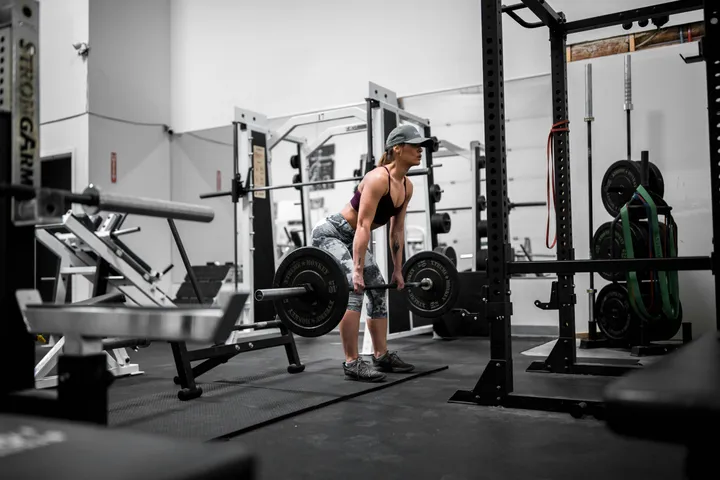
- Hinge: bending at the hips with a flat back. Romanian deadlift, hip hinge, deadlift. This is the king for the back of your body and your bone-loading.
- Push: pressing weight away from you. Dumbbell bench or incline press, overhead press, push-ups.
- Pull: pulling weight toward you. Dumbbell row, seated row, assisted pull-up. Great for posture.
- Carry: picking up something heavy and walking with it. Farmer’s carry. Brutally practical and it trains your grip, core, and whole body at once.
Train those five and you cover your entire body with real, transferable strength. If you want to go deeper on individual lifts, we have detailed walk-throughs for leg exercises, glute work, and back and row movements.
Strength training for women over 50: the routine
Here is a real beginner program. It is two or three full-body sessions a week, and it is the same session each time, which is exactly what a beginner wants: repetition builds skill and lets you see your weight go up week to week.
The beginner full-body plan
Do this workout 2 to 3 times a week, on non-consecutive days (for example Monday, Wednesday, Friday). Warm up first with 5 minutes of easy movement and a light set of each lift.
| Exercise | Sets x Reps | Notes |
|---|---|---|
| Goblet squat | 3 x 8-12 | Hold one dumbbell at your chest |
| Romanian deadlift | 3 x 8-12 | Flat back, push hips back, feel the hamstrings |
| Dumbbell bench or incline press | 3 x 8-12 | Or push-ups, on the floor or against a bench |
| Dumbbell row | 3 x 8-12 per arm | Brace on a bench, pull to your hip |
| Farmer’s carry | 3 x 30-40 yards | Heavy dumbbell in each hand, walk tall |
| Plank | 3 x 20-40 sec | Optional core finisher |
That is the whole workout. Six movements, about 35 to 45 minutes including warm-up. You do not need more to get strong.
How to progress (this is the part that matters)
Progressive overload is the entire game, and it is simpler than it sounds. Pick a weight you can lift for about 8 to 10 reps with two reps left in the tank. Stay there until you can complete all your sets at the top of the rep range (12 reps) with good form. The next session, add a small amount of weight, often just 2.5 to 5 pounds, and start the climb again.
That is it. You are not chasing soreness or exhaustion. You are chasing a slightly heavier weight than last week. Over months, those small jumps add up to a person who is dramatically stronger than the one who started.
How many days a week
Two days a week builds real strength and is plenty if your schedule or recovery is tight. Three is better if you feel good. After 50, your muscles want 48 to 72 hours to recover between sessions that train them, which is exactly why full-body workouts two or three times a week fit so well: each session hits everything, then you rest.
Equipment: what you actually need
Less than the fitness industry wants you to believe. You can run this entire program with:
- A pair of adjustable dumbbells, or a few fixed pairs in light, medium, and heavier weights. Adjustable is the better value because you will outgrow light weights fast.
- A sturdy bench or a stable chair for presses and rows.
- That is genuinely enough to start.
As you get stronger, a barbell and plates open up heavier squats, hinges, and presses, and a lifting belt becomes worth considering for your heaviest sets. But do not let “I do not have a gym” stop you. A corner of a bedroom and one pair of adjustable dumbbells is a complete starting setup.
Eat enough protein to keep the muscle
Lifting is the signal; protein is the building material. Without enough of it, you are asking your body to rebuild muscle without supplies.
Aim for roughly 0.7 to 1 gram of protein per pound of body weight per day, spread across your meals. After 50 this matters more, not less, because older muscle is a bit more resistant to the muscle-building signal, so getting a solid 30 or so grams of protein at each meal helps overcome that. Our guide to protein for women over 50 covers the math and the easy ways to hit it.
One supplement is worth adding because it has the evidence to back it up. Creatine is one of the most studied supplements there is, and a meta-analysis found that combining it with resistance training improved lean mass and strength in older adults. Three to five grams a day, every day. The rest of the supplement aisle you can ignore.
What changes in your first 12 weeks
So you know what to expect, and do not quit at week three thinking nothing is happening:
- Weeks 1 to 2: you learn the movements and feel coordination improve. Some muscle soreness is normal; sharp joint pain is not.
- Weeks 2 to 4: you get noticeably stronger fast. This early jump is mostly your nervous system getting efficient, before the muscle itself grows much.
- Weeks 4 to 8: the weights you started with feel light. You are adding load regularly. Lean muscle is building.
- Weeks 8 to 12: strength is meaningfully up, daily tasks feel easier, posture and balance improve, and many women notice better sleep and steadier energy.
The scale may not move much, because you are gaining muscle while you lose fat. That is the point. Judge this by your strength numbers and how your clothes fit, not the bathroom scale.
Where to go after your first 12 weeks
Once the single full-body workout stops challenging you and you recover easily from it, you have two good options.
The first is to split into an A/B routine. Instead of the same session every time, you alternate two full-body days: Day A leans on the squat and a press, Day B leans on the hinge and a row, and you rotate A, B, A one week and B, A, B the next. This lets you add a second set of variations, front squats, hip thrusts, overhead presses, lat pulldowns or assisted pull-ups, and a suitcase carry, so you keep building skill while you keep adding weight.
The second is to add a barbell. A barbell lets you load a squat, deadlift, and press far heavier than dumbbells allow, which is exactly the heavy, bone-loading stimulus the LIFTMOR research used. Start light to learn the bar path, and progress the same way: small jumps, good form.
Either way, the rule never changes. Add weight or reps over time. If you want a fully structured plan to follow rather than building your own, our strength training program for women over 40 lays one out week by week and applies just as well in your 50s.
What to skip
- Gentle, low-impact-only programs. Wall sits, pelvic floor squeezes, and pulsing with no weight will not make you stronger or protect your bones. If a workout never gets hard, it never changes you.
- Two- and three-pound “toning” dumbbells. If you can do 30 reps without effort, the weight is not doing anything. Pick a load that is genuinely hard by rep 10 to 12.
- The word “toning.” There is no separate “tone.” You build muscle and lose fat. Chasing “long lean muscles” with feather weights is a marketing idea, not a physiological one.
- Trading lifting for endless cardio. Walking and cardio are great for your heart, but walking does not build muscle or bone the way resistance training does. You need the weights.
- Machines only. Machines are fine, but learning the free-weight patterns gives you real-world strength and better bone loading. Do not avoid dumbbells out of nervousness.
- Program-hopping. Switching routines every two weeks because you saw a new one online guarantees you never progress on anything. Pick the plan above and run it for at least 8 to 12 weeks.
The bottom line
Strength training for women over 50 is not a watered-down, careful version of real training. It is real training, run by a smart adult who happens to be over 50. Pick up challenging weights two or three times a week, build everything around the five movements, add weight when it gets easy, and eat your protein. Do that for three months and you will be measurably stronger, better protected against the bone and muscle loss of these years, and a lot harder to knock off your feet, literally. The women’s-fitness internet decided you were fragile. The research, and your own results, will prove it wrong.