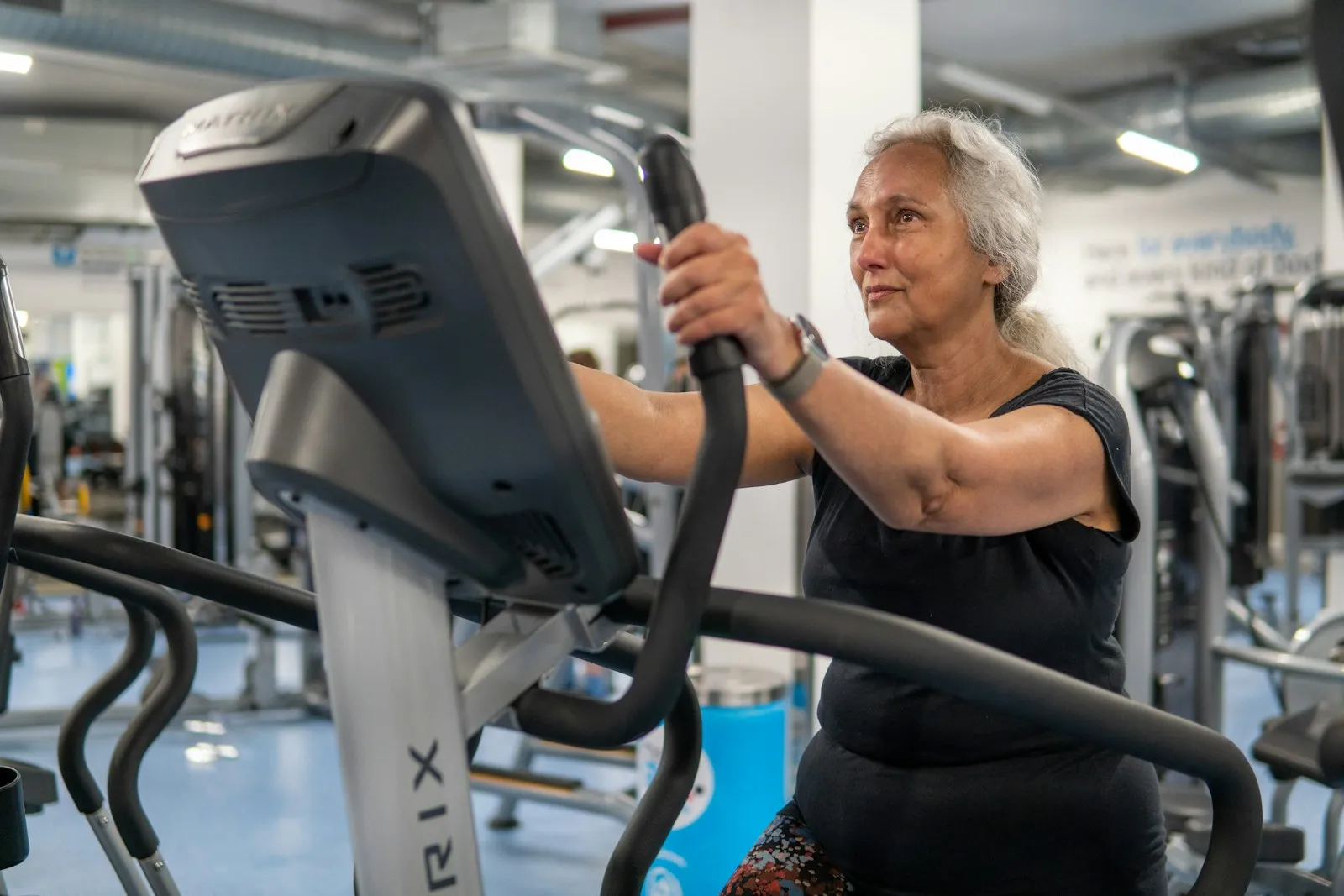
The Norwegian 4x4 is four 4-minute intervals at 85-95% of your max heart rate, each followed by 3 minutes of easy movement. With a warm-up and cool-down it takes about 40 minutes, and it is one of the most-studied interval workouts for raising VO2 max, the measure of aerobic fitness most closely tied to how long, and how well, people live.
Almost every guide to it leans on 220 minus your age, a formula that overestimates max heart rate in women. For a 55-year-old woman, that sets her interval target about 6 beats per minute too high, which turns a hard-but-doable session into one she can’t hold and quits. This page gives you targets that fit, a 6-week way in, and how to run the 4x4 alongside your lifting.
Who this is for
- You lift two or three days a week (or are about to start) and want one cardio session that does the most for your heart in the least time.
- You are somewhere between 40 and 65, in perimenopause or past menopause.
- You have heard about the 4x4 on a podcast or seen it suggested by your watch, and you want the actual numbers.
- You walk regularly but have never done structured hard intervals.
This is not a substitute for strength training. If you are not lifting yet, start with strength training for women over 50 or our full body workout, then add the 4x4. If you have a heart condition, read the safety section before anything else.
The short version
- The session: 10-minute warm-up, then 4 minutes hard and 3 minutes easy, four times, then a 5-minute cool-down. About 40 minutes.
- How hard: 85-95% of max heart rate on the intervals (8 or 9 out of 10 effort), about 70% on the recoveries. Hard enough that you can’t talk in sentences, not a sprint.
- Your max heart rate: use 206 minus 0.88 times your age, a formula built from 5,437 women. At 55 that gives 158 bpm, so intervals at about 134-150.
- How often: once a week to start, twice once you’re through the ramp-up. Two a week is what the 5-year Generation 100 study used in adults in their 70s.
- What to do it on: incline treadmill walking or a bike are the easiest on 45- to 60-year-old joints. Running only if it already feels good.
- Around lifting: on a non-lifting day, or after your lifting session. Not before heavy squats or deadlifts.
- Skip: 220 minus your age, an all-out final interval, standing still between intervals, and more than three sessions a week.
What is the Norwegian 4x4?
The Norwegian 4x4 is an interval workout: a 10-minute warm-up, then four 4-minute intervals at 85-95% of your maximum heart rate, each followed by 3 minutes of active recovery at about 70%, and a 5-minute cool-down. It was developed by exercise researchers at the Norwegian University of Science and Technology (NTNU) in Trondheim to raise VO2 max in as little time as possible.
| Block | Time | Effort |
|---|---|---|
| Warm-up | 10 min | Easy to moderate |
| Hard interval (x4) | 4 min each | 85-95% max HR |
| Recovery (x3) | 3 min each | About 70% max HR |
| Cool-down | 5 min | Easy |
| Total | About 40 min |
It is a form of HIIT, but a different animal from the 20-second sprints of Tabata. The 4-minute intervals are long enough for your heart rate to climb into the top of its range by the first or second minute and stay there. That accumulated time near your aerobic ceiling is the stimulus that raises VO2 max, and four minutes is short enough that you can repeat it four times at the same quality.
The lab that created it, NTNU’s Cardiac Exercise Research Group (CERG), still publishes its exercise advice and an FAQ on the 4x4. Several of the practical rules below come straight from that page.
Why VO2 max matters more after 40
VO2 max is the most oxygen your body can take in and use during hard exercise, expressed in milliliters per kilogram of body weight per minute (mL/kg/min). It reflects how well your heart, lungs, blood vessels, and muscles work together, and it is the number the 4x4 was designed to move.
It tracks with survival as strongly as the classic risk factors. In a Cleveland Clinic study of 122,007 adults who did treadmill tests, people with below-average fitness for their age and sex had 41% higher risk of death over a median 8.4 years than people with above-average fitness. The hazard ratio was 1.41, identical to smoking’s in the same analysis. That is an observational association, not proof that fitness alone causes the difference, but the gradient held from the lowest group to the very fittest with no upper limit.
It drops every decade, and the drop is not small. In the US FRIEND registry’s 2022 reference standards for cardiorespiratory fitness, measured peak VO2 fell by an average of 13.5% per decade. Here is what the women’s treadmill results look like (mL/kg/min):
| Age | 20th pct | Median | 80th pct |
|---|---|---|---|
| 40-49 | 19.7 | 25.7 | 33.0 |
| 50-59 | 18.5 | 22.9 | 28.4 |
| 60-69 | 15.4 | 19.6 | 24.3 |
| 70-79 | 14.0 | 17.2 | 20.8 |
Read across a row and down a column at the same time: a 52-year-old woman at the 80th percentile (28.4) is fitter than the median woman in her 40s (25.7). To find your own number without a lab, try our VO2 max calculator. Training moves you between columns, and that is worth more than the decade you are in. These are lab treadmill tests; a watch’s VO2 max estimate is a rougher number, but it lives on the same scale. For every percentile from your 20s to your 80s, and why your watch’s “Poor” or “Good” label may disagree with this data, see our VO2 max chart by age.
Menopause adds to the case. The American Heart Association’s 2020 scientific statement on menopause and cardiovascular disease risk identifies the menopause transition as a period of accelerating cardiovascular risk and a window for early prevention. The good news is that the training response does not disappear. In a three-month trial of 79 women, high-intensity training improved cardiovascular risk factors to the same extent in late premenopausal and early postmenopausal women (average ages 49 and 53): lower fat mass, waist, diastolic blood pressure, resting heart rate, and LDL cholesterol, plus more lean mass, in both groups.
What the Norwegian 4x4 research actually shows
The 4x4 gets called the “gold standard” a lot. Here is what the three studies behind that reputation found, including the parts that usually get left out.
Helgerud 2007: the original comparison. Forty moderately fit men were split into four groups that did the same total amount of work three times a week for eight weeks: long slow running, threshold running, short 15-second intervals, or 4x4 intervals. The 4x4 group’s VO2 max rose 7.2%, from 55.5 to 60.4 mL/kg/min, and both interval groups improved significantly more than the steady-pace groups. The catch for us: these were fit young men, not 50-year-old women, and three sessions a week is more than most lifters will sustain.
Wisløff 2007: heart failure patients. Twenty-seven heart failure patients averaging 75 years old, all on beta-blockers, trained three times a week for 12 weeks. VO2 peak rose 46% with interval training versus 14% with moderate continuous training, and the pumping strength of the heart (ejection fraction) rose 35%. Every session was supervised. Norwegian cardiac rehab centers now use supervised intervals (their safety record is below), but this is not a reason to self-prescribe them if you have heart disease.
Generation 100: five years in people in their 70s. This is the one most relevant to you, and the one most guides skip. NTNU randomized 1,567 adults aged 70 to 77, 790 of them women, to two 4x4 sessions a week, two 50-minute moderate sessions a week, or the national activity guidelines, and followed them for five years. Deaths were 3.0% in the interval group, 4.7% in the guidelines group, and 5.9% in the moderate group. That difference was not statistically significant, partly because everyone did well and the guidelines group did more high-intensity exercise on their own than the moderate group did. After five years, the interval group’s VO2 peak was 0.7 mL/kg/min higher than both other groups.
A 0.7 gain sounds tiny. Set against the FRIEND average decline of about 4 mL/kg/min per decade, it is roughly two years’ worth of age-related loss. And the group doing hard intervals in their 70s had the lowest death rate of the three, which is reassuring if you worry the 4x4 is too much for an older body. That is the honest version: strong evidence that the 4x4 raises fitness, encouraging but unproven evidence on lifespan.
Norwegian 4x4 heart rate targets for women
The 4x4 is defined by heart rate, so the target is only as good as your max heart rate estimate. This is where most guides quietly fail women.
The familiar 220 minus age formula was never validated in women. A large 2001 meta-analysis proposed 208 minus 0.7 times age and found no difference between men and women. But when cardiologists followed 5,437 women through exercise stress tests in the St. James Women Take Heart Project, they found that women’s peak heart rate averaged 206 minus 0.88 times age, and that the traditional male-based formula overestimates it.
We checked the three formulas against the measured peak heart rates for women in the FRIEND registry. For women in their 50s (average age 54.5), the measured average was 160 bpm. The women’s formula predicts 158. 220 minus age predicts about 166, and 208 minus 0.7 times age about 170. Across the 40s, 50s, and 60s, the women’s formula landed within 3 beats of the measured average every time, while 220 minus age ran 6 to 9 beats high and the 208 formula 9 to 16 beats high.
So here are the targets using the women’s formula:
| Age | Est. max HR | Intervals (85-95%) | Recovery (70%) |
|---|---|---|---|
| 40 | 171 | 145-162 | 120 |
| 45 | 166 | 141-158 | 116 |
| 50 | 162 | 138-154 | 113 |
| 55 | 158 | 134-150 | 110 |
| 60 | 153 | 130-146 | 107 |
| 65 | 149 | 126-141 | 104 |
| 70 | 144 | 123-137 | 101 |
Treat these as a starting point. In FRIEND, the spread around that 160 bpm average for women in their 50s was about 20 beats either way, so plenty of healthy women run well above or below their formula number. Three ways to sharpen it:
Use effort as a cross-check. The intervals should feel like 8 or 9 out of 10: breathing hard, able to say a few words but not a sentence, and still able to hold the pace for all 4 minutes. In Generation 100, participants averaged 16.9 on the 6-to-20 Borg scale during intervals, which sits between “hard” and “very hard”. If your watch says 150 and you could chat, your max is higher than the formula thinks.
Find your real max, if you are healthy and already doing hard exercise. NTNU’s own field test: warm up until you are sweating, do two 4-minute hard intervals with 3 minutes of slow walking between them, then start a third and, 2 minutes in, go as hard as you can until you can’t continue. The highest heart rate you see is your max. This is an all-out effort; skip it if you have any of the conditions in the safety section below.
Wear a chest strap if the number matters. In a test of five optical monitors against an ECG, a chest strap agreed with the ECG almost perfectly, while wrist monitors varied. Most did fine on the treadmill, fewer on the bike, and none was accurate on the elliptical with moving arm handles. Watches have improved since those 2017 models, but if you are doing intervals on an elliptical or bike, a chest strap such as the Polar H10 removes the guesswork. On a treadmill, your watch is probably good enough.
If you take a beta-blocker, ignore the table. Beta-blockers blunt your heart rate response, so heart rate targets won’t apply. Use the effort scale, and agree on limits with your doctor.
How to do the Norwegian 4x4, step by step
- Warm up for 10 minutes. Start easy and build to a moderate pace by the end. You should be warm and breathing a bit harder before the first interval.
- Interval 1: 4 minutes hard. Raise the pace or resistance so your heart rate climbs into your interval range within 1 to 2 minutes. NTNU’s guidance is that reaching about 90% of max during the first interval is the goal, and that later intervals should take 1 to 2 minutes to get there.
- Recovery: 3 minutes easy, still moving. Walk or pedal slowly at about 70% of max. NTNU recommends this level because it clears lactate fastest. Don’t stop, sit, or stretch.
- Repeat until you have done four hard intervals with three recoveries between them.
- Cool down for 5 minutes at an easy pace.
Pacing rules that make it work:
- All four intervals should feel equally hard. If interval 4 is a crawl, interval 1 was too fast.
- Finish feeling you could have done one more. That is NTNU’s own test of the right intensity. If another interval sounds impossible, you went too hard.
- Don’t go all-out on the last one. NTNU says it does no harm but the benefit is “practically negligible”, and it makes the next session harder to face.
- Use the same machine and settings each week so you can see progress: same heart rate at a higher incline or resistance means you are fitter. That is progressive overload applied to your heart.
Best machines for the Norwegian 4x4 after 40
Any cardio machine works as long as you can push your heart rate into the top of its range for 4 minutes. For women in their 40s, 50s, and 60s, some are simply easier on the body than others.
Incline treadmill walking
Our default starting point. NTNU’s advice is that uphill work gets your heart rate up more easily because it recruits more muscle, and is easier on joints than fast running on the flat. Pick a speed you can hold without gripping the handrails, often 3 to 3.5 mph, and raise the incline for each interval until you reach your target. Drop it to 1-3% for the recoveries. Fitter walkers will need a steep grade; if you max out the incline and still fall short, add speed or switch to the bike.
Bike (upright, spin, or air bike)
The lowest-impact option and the easiest to control: turn the resistance up for the interval, down for the recovery. It is the best choice for knee arthritis or achy hips (our article on menopause and joint pain covers why joints flare in this stage). Expect your heart rate to top out lower on a bike. In FRIEND, women in their 50s peaked at an average of 150 bpm on the bike versus 160 on the treadmill. Aim for the lower half of your interval range and lean on effort.
Rowing machine
Uses legs, back, and arms, which makes it easy to reach a high heart rate. It is also the most technique-dependent: drive with your legs first, then lean back, then pull. If your lower back is sore after rowing, use another machine for intervals until your technique (or your back) improves.
Elliptical
Low impact and familiar, and the arm handles add muscle mass to the work. Just know it is the machine where wrist heart rate is least reliable, so use a chest strap or go by effort.
Running
Fine if running already feels good on your joints. Hills are better than flat sprints for the reasons above. If running or jumping causes bladder leaks, that is a reason to do your intervals on the bike or an incline walk, not a reason to skip them, and a pelvic floor physical therapist can help with the leaks.
A 6-week Norwegian 4x4 plan for beginners
If you don’t currently do any hard cardio, don’t open with the full protocol. Spend three or four weeks walking briskly or doing easy cardio two or three times a week (our article on whether walking builds muscle covers what walking does and doesn’t do), then ramp in like this. Keep the 10-minute warm-up and 5-minute cool-down every time.
| Week | Hard intervals | Recovery | Target |
|---|---|---|---|
| 1 | 4 x 2 min | 3 min | 85% |
| 2 | 4 x 3 min | 3 min | 85% |
| 3 | 3 x 4 min | 3 min | 85-90% |
| 4 | 4 x 4 min | 3 min | 85-90% |
| 5 | 4 x 4 min | 3 min | About 90% |
| 6 | 4 x 4 min | 3 min | About 90% |
One session a week through week 6. If you are sleeping well, your lifts are still moving up, and your legs feel fresh for your next strength session, add a second weekly 4x4 from week 7. If any week feels like too much, repeat it. This ramp is our recommendation for women new to intervals, not a protocol from the research; the trials started people on the full session under supervision.
How to fit the 4x4 into a lifting week
Cardio and lifting get along better than gym lore suggests. A 2022 meta-analysis of 43 studies found that adding aerobic training to strength training did not reduce muscle growth or maximal strength gains, and the result didn’t change with age. The one thing that suffered was explosive strength, and only when both were done in the same session. Separating them by at least 3 hours removed the effect.
How often. NTNU’s rule of thumb: one interval session a week maintains your fitness, two or three improve it. Their researchers saw people doing around eight interval sessions a week fail to adapt, most likely from overreaching. If you lift three days a week, two 4x4 sessions is a sensible ceiling.
Here is a week built around our full body workout:
| Day | Session |
|---|---|
| Mon | Lift (full body) |
| Tue | Norwegian 4x4 |
| Wed | Lift (full body) |
| Thu | Easy walk, 30-45 min |
| Fri | Lift (full body) |
| Sat | Second 4x4 (from week 7), or a long walk |
| Sun | Off |
Same-day option. If you can only train on lifting days, lift first and do the 4x4 afterward, or put them at least 3 hours apart. Never do the 4x4 right before heavy squats or deadlifts: you would be lifting on tired legs, which costs you quality reps and raises the odds of sloppy form. If your week is shaped by perimenopause symptoms and bad-sleep days, our perimenopause workout plan shows where cardio fits around them.
Is the Norwegian 4x4 safe? When to check with your doctor first
For healthy women, yes. Generation 100’s 70-somethings did it twice a week for five years. But hard intervals do carry more acute risk than moderate exercise, and the research shows that honestly. In Norwegian cardiac rehab centers, among 4,846 patients with coronary heart disease, there was one cardiac event per 23,182 hours of high-intensity training versus one per 129,456 hours of moderate training. Both rates are low, and every session was supervised.
Talk to your doctor before starting if you:
- Have heart disease, a stent, a past heart attack, or a diagnosed arrhythmia such as atrial fibrillation
- Have high blood pressure that isn’t under control
- Take a beta-blocker or another medication that affects heart rate
- Have had chest pain, pressure, dizziness, or unusual breathlessness during exertion
- Have been inactive for a long time and have risk factors such as diabetes, smoking, or a strong family history of heart disease
NTNU uses the 4x4 with heart patients and says plainly that if you are unsure, you should see your doctor and ask for a referral for an exercise test. That is good advice.
Stop the session and get medical help if you feel chest pain or pressure, feel faint, or notice a racing or irregular heartbeat that doesn’t settle when you slow down.
What to skip
- 220 minus your age. It runs 6 to 9 beats above women’s measured averages. Use 206 minus 0.88 times your age, then adjust by effort.
- Sprinting interval 1. If you can’t match it on interval 4, you went out too hard.
- An all-out final interval. NTNU calls the benefit practically negligible.
- Stopping during recoveries. Keep moving at about 70% of max. Sitting on the bench turns the next interval into a cold start.
- More than three sessions a week. One maintains, two or three improve, eight backfired in NTNU’s own data.
- Intervals before heavy lower-body lifting. Lift first or do them on another day.
- A weighted vest during intervals. A vest has a place on walks (see our guide to the benefits of a weighted vest), but during intervals it adds joint load without adding anything an incline can’t.
- Replacing a lifting day with intervals. The 4x4 trains your heart. It does not build the muscle and bone that strength training does.
- Watching your watch’s VO2 max number every day. It is an estimate that wobbles. Look at the trend over months, and at what your heart rate does at the same incline or resistance.
- Apps that sell 20-second Tabata rounds as “the 4x4”. The 4-minute interval length is the point.
The bottom line
The Norwegian 4x4 is about 40 minutes, once or twice a week, and it is one of the best-supported ways to raise the fitness measure most tied to long-term health. For women past 40, the protocol works as written, but the heart rate math does not: set your targets with 206 minus 0.88 times your age, check them against effort, and pick a machine your joints like. Keep lifting as the foundation, and add the 4x4 as the hard day that keeps your heart in step with your muscles.
If you are building your week from scratch, start with the full body workout for the strength side. If fat loss is the goal, our guide to body recomposition for women over 40 explains why the lifting and protein matter more than any cardio protocol.