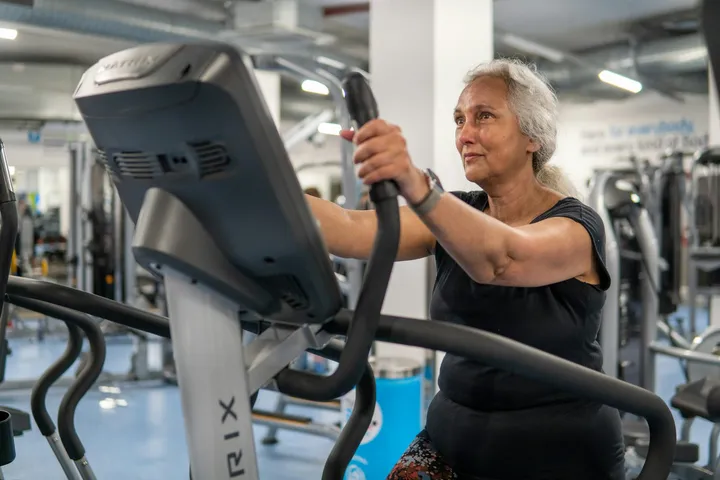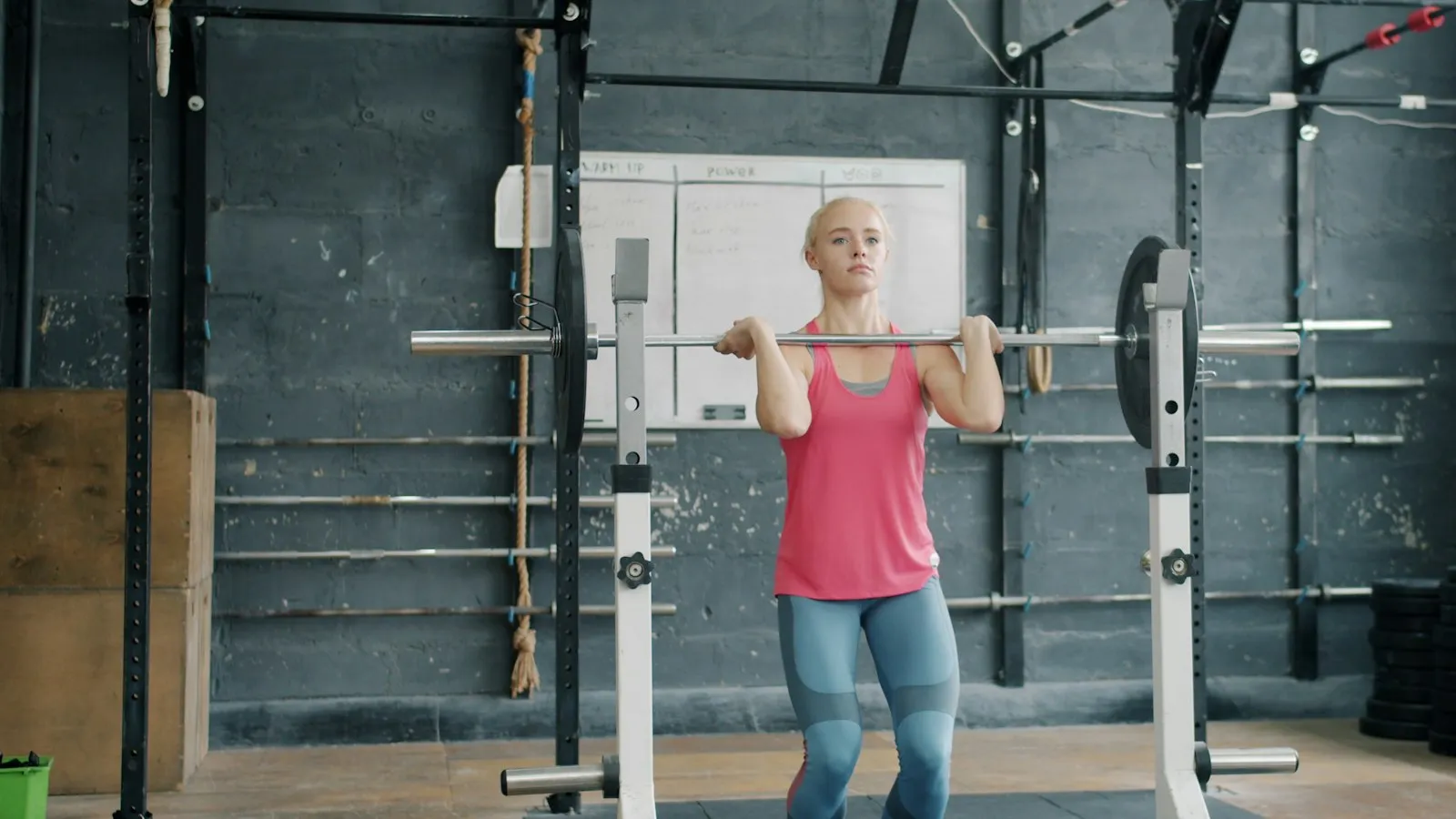
A full body workout trains your legs, hips, back, chest, shoulders, and core in every session, and for most women over 40 it is the best way to organize strength training. Not the gentlest way. The best. It builds as much muscle and strength as a body-part split, gives you more days to recover, and a missed session costs you almost nothing.
This is the routine we would hand a friend: two workouts (A and B), five movements each, about 45 minutes, with starting weights in pounds, a dumbbell-only version for home, and the progression rule that makes it work. Most full body workout pages give you a list of exercises and “3 sets of 12” for everything. You will get the numbers.
Who this full body workout is for
- You are starting strength training, or coming back after a long break.
- You have two or three days a week, 45 minutes each.
- You train at a gym with a barbell, dumbbells, and a cable or pulldown machine, or at home with a pair of adjustable dumbbells and a bench.
- You are in perimenopause or past menopause and want to build muscle and bone, not just sweat.
Who this is not for: if you are already running a program and still adding weight every week, keep running it. If you are training for a powerlifting meet, you need something more specific. For the bigger picture of why lifting matters this much after 40, start with strength training for women over 40.
The short version
- What it is: a full body workout trains every major muscle group (legs, hips, back, chest, shoulders, and core) in one session, usually with five or six compound exercises, two or three times a week.
- The routine: two workouts, A and B, alternated. Each has a squat, a hinge, a push, a pull, and a carry or core exercise.
- How often: two or three times a week on non-consecutive days. Twice is a complete program; three is better if you recover well.
- Sets and reps: 3 sets of 5 to 12 reps, ending each set with 2 or 3 reps left in the tank.
- Starting weights: lighter than you think. A typical first week: goblet squat with a 15-25 lb dumbbell, Romanian deadlift with 15-20 lb per hand, dumbbell bench press with 10-15 lb per hand.
- Progression: when every set reaches the top of the rep range, add weight. 5 lb on lower-body lifts, the smallest jump available on upper-body lifts.
- Time: 40 to 50 minutes. Thirty if you pair exercises.
- Skip: burpee circuits sold as strength work, 3-lb dumbbells for 25 reps, and nine-exercise sessions padded with curls and kickbacks.
Why a full body workout beats a split after 40
On results alone, it is a tie. A 2024 meta-analysis of 14 studies and 392 people found that split and full-body routines produce similar strength gains and similar muscle growth when weekly training volume is matched. The authors’ conclusion was blunt: pick the routine you prefer.
So pick the one that survives a real week. For a woman in her 40s or 50s with a job, a family, and the occasional night of four hours’ sleep, that is full body, for four reasons.
A missed session does not skip a body part. On a split, missing leg day means your legs go untrained that week. On a three-day full body routine, missing one session still leaves every muscle trained twice. Consistency over months is what builds strength, and full body is the structure most forgiving of real life.
Every session loads your hips and spine. A squat and a hinge in every workout means bone-relevant loading two or three times a week instead of once. That frequency is enough: the best-known bone trial in postmenopausal women used just two 30-minute sessions a week (more on that in the bone-density section below).
You get more recovery days. Three sessions a week leaves four days off. If your sleep is worse than it used to be, those days are a feature, not wasted time.
You practice the lifts more often. Squatting two or three times a week instead of once means you learn the movement faster, and a large share of early strength gains comes from simply getting better at the lifts.
The full body workout routine: Workout A and Workout B
Alternate the two workouts. On three days a week, week 1 is A-B-A and week 2 is B-A-B. On two days a week, do A then B.
Rest 2 to 3 minutes after sets of the first two exercises and 60 to 90 seconds after the rest. End every set with 2 or 3 reps left: the bar should slow down on the last rep, but your form should not change.
Workout A
| Exercise | Sets x reps | Notes |
|---|---|---|
| Goblet squat (or barbell back squat) | 3 x 8-10 | Elbows inside knees, sit between your heels |
| Romanian deadlift (dumbbells or barbell) | 3 x 8-10 | Hips back, soft knees, flat back |
| Dumbbell bench press | 3 x 8-12 | Flat or incline bench |
| One-arm dumbbell row | 3 x 10-12 per arm | Brace on a bench, pull to your hip |
| Farmer’s carry | 3 x 30-40 yards | Heavy dumbbell in each hand, walk tall |
Workout B
| Exercise | Sets x reps | Notes |
|---|---|---|
| Trap bar or barbell deadlift | 3 x 5-6 | Dumbbell or kettlebell deadlift at home |
| Split squat | 3 x 8-10 per leg | Back knee to just above the floor |
| Dumbbell overhead press | 3 x 8-10 | Standing or seated |
| Lat pulldown | 3 x 10-12 | Pull the bar to your upper chest |
| Side plank | 3 x 20-30 sec per side | Or a dead bug, 3 x 8 per side |
Each session takes about 15 working sets. Over a three-day week, that is roughly 9 sets for each movement pattern; over two days, about 6. Both clear the minimum of 4 hard sets per muscle group per week that a review of time-efficient strength training recommends. If any of these lifts are new to you, our guides to the deadlift, dumbbell overhead press, and rows and pulldowns cover the technique.
Warmup
Five minutes on a bike, rower, or a brisk walk. Then two ramp-up sets of your first lift: 8 reps at about half your working weight, then 5 reps at about three-quarters. That is it. The same review found exercise-specific warmups are enough, and static stretching is worth the time only if flexibility itself is your goal.
The full body dumbbell workout (home version)
The same five patterns work with dumbbells and a bench. You need a pair of adjustable dumbbells that reach at least 40 to 50 lb per hand, and a sturdy flat or adjustable bench.
| Workout A | Workout B | |
|---|---|---|
| Squat | Goblet squat, 3 x 8-12 | Bulgarian split squat, 3 x 8-10 per leg |
| Hinge | Romanian deadlift, 3 x 8-12 | Dumbbell deadlift, 3 x 6-8 |
| Push | Bench or floor press, 3 x 8-12 | Overhead press, 3 x 8-10 |
| Pull | One-arm row, 3 x 10-12 per arm | Chest-supported row, 3 x 10-12 |
| Core | Farmer’s hold, 3 x 30-45 sec | Side plank, 3 x 20-30 sec per side |
The limit at home is load on your legs. A goblet squat tops out at whatever dumbbell you can hold at your chest, and most women outgrow that within a few months. When you can do 15 clean reps with your heaviest dumbbell, move the weight to single-leg work: a Bulgarian split squat (back foot up on the bench) with the same dumbbells is far harder than a goblet squat. For the dumbbell deadlift, hold the weights at your sides; for the chest-supported row, lie face down on an incline bench. Slowing the lowering to 3 seconds and pausing at the bottom buys more time.
A fixed set of 5-30 lb dumbbells covers your presses and rows for a long time. Your legs and hips will outgrow it in months, which is why adjustable dumbbells that go heavier are the better buy. For a single extra tool, a kettlebell handles swings and deadlifts well; our kettlebell exercises guide shows how.
How to choose your starting weights
Use this test, not a chart. Pick a weight you think you can lift for the bottom of the rep range with 2 or 3 reps left over. Do one set. If you could have done 4 or more extra reps, go heavier on the next set. If your form broke down or you fell short of the bottom of the range, go lighter.
As a sanity check, here is where most women land in week 1:
| Exercise | New to lifting | Some lifting background |
|---|---|---|
| Goblet squat | 15-25 lb dumbbell | 25-40 lb dumbbell |
| Romanian deadlift (dumbbells, per hand) | 15-20 lb | 25-35 lb |
| Romanian deadlift (barbell) | 45-65 lb | 65-95 lb |
| Trap bar or barbell deadlift | 65-95 lb | 95-135 lb |
| Dumbbell bench press (per hand) | 10-15 lb | 15-25 lb |
| One-arm dumbbell row | 15-20 lb | 20-30 lb |
| Dumbbell overhead press (per hand) | 8-12 lb | 12-20 lb |
| Split squat (per hand) | Bodyweight | 10-20 lb |
| Farmer’s carry (per hand) | 20-30 lb | 30-45 lb |
The test wins whenever it disagrees with the table. Most trap bars weigh 45 to 65 lb empty and a standard barbell weighs 45 lb, so check what you are lifting before you count plates. Lat pulldown stacks vary too much between machines for a useful number.
Starting light is not timid. It is how you get eight to twelve weeks of steady increases before your first plateau.
How to progress
Use double progression. Every exercise has a rep range, such as 8 to 10. Start at the bottom of the range. Add a rep or two each session until all three sets reach the top. Then add weight and start again at the bottom.
- Lower-body lifts (squats, deadlifts, carries): add 5 lb, or 10 lb on deadlifts while they are moving fast.
- Upper-body lifts (presses, rows): add the smallest jump you have. Going from 10 lb to 15 lb dumbbells is a 50% increase, which is why the upper-body lifts have wider rep ranges. You will climb reps longer before each jump, and our progressive overload guide shows four ways to bridge it.
Write down every weight and every rep. A logbook is the difference between progressing and guessing, and it is most of why programs like this work.
Expect to add weight to your lower-body lifts most weeks for the first two or three months, then slower. Every 6 to 8 weeks, or whenever a lift stalls for two sessions in a row, take an easy week: same exercises, 2 sets each, at about 60-70% of your working weights.
Signs you are doing more than you can recover from:
- Your weights are going backward for two or more sessions.
- Joint aches last three days or more (normal muscle soreness fades in a day or two).
- Your sleep gets worse and you dread sessions you used to tolerate.
The fix is usually to drop a set from each exercise for a week, then look at food. Muscle needs protein to rebuild: roughly 0.7 to 1 gram per pound of body weight a day, as our body recomposition guide explains.
How many full body workouts a week?
Twice a week is a complete program, not a compromise. In a 24-week trial of adults aged 65 to 79 doing 3 sets of 8 exercises at 80% of their one-rep max, strength rose about 37% training once a week, 42% twice, and 40% three times, with no significant difference between the groups. The control group gained 4%.
Three times a week is the best default if you can recover. A meta-analysis of 25 studies found that when weekly volume is equal, training frequency makes no meaningful difference to muscle growth. The third session helps because it adds sets and practice, not because three is magic. If a third day is easy to fit in, take it.
Four or more full body sessions a week works for experienced lifters, but at that point most people do better alternating heavy and light days or moving to an upper/lower split.
| Plan | Mon | Tue | Wed | Thu | Fri | Sat | Sun |
|---|---|---|---|---|---|---|---|
| 2 days | A | B | |||||
| 3 days (week 1) | A | B | A | ||||
| 3 days (week 2) | B | A | B |
Walking fits on any day, lifting days included, and it is the easiest cardio to recover from. Harder cardio, like the Norwegian 4x4 interval workout, goes on non-lifting days or after you lift, never before heavy squats or deadlifts. To measure what the cardio is doing for you, compare your number with a VO2 max chart by age. For how walking and lifting divide the work, see does walking build muscle.
If you follow the popular 3-2-1 method (three strength sessions, two Pilates sessions, one cardio session a week), this routine is your three strength days. Just make sure they stay real lifting days with weights you increase.
How long should a full body workout take?
Plan on 40 to 50 minutes: a 5-minute warmup, about 15 working sets, and 1 to 3 minutes of rest between sets.
With only 30 minutes, use supersets. Pair two exercises that use different muscles and alternate between them, resting 60 to 90 seconds after each pair. The time-efficiency review mentioned above found supersets roughly halve training time while keeping the same volume, though it also notes they may be slightly better for muscle growth than for maximal strength. Keep your heaviest lift on its own.
30-minute Workout A:
- Goblet squat + dumbbell bench press, 3 rounds
- Romanian deadlift + one-arm row, 3 rounds
- Farmer’s carry, 2 rounds
30-minute Workout B:
- Deadlift, 3 sets on its own
- Split squat + overhead press, 3 rounds
- Lat pulldown + side plank, 3 rounds
Adjusting the full body workout plan for joints, bone density, and bad days
Knees, back, and shoulders
Knees: squat to a box or bench at a depth that feels fine, then lower the box over the following weeks. A leg press is a reasonable stand-in. Sharp pain, or pain that is worse the next morning, means change the exercise or the depth; do not push through it.
Lower back: a trap bar or dumbbells held at your sides keep you more upright than a barbell in front of your legs. For the second hinge, a hip thrust loads your hips heavily with almost no load on your spine.
Shoulders: press with your palms facing each other, use an incline bench instead of a flat one, and use a neutral-grip handle on the pulldown.
Osteopenia and osteoporosis
Heavy lifting is not off-limits with low bone mass, but it needs supervision to start. In the LIFTMOR trial, 101 postmenopausal women with low bone mass (average age 65) trained twice a week for 30 minutes, doing high-intensity resistance and impact training at 5 sets of 5 above 85% of their one-rep max. Over 8 months, their lumbar spine bone density rose 2.9% while the low-intensity group’s fell 1.2%, and their femoral neck density held steady (+0.3%) while the comparison group’s fell 1.9%. There was one minor adverse event, a lower-back spasm.
Every session in that trial was supervised. If you have osteoporosis or have had a fracture, talk to your doctor and work with a physical therapist or an experienced coach before you load heavy. Our benefits of deadlifts article covers what the bone research does and does not show.
Bad days
When you slept badly or symptoms are rough, do a shorter session instead of skipping: the first two exercises of the day, 2 sets each, at your normal weight or 10% lighter. That takes about 20 minutes and keeps both the habit and the strength. Our perimenopause workout plan has a full low-volume replacement session and when to use it.
What to skip
- “Full body” conditioning circuits sold as strength training. Burpees, thrusters, and devil’s presses get your heart rate up. Fatigue ends those sets, not load, so they build little strength.
- 3-lb dumbbells for 25 reps. If you can do 25 reps, the weight is too light to build much strength or bone.
- Nine-exercise sessions. Curls, kickbacks, shrugs, and calf raises after five compound lifts add time and little result. Add arm work later if you want it.
- A hard full body workout every day. Two or three heavy sessions a week, with walking in between, beats seven tired ones.
- Training to failure on every set. Leave 2 or 3 reps in the tank. Grinding out the last rep on squats and deadlifts costs recovery and form for very little extra benefit.
- Lifting on Bosu balls and wobble boards. Unstable surfaces cut how much you can lift. Train balance separately if you need it.
- Switching to a body-part split in month two. Run full body until your progress genuinely stalls, which usually takes many months.
When to move from a full body workout to a split
You never have to. Full body training two or three days a week is a long-term program, not a beginner phase, and the 2024 meta-analysis found no extra benefit from splits when volume is matched.
The practical reasons to switch:
- You want to lift four or more days a week.
- Your sessions run past an hour because you need more sets per lift to keep progressing.
- You want more variety, and variety keeps you training.
The usual next step is an upper/lower split four days a week. If you want more structure first, our 12-week strength training program runs these same movement patterns through three phases, with weekly targets and symptom-day adjustments built in.
The bottom line
A full body workout is the most efficient and most forgiving way for a woman over 40 to get strong. Two workouts, five patterns each, two or three days a week, 45 minutes. Start lighter than your ego wants, add weight every time all your sets reach the top of the rep range, and write everything down. Do that for 12 weeks and you will be squatting, deadlifting, and pressing weights that would have seemed unrealistic on day one, with your bones loaded twice a week or more, and a training habit that fits around the rest of your life.